Cariñosa
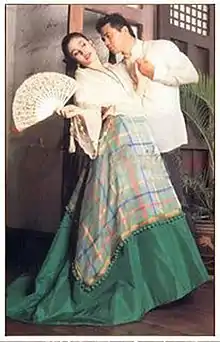
Cariñosa (Spanish pronunciation: [kaɾiˈɲosa], meaning loving or affectionate) is a Philippine dance of colonial-era origin from the Maria Clara suite of Philippine folk dances, where the fan or handkerchief plays an instrumental role as it places the couple in romance scenario.
History
The dance originated in Panay Island in the Visayan Islands and was introduced by the Spaniards during their colonization of the Philippines. It is related to some of the Spanish dances like the bolero and the Mexican dance Jarabe Tapatio or the Mexican Hat Dance.
Bicolano Cariñosa
According to the book of Francisca Reyes-Aquino, Philippine Folk Dances, Volume 2, there is a different version of the dance in the region of Bicol. Reyes-Aquino is a Filipino folk dancer and cultural researcher who discovered and documented Philippine Traditional dances such as the Cariñosa.[1] In the Bicol Region Cariñosa, hide and seek movement in different ways. In the original version, the dancers used the Fan and handkerchief as the way to do the hide and seek movement, in Bicol they used two handkerchiefs holding the two corners of the handkerchief and doing the hide and seek movement as they point their foot forward and their hands go upward together with their handkerchiefs following the movement. It is a complicated step however it is still used in Bicol Region during festivals and social gatherings.
Costume
Originally, the Cariñosa was danced with María Clara gown and Barong Tagalog for it is a María Clara Spanish dance when it was introduced. In addition, Filipino wore the patadyong kimona and camisa de chino to reveal nationalism. (a native dress of the Tagalog regions), camisa (a white sleeve) or patadyong kimona (a dress of the Visayan people) and for boys, a barong Tagalog and colored pants.
Status as the Philippine National Dance
Neither Cariñosa or Tinikling is considered as the official national dance of the Philippines as there are no Philippine laws supporting such claims according to an article from the National Commission for Culture and the Arts.[2] In 2014, House Representative Rene Relampagos introduced House bill No. 3926, or “An Act Declaring the National Symbols of the Philippines” which aims to correct Cariñosa's unofficial status.[3]
References
- Staff, ANCX (9 March 2019). "Google pays tribute to Francisca Reyes Aquino on her 120th birth anniversary". ABS-CBN News. Retrieved 2 December 2021.
- Alba, Reinerio A. (28 August 2009). "In Focus: Official National Symbols of the Philippines". National Commission for Culture and the Arts. Retrieved 2 December 2021.
- "House Bill No. 3926" (PDF). Philippine House of Representatives. Archived from the original (PDF) on 18 November 2017. Retrieved 2 December 2021.
Music of the Philippines and Original Pilipino music (OPM) | ||
|---|---|---|
| Fusions and sub-genres |  | |
| Styles | ||
| Instruments | ||
| Music by year | ||