Carigara
Carigara (IPA: [kɐɾiˈɡaɾɐʔ]), officially the Municipality of Carigara (Waray: Bungto han Carigara/Munisipyo han Carigara; Tagalog: Bayan ng Carigara), is a 2nd class municipality in the province of Leyte, Philippines. According to the 2020 census, it has a population of 54,656 people. [3]
Carigara
Kalgara | |
|---|---|
| Municipality of Carigara | |
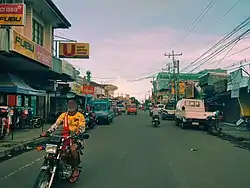 Downtown Area (Real St.) | |
 Seal | |
| Etymology: Kan Gara to Kalgara | |
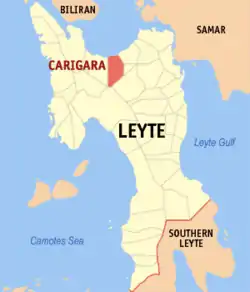 Map of Leyte with Carigara highlighted | |
OpenStreetMap 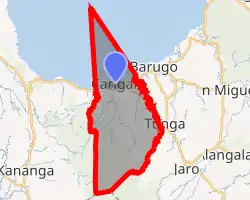
| |
.svg.png.webp)  Carigara Location within the Philippines | |
| Coordinates: 11°18′N 124°41′E | |
| Country | Philippines |
| Region | Eastern Visayas |
| Province | Leyte |
| District | 2nd district |
| Founded | 25 January 1571 |
| Named for | Datu Gara |
| Barangays | 49 (see Barangays) |
| Government | |
| • Type | Sangguniang Bayan |
| • Mayor | Eduardo "Boy" C. Ong |
| • Vice Mayor | Eduardo "Ed" T. Ong Jr. |
| • Representative | Lolita T. Javier |
| • Councilors | List |
| • Electorate | 36,532 voters (2019) |
| Area | |
| • Total | 117.86 km2 (45.51 sq mi) |
| Elevation | 130 m (430 ft) |
| Highest elevation | 1,267 m (4,157 ft) |
| Lowest elevation | 0 m (0 ft) |
| Population | |
| • Total | 54,656 |
| • Density | 460/km2 (1,200/sq mi) |
| • Households | 11,230 |
| Demonym(s) | Carigaran-on |
| Economy | |
| • Income class | 2nd municipal income class |
| • Poverty incidence | 31.20% (2015)[4] |
| • Revenue | ₱192,246,637.02 (2020) |
| • Assets | ₱606,129,666.64 (2020) |
| • Expenditure | ₱156,610,346.67 (2020) |
| • Liabilities | ₱160,834,424.88 (2020) |
| Service provider | |
| • Electricity | Leyte 3 Electric Cooperative (LEYECO 3) |
| • Water | Metro Carigara Water District (MCWD) |
| Time zone | UTC+8 (PST) |
| ZIP code | 6529 |
| PSGC | |
| IDD : area code | +63 (0)53 |
| Native languages | Waray Tagalog |
| Website | www |
The first town established on the entire region of Eastern Visayas, founded on 1571. In 1735, Leyte and Samar were separated from Cebu to be established as a single provincial government with Carigara as the first provincial capital.
Carigara is known for its pastillas, humba, sundang (machete), and the hubhob, a local delicacy made from grated cassava, egg, kalamay, milk, and sugar cooked inside a bagacay (bamboo pole) over charcoals.
Geography
Topography
It is a town in northern Leyte located right on the shore of Carigara Bay, and surrounded by wide rice fields fanning out towards the mountains in the distance.
Carigara shares borders with Capoocan to the west, Ormoc to the south, Jaro to the southeast, Tunga to the east and Barugo to the northeast.
Flora
The climate and topographical features of the vast land, wide rice fields and hilly areas of Carigara make it ideal for the growing of fruit-bearing trees, vegetables and various crops. Among the fruit-bearing trees most fitting to be planted are bananas, coconuts, jackfruits, mangoes, guavas, rambutans, santol, and star apples. For vegetables, gábi, kalabása, pipíno, malúnggay, marigóso, monggós, sítao, and úpo are the most commonly produced by some farmers and local residents in which thrive best in the community. For crops, kamote is one of the root crops that mainly thrive on the hilly areas, rice crops, and many more.
Fauna
Carigara possesses vast forests especially near the highlands, its fauna is a mixture of local and domesticated animals. Some of those domesticated are horses, cats, dogs, chickens, and pigs. Local animals should include snakes, frogs, insects, various kinds of lizards, and many more.
Barangays
Carigara is politically subdivided into 49 barangays, namely: [5]
- Bagong Lipunan
- Balilit
- Barayong
- Barugohay Central
- Barugohay Norte
- Barugohay Sur
- Baybay (Poblacion)
- Binibihan
- Bislig
- Caghalo
- Camansi
- Canal
- Candigahub
- Canfabi
- Canlampay
- Cogon
- Cutay
- Guindapunan East
- Guindapunan West
- Hiluctogan
- Jugaban (Poblacion)
- Libo
- Lower Hiraan
- Lower Sogod
- Macalpi
- Manloy
- Nauguisan
- Paglaum
- Pangna
- Parag-um
- Parena (Parina)
- Piloro
- Ponong (Poblacion)
- Rizal (Tagak East)
- Sagkahan
- San Isidro
- San Juan
- San Mateo (Poblacion)
- Santa Fe
- Sawang (Poblacion)
- Tagak
- Tangnan
- Tigbao
- Tinaguban
- Upper Hiraan
- Upper Sogod
- Uyawan
- Visoria (East)
- Visoria (West)
Climate
| Climate data for Carigara, Leyte | |||||||||||||
|---|---|---|---|---|---|---|---|---|---|---|---|---|---|
| Month | Jan | Feb | Mar | Apr | May | Jun | Jul | Aug | Sep | Oct | Nov | Dec | Year |
| Average high °C (°F) | 28 (82) |
29 (84) |
29 (84) |
31 (88) |
31 (88) |
30 (86) |
30 (86) |
30 (86) |
30 (86) |
29 (84) |
29 (84) |
29 (84) |
30 (85) |
| Average low °C (°F) | 22 (72) |
22 (72) |
22 (72) |
23 (73) |
24 (75) |
25 (77) |
25 (77) |
25 (77) |
25 (77) |
24 (75) |
24 (75) |
23 (73) |
24 (75) |
| Average precipitation mm (inches) | 73 (2.9) |
56 (2.2) |
75 (3.0) |
71 (2.8) |
114 (4.5) |
174 (6.9) |
172 (6.8) |
163 (6.4) |
167 (6.6) |
161 (6.3) |
158 (6.2) |
125 (4.9) |
1,509 (59.5) |
| Average rainy days | 15.2 | 12.5 | 16.2 | 17.3 | 23.9 | 27.3 | 28.4 | 26.9 | 26.9 | 27.1 | 23.8 | 19.3 | 264.8 |
| Source: Meteoblue (Use with caution: this is modeled/calculated data, not measured locally.) [6] | |||||||||||||
Demographics
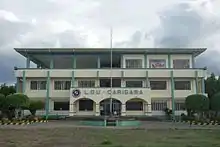
|
| |||||||||||||||||||||||||||||||||||||||||||||||||||
| Source: Philippine Statistics Authority [7] [8] [9][10] | ||||||||||||||||||||||||||||||||||||||||||||||||||||
In the 2020 census, the population of Carigara, Leyte, was 54,656 people, [3] with a density of 460 inhabitants per square kilometre or 1,200 inhabitants per square mile.
Language
The Waray language is the predominant language spoken by the people within the municipality and serves as the lingua franca of the town. Other recognized languages are Cebuano and Tagalog.
Economy
| Poverty Incidence of Carigara | |
| Source: Philippine Statistics Authority[11][12][13][14][15][16] | |
History
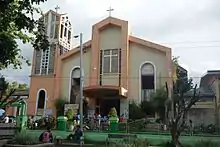
Carigara was originally called "Kan Gara", meaning "that of Gara" or simply "Gara's." Gara was said to have come from Borneo, one of the unnamed companions of the ten datus who landed in Panay and purchased that island from the Ati (or Aeta) chief Marikudo. Later, for phonetic convenience, "Kan Gara" became Kalgara and when the Spaniards came, they called the place Carigara; hence its present name.
Carigara is the first town established in Eastern Visayas.[17] Its town fiesta which is celebrated every 16th of July, commemorates the day of the first coming of the Spaniards dated July 16, 1569. The fiesta that is celebrated almost the entire month of July was dubbed as the Fiesta of the Holy Cross.
In the first quarter of 2018, Puregold was able to penetrate the town market and became operational to serve Carigaran-ons and the neighboring towns. The first mall opened as well, then followed by Goldilocks in the second quarter of 2019.
Carigara's Attempt for a World Record

Last July 14, 2018, Carigara attempted to clinch Guinness World Records for the "Largest Participants in Philippine Folk Dance" by performing Kuratsa or Curacha.[18] The event was part of the town's 423rd fiesta celebration on July 16, it made the locals proud and hopeful that the said event will help to boost their town's economic and tourism activities. With nearly 5,000 participants mostly students and teachers from different schools, municipal workers, the private sector, and local residents have joined. Carigara had already submitted their bid, waiting for the official confirmation.
Culture
Festival
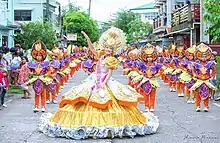
On January 25, 2019, Carigara had officially celebrated its first festival along with their 448th founding anniversary called the Magara Festival.[19] Magara locally means abundant, elegant, and vibrant. The first Magara Festival focuses mainly on the celebration of the abundance of the town's agriculture, local products, history, and its people. The week-long celebration highlights the presentation of the Datu Gara Awards to outstanding Carigaran-ons.
Events
Turugpo is a public fight between two male carabaos or two male horses held every Black Saturday. It is a popular event in the town attracting thousands of local and foreign tourists just to witness the famous fight. It is a major event in Carigara and one of the things Carigaran-ons can be proud of.[20] [21]
Tourism
Here's a list of some tourist attractions of the municipality of Carigara.
Heritage Sites
- Lauron Boulevard (Brgy. Baybay & Ponong) This is the place where you can buy street foods like isaw, pork barbecues, and many more while enjoying the view of Carigara Bay with family and friends.
- Carigara Municipal Library and Museum (Brgy. Baybay)
- Cassidy Elementary School (Brgy. Ponong) A school with renovated Spanish-style building.
- Datu Gara Shrine (Brgy. Canal)
- Gawas 'en Harigue (Brgy. Baybay) An old house within the town proper with exposed posts on the sides.
- Heroes Shrine (Brgy. Baybay & Ponong) Located right between Carigara Boulevard and Kan Gara Gymnasium.
- Holy Cross Parish Church (Brgy. Ponong) The oldest church in Carigara and the largest one.
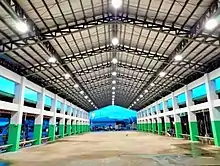
- Kan Gara Gymnasium (Brgy. Ponong) The largest gymnasium.
- Lumen Ancestral House (Brgy. Sawang) The only house in Carigara which serves as a shelter for swiftlets, locally called in the Philippines as "balinsasayaw" birds.
- Pantalan/Port of Carigara (Brgy. Baybay)
- Plaza Triunfo (Brgy. Ponong) One of the largest plaza in the town.
- St. Francis Assisi Parish (Brgy. Jugaban)
Private Resorts
- Bella Anthea Resort (Brgy. Manloy)
- Balai Constancia (Brgy. Bislig)
- Maribeth's Garden (Brgy. Sagkahan)
Beach Resorts
- Destino Beach Resort (Brgy. Nauguisan)
- Karigusan Beach Resort (Brgy. Tangnan)
Farm Resorts
- Cutay Farm (Brgy. Cutay)
- Familia Bodo Camp Site (Brgy. San Isidro)
- Jacela's Garden (Brgy. Bagong Lipunan)
- Kan Dada Integrated Farm (Brgy. Tigbao)
Falls
- Arambakan Falls (Sitio Palali, Brgy. Canlampay)
- Blue Falls (Brgy. San Isidro)
- Canhawan Falls I & II (Brgy. Caghalo)
- Danikop Gorge (Brgy. Caghalo)
- Ginantalan Falls (Sitio Palali, Brgy. Canlampay)
- Guinhagdanan Falls (Brgy. San Isidro)
- Igbaw Falls (Sitio Palali, Brgy. Canlampay)
- Kanal-kanalan Falls (Brgy. Tinaguban)
- Kantotong Falls (Brgy. Tinaguban)
- Kasipitan Falls (Brgy. Caghalo)
- Kasugbong Falls (Brgy. Tinaguban)
- Kinaraha Falls (Sitio Palali, Brgy. Canlampay)
- Mosokbusok Falls (Brgy. Parag-um)
- Olon Halas Falls (Brgy. Caghalo)
- Tambara Falls (Brgy. San Isidro)
- Twin Falls (Brgy. San Isidro)
- Virgin Falls and Cave (Brgy. San Isidro)
Infrastructures
Land Transport
- Pedicabs are the common mode of transportation within the town proper and the poblacións.
- Tricycles and habal-habals on the other hand are commonly used for travelling within the town, especially to the far-flung barangays.
- Vans, jeepneys and buses are the mode of transport when the destination is within the cities of Tacloban and Ormoc or to the municipalities that are faraway from the town. There are few bus companies situated in Carigara.
There are new modernized PUVs that travel from Carigara to Tacloban and vice versa issued by its local government this 24th November 2021.
Sea Transport
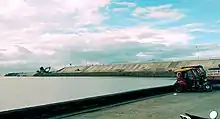
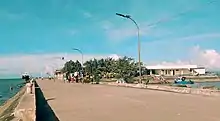
The municipality owns a port that is located in Barangay Baybay where local boats and ships docks. The port is currently under construction.
Healthcare Service
Carigara District Hospital, also abbreviated as CDH is the only public hospital in the town. Other residents of nearby towns also come here to bring their ill patients for admission and further medical service attention.
Utilities
(this section needs additional information)
Education
There are a total of 30 elementary schools, 5 high schools (1 Private, 4 Public) and 2 college institutions located inside Carigara.[22]
Grade School/Elementary School
- Balilit Elementary School
- Barugohay Norte Elementary School
- Barugohay Sur Elementary School
- Binibihan Elementary School
- C.A.T.A.M.C.S. (Cong. Alberto T. Aguja Memorial Central School)
- Caghalo Elementary School
- Camansi Elementary School
- Candigahub Elementary School
- Canfabi ES (Santa Fe ES)
- Canlampay Elementary School
- Carigara II CS
- Cassidy Elementary School
- Cogon Elementary School
- Guindapunan Elementary School
- Hiluctogan Elementary School
- Hira-an Elementary School
- M. Morales Memorial Elementary School
- Macalpi Elementary School
- Manloy Elementary School
- Nauguisan Elementary School
- Pangna Elementary School
- Parag-um Elementary School
- Ponong Elementary School
- Sagkahan Elementary School
- Sogod Elementary School
- Santa Fe Elementary School
- Tagak Elementary School
- Tigbao Elementary School
- Tinaguban Elementary School
- Uyawan Elementary School
Secondary School/High School
- Carigara National High School
- Carigara National Vocational School (formerly Carigara School of Fisheries)
- Jugaban National High School (Carigara NHS - Jugaban Annex)
- Sogod National High School
- Holy Cross College of Carigara
College
- Holy Cross College of Carigara
- Eastern Visayas State University (Carigara Campus)
Notable people
- Eduardo Makabenta Sr. - Waray-language poet and translator[23]
- Mike Hanopol - musician, singer-songwriter
Gallery
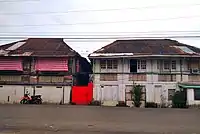 Century-old houses in Brgy. Jugaban, Carigara, Leyte
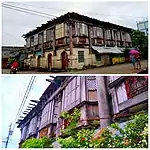 Gawas An Harigue
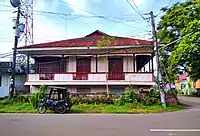 Carigara Municipal Library and Museum
References
- Municipality of Carigara | (DILG)
- "2015 Census of Population, Report No. 3 – Population, Land Area, and Population Density" (PDF). Philippine Statistics Authority. Quezon City, Philippines. August 2016. ISSN 0117-1453. Archived (PDF) from the original on May 25, 2021. Retrieved July 16, 2021.
- Census of Population (2020). "Region VIII (Eastern Visayas)". Total Population by Province, City, Municipality and Barangay. PSA. Retrieved 8 July 2021.
- https://psa.gov.ph/sites/default/files/City%20and%20Municipal-level%20Small%20Area%20Poverty%20Estimates_%202009%2C%202012%20and%202015_0.xlsx; publication date: 10 July 2019; publisher: Philippine Statistics Authority.
- "Province: Leyte". PSGC Interactive. Quezon City, Philippines: Philippine Statistics Authority. Retrieved 12 November 2016.
- "Carigara: Average Temperatures and Rainfall". Meteoblue. Retrieved 9 February 2020.
- Census of Population (2015). "Region VIII (Eastern Visayas)". Total Population by Province, City, Municipality and Barangay. PSA. Retrieved 20 June 2016.
- Census of Population and Housing (2010). "Region VIII (Eastern Visayas)". Total Population by Province, City, Municipality and Barangay. NSO. Retrieved 29 June 2016.
- Censuses of Population (1903–2007). "Region VIII (Eastern Visayas)". Table 1. Population Enumerated in Various Censuses by Province/Highly Urbanized City: 1903 to 2007. NSO.
- "Province of Leyte". Municipality Population Data. Local Water Utilities Administration Research Division. Retrieved 17 December 2016.
- "Poverty incidence (PI):". Philippine Statistics Authority. Retrieved 28 December 2020.
- https://psa.gov.ph/sites/default/files/NSCB_LocalPovertyPhilippines_0.pdf; publication date: 29 November 2005; publisher: Philippine Statistics Authority.
- https://psa.gov.ph/sites/default/files/2003%20SAE%20of%20poverty%20%28Full%20Report%29_1.pdf; publication date: 23 March 2009; publisher: Philippine Statistics Authority.
- https://psa.gov.ph/sites/default/files/2006%20and%202009%20City%20and%20Municipal%20Level%20Poverty%20Estimates_0_1.pdf; publication date: 3 August 2012; publisher: Philippine Statistics Authority.
- https://psa.gov.ph/sites/default/files/2012%20Municipal%20and%20City%20Level%20Poverty%20Estima7tes%20Publication%20%281%29.pdf; publication date: 31 May 2016; publisher: Philippine Statistics Authority.
- https://psa.gov.ph/sites/default/files/City%20and%20Municipal-level%20Small%20Area%20Poverty%20Estimates_%202009%2C%202012%20and%202015_0.xlsx; publication date: 10 July 2019; publisher: Philippine Statistics Authority.
- "Carigara Celebrates 446th Founding Anniversary". metrocarigarawd.gov.ph. 21 January 2017. Retrieved 3 December 2018.
- "Carigara attempts Guinness' largest participants in folk dance". sunstar.com.ph. 14 July 2018. Retrieved 28 November 2021.
- "Oldest town in Leyte holding first official festival". mb.com.ph. 24 January 2019. Retrieved 27 November 2021.
- "Leyte's animal jousts festival showcases delicacies". sunstar.com.ph. 29 March 2016. Retrieved 29 November 2021.
- ""No animal cruelty" in Turugpo". www.pressreader.com. 27 March 2016. Retrieved 29 November 2021.
- "Archived copy". School Torkis Directory. Archived from the original on October 30, 2018. Retrieved October 31, 2018.CS1 maint: archived copy as title (link)
- Sugbo, Victor, ed. (1995). Tinipigan: An Anthology of Waray Literature. Manila, Philippines: National Commission for Culture and the Arts. p. 271. OCLC 645852700. Retrieved 27 September 2019.
External links
 |
Wikimedia Commons has media related to Carigara. |
 |
Wikisource has the text of the 1911 Encyclopædia Britannica article "Carigara". |
 |
Wikivoyage has a travel guide for Carigara. |
- Carigara Profile at PhilAtlas.com
- Philippine Standard Geographic Code
- Philippine Census Information
- Local Governance Performance Management System


 Province of Leyte Province of Leyte | |
|---|---|
Tacloban (capital) | |
| Municipalities |
|
| Component city | |
| Independent component city |
|
| Highly urbanized city |
|
Authority control  |
|---|