Carry That Weight
"Carry That Weight" is a song by the English rock band the Beatles from their 1969 album Abbey Road. Written by Paul McCartney and credited to Lennon–McCartney, it is the seventh and penultimate song in the album's climactic side-two medley. It features unison vocals in the chorus from all four Beatles, a rarity in their songs. It is preceded by "Golden Slumbers" and segues into "The End".
| "Carry That Weight" | |
|---|---|
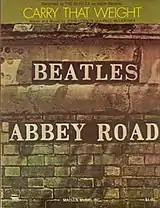 Cover of the song's sheet music | |
| Song by The Beatles | |
| from the album Abbey Road | |
| Released | 26 September 1969 |
| Recorded | 2–4, 30–31 July and 15 August 1969 |
| Studio | EMI, London |
| Genre | Symphonic rock |
| Length | 1:36 |
| Label | Apple |
| Songwriter(s) | Lennon–McCartney |
| Producer(s) | George Martin |
The middle bridge, featuring brass instruments, electric guitar and vocals, reprises the beginning of "You Never Give Me Your Money", but with different lyrics. The ending also reprises the arpeggiated guitar motif from the end of that track, which is itself reminiscent of the figure featured prominently in the George Harrison–written track "Here Comes the Sun", which opens side two of Abbey Road.
The line "You’re gonna carry that weight" would later be used in the popular anime series Cowboy Bebop (1998).[1]
Interpretation
Music critic Ian MacDonald interpreted the lyric as an acknowledgement by the group that nothing they would do as individual artists would equal what they had achieved together, and they would always carry the weight of their Beatle past.[2] McCartney said the song was about the Beatles' business difficulties and the atmosphere at Apple at the time.[3] In the film Imagine: John Lennon, Lennon says that McCartney was "singing about all of us".
Recording
The Beatles began recording "Golden Slumbers"/"Carry That Weight" as one piece on 2 July 1969.[4] McCartney, Harrison and Ringo Starr recorded 15 takes of the two songs[4] while Lennon was in a hospital recovering from a car accident in Scotland.[5]
The rhythm tracks featured McCartney on piano, Harrison on bass guitar and Starr on drums. The best were takes 13 and 15, which were edited together on 3 July.[4] That day and the next, McCartney overdubbed his lead vocals and rhythm guitar, Harrison added lead guitar, and all three sang the chorus.[4]
On 30 July, they added more vocals, including Lennon, who had rejoined the sessions on 9 July.[6][7] More vocals, timpani and drums were overdubbed on 31 July.[6] The orchestra that marked 30 musicians altogether was recorded on 15 August.[8]
Personnel
According to Ian MacDonald[9] and Mark Lewisohn (who is unsure whether Starr or McCartney played timpani):[10]
The Beatles
- Paul McCartney – lead vocal, piano, rhythm guitar, chorus vocal
- John Lennon – chorus vocal
- George Harrison – 6-string bass guitar, lead guitar, chorus vocal
- Ringo Starr – drums, chorus vocal, timpani
Additional musicians
- Uncredited – twelve violins, four violas, four cellos, double bass, four horns, three trumpets, trombone, bass trombone
- George Martin – orchestral arrangement
Cover versions
- In 1972, Melbourne-based Australian pop singer Colleen Hewett had a hit on the Australian singles chart with her cover of the song and her interpretation had both the song and sections of "Golden Slumbers".
- In 1976, the Bee Gees covered the song for the musical documentary All This and World War II. Two years later, they did the same for the movie version of Sgt. Pepper's Lonely Hearts Club Band.
- American singer Judy Collins covered the song on her 2007 album Judy Collins Sings Lennon and McCartney.
Notes
- "How the Cowboy Bebop ending explains the meaning of "You're gonna carry that weight"". Bateszi Anime Blog. 7 August 2010. Retrieved 14 October 2021.
- MacDonald 2005, p. 356.
- Miles 1997, p. 557–558.
- Lewisohn 1988, p. 178.
- Lewisohn 1988, p. 177.
- Lewisohn 1988, p. 183.
- Lewisohn 1988, p. 179.
- Lewisohn 1988, p. 190.
- MacDonald 2005, p. 355.
- Lewisohn 1988, pp. 178, 184, 190.
References
- Lewisohn, Mark (1988). The Beatles Recording Sessions. New York: Harmony Books. ISBN 0-517-57066-1.
- MacDonald, Ian (2005). Revolution in the Head: The Beatles' Records and the Sixties (Second Revised ed.). London: Pimlico (Rand). ISBN 1-84413-828-3.
- Miles, Barry (1997). Paul McCartney: Many Years From Now. New York: Henry Holt and Company. ISBN 0-8050-5249-6.
