Cathach of St. Columba
The Cathach of St. Columba, known as The Cathach (meaning "the Battler" or "Champion")[1] (Dublin, Royal Irish Academy, RIA MS 12 R) is a late 6th century Insular psalter.
| Royal Irish Academy | |
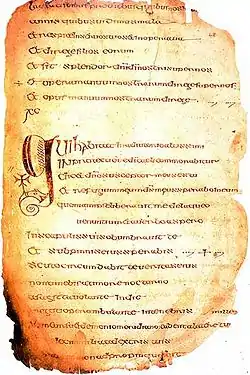 Text from the Cathach of St. Columba | |
| Type | Psalter |
|---|---|
| Date | Before AD 561 |
| Place of origin | Ireland |
| Language(s) | Vulgar Latin |
| Material | Vellum |
| Size | 27cm x 19cm |
| Format | Folio |
The relic was used by the Clan Ó Domhnaill (O’Donnell Clan), the old Gaelic royal family in Tír Chonaill, as a rallying cry and protector in battle. It is the oldest surviving manuscript in Ireland, and the second oldest Latin psalter in the world.[2] The Cathach is badly damaged, with just 58 vellum leaves, out of an original 110, surviving.[1]
The manuscript
The manuscript is 27 cm x 19 cm and contains the Vulgate version of Psalm 30:13 to 105:13. The manuscript is dated to 560-600. The current manuscript is 58 folios; the complete manuscript would have contained around 110 folios.[3]
The decoration of the Cathach is limited to the initial letter of each Psalm. Each initial is in black ink and is larger than the main text. They are decorated with trumpet, spiral and guilloche patterns and are often outlined with orange dots. These patterns are not merely appended to the letters or used to fill spaces. They instead distort the shape of the letters themselves. The letters following the enlarged initials gradually reduce in size until they reach the same size as the main text. Irish manuscripts like this one, produced in a culture isolated from Rome, were written in localized scripts.[4]
History
An Cathach was used as a rallying cry and protector in battle. It was said to protect and guarantee victory in war to the Donegal leaders. Before a battle it was customary for a chosen monk/holy man (usually attached to the McGroarty clan, and someone who was sinless) to wear the Cathach in its cumdach, or book shrine, around his neck and then walk three times around the troops of O'Donnell.[5]
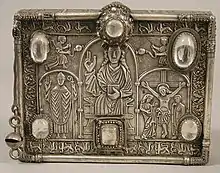
As a chief of the O'Donnells, the manuscript was inherited by Brigadier-General Daniel O'Donnell (1666–1735), and was regarded by him, in accordance with its traditional history, as a talisman of victory if carried into battle by any of the Cinel Conaill. He served James II of Ireland and then in the French Irish Brigade. He placed it in a silver case and deposited it for safety in a Belgian monastery, leaving instructions in his will that it was to be given up to whoever could prove himself chief of the O'Donnells. Through an Irish abbot it was restored to Sir Neale O'Donnell, 2nd Baronet, of Newport House, County Mayo, in 1802. His son, Sir Richard Annesley, entrusted the relic to the Royal Irish Academy in 1842.[6] The leaves were stuck together until separated at the British Museum in 1920; the manuscript was further restored in 1980–81.[3]
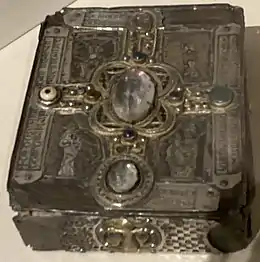
The specially made cumdach is in the National Museum of Ireland – Archaeology. The initial work on the case was done between 1072 and 1098 at Kells, but a new main face was added in the 14th century with a large seated Christ in Majesty flanked by scenes of the Crucifixion and saints in gilt repoussé (NMI R2835, 25.1 cm (9.9 in) wide).[7] The cumdach (book shrine) cover consists of a wooden box measuring 230 mm (9 in) long, 200 mm (8 in) wide and 51 mm (2 in) thick.[8]
See also
- Springmount Bog Tablets, 7th-century Irish psalter written on wooden wax tablets
Notes
- O'Neill (2014), p. 12
- McNamara, Martin (2000). The Psalms in the Early Irish Church. Continuum International Publishing Group. p. 8. ISBN 9781850759256.
- "The Cathach at the Royal Irish Academy". Archived from the original on 2014-07-02.
- De Hamel, Christopher (1986). A History of Illuminated Manuscripts. Oxford: Phaidon Press Limited. p. 20. ISBN 0-7148-2361-9.
- Roy Stokes (20 May 2011). A Bibliographical Companion. Scarecrow Press. pp. 80–. ISBN 978-1-4617-3662-2.
-
 One or more of the preceding sentences incorporates text from a publication now in the public domain: Chichester, Henry Manners (1895). "O'Donnell, Daniel". In Lee, Sidney (ed.). Dictionary of National Biography. 41. London: Smith, Elder & Co. pp. 434–435. and Joynt, M. (1917). "The Cathach of St. Columba". The Irish Church Quarterly. 10 (39): 187. doi:10.2307/30067688. JSTOR 30067688.
 - Antiquities, 233, 269; Stokes, 79; Reproduction in New York
- Audit of Columban Heritage (page 114)
References
- "Antiquities": Wallace, Patrick F., O'Floinn, Raghnall eds. Treasures of the National Museum of Ireland: Irish Antiquities, 2002, Gill & Macmillan, Dublin, ISBN 0-7171-2829-6
- De Hamel, Christopher. A History of Illuminated Manuscripts. Boston: David R. Godine, 1986.
- Moss, Rachel. Medieval c. 400—c. 1600: Art and Architecture of Ireland. New Haven, CT: Yale University Press, 2014. ISBN 978-03-001-7919-4
- Stokes, Margaret, Early Christian Art in Ireland, 1887, 2004 photo-reprint, Kessinger Publishing, ISBN 0-7661-8676-8, ISBN 978-0-7661-8676-7, google books
- O'Neill, Timothy. The Irish Hand: Scribes and Their Manuscripts From the Earliest Times. Cork: Cork University Press, 2014. ISBN 978-1-7820-5092-6
- "Audit of Columban Heritage", by Neil Jackman and Dr. Conor Ryan, prepared for Donegal County Council, Derry City & Strabane District Council, Foras na Gaeilge and The Heritage Council, Abarta Heritage, Ireland, November 2018 [f].
External links
 |
Wikimedia Commons has media related to Cathach of St. Columba. |
- More information at Earlier Latin Manuscripts
- The Cathach / The Psalter of St Columba : RIA MS 12 R 33 c. A.D. 560-600 Vellum: 27cm x 19cm 58 leaves (original c. 110 leaves)
| Extant |
|  |
|---|---|---|
| Lost |
| |
| Relate | ||