National Museum of Ireland – Archaeology
The National Museum of Ireland – Archaeology (Irish: Ard-Mhúsaem na hÉireann - Seandálaíocht, often known as the "NMI") is a branch of the National Museum of Ireland located on Kildare Street in Dublin, Ireland, that specialises in Irish and other antiquities dating from the Stone Age to the Late Middle Ages.
Ard-Mhúsaem na hÉireann - Seandálaíocht | |
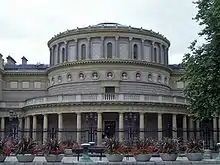 Entrance to the museum | |
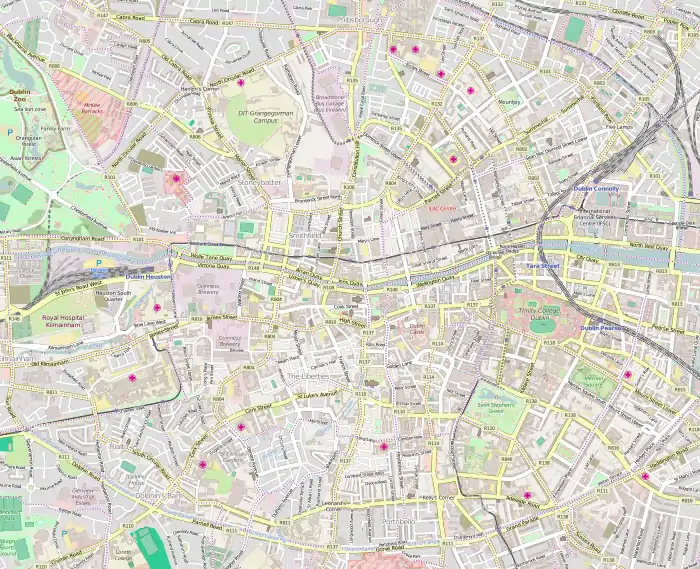  Location of the museum in Dublin | |
| Established | 29 August 1890 |
|---|---|
| Location | Kildare Street Dublin 2 Ireland |
| Coordinates | 53.340362°N 6.254907°W |
| Type | National museum |
| Visitors | 370,965 (2009)[1] |
| Curator | Maeve Sikora, July, 2017 (Keeper) |
| Public transit access | St Stephen's Green  Dublin Pearse  Dublin Bus routes: 39, 39a, 46a, 145 |
| Website | Museum website |
| National Museum of Ireland network | |
The museum was established under the Science and Art Museum Act of 1877. Before, its collections had been divided between the Royal Dublin Society and the Natural History Museum on Merrion Street[2] The museum was built on Kildare Street, by the father and son architects Thomas Newenham Deane and Thomas Manly Deane.[3]
The NMI holds a number of objects from prehistoric Ireland, including bog bodies and Iron and Bronze Age artifacts, such as axeheads, swords and shields in bronze, silver and gold, with the earliest dated to c. 7000 BC.[3] It holds the world's most substantial collection post-Roman era Irish medieval art (known as Insular art). In addition, it houses a substantial collection of medieval metalwork, Viking artefacts, and classical objects from Ancient Egypt, Cyprus and the Roman world.
Formation
Many of these pieces were found in the 19th century by peasants or agricultural labourers, when population expansion led to cultivation of land which had not been touched since the Middle Ages. Only the intervention of George Petrie of the Royal Irish Academy, and like-minded individuals from the Royal Society of Antiquaries of Ireland, prevented the metalwork from being melted for the intrinsic value of its materials. Contemporary Irish are more tuned to their heritage, as can be seen in the example of the Faddan More Psalter, discovered by a machine operator in a bog in July 2006.[4]
The Museums of both the above-mentioned institutions (the RIA and RSAI) formed the basis for the Archaeology and History section of the Museum at Kildare Street. This is the original site opened in 1890 as the Dublin Museum of Science and Art in the building designed by Thomas Newenham Deane and his son, Thomas Manly Deane. Until 1922, this site also included Leinster House, now the home of the Oireachtas.
Collection
The NMI has a number of large permanent exhibits, mainly of Irish historical objects and also a few smaller exhibits on the ancient Mediterranean.[5] There are also galleries on "Ancient Egypt",[6] and "Ceramics and Glass from Ancient Cyprus".[7]
Prehistoric
The prehistoric Ireland section contains artefacts from the earliest period of human habitation in Ireland (just after the Last Ice Age) up to the Celtic Iron Age. There are numerous stone implements created by the first hunter-gatherer colonists beginning around 7000 BC, then moving on to the tools, pottery and burial objects of the Neolithic farmers. Some notable artefacts include four rare Jadeite axeheads imported from the Alps of Neolithic Italy, and the unique ceremonial macehead discovered at the tomb of Knowth.[8][9] The exhibit then covers the introduction of metallurgy into Ireland around 2500 BC, with early copper implements. From the later Bronze Age period there is an impressive array of bronze axes, daggers, swords, shields, cauldrons and cast bronze horns (the earliest known Irish musical instruments). There are a few very early Iron weapons. Wooden objects include a large dugout logboat, wooden wheels and cauldrons and ancient reed fishing equipment.[10]
Bronze age
The NMI contains artifacts from excavation of the earliest Irish settlements, including bronze age blades, flint points and spearheads dated to before 4500 B.C..[11] Other artifacts include bronze rings and necklaces.[12]
Its collection of bronze age gold work ranges from c. 2200 to 1800 B.C and is considered one of the "largest and most important" in Western Europe, and includes crescent shaped collars called lunula collars, bracelets and dress-fastners.[13] Most of the goldwork is probably jewellery, but many of the objects of are of unknown (possibly ritual) function. In the early Bronze Age most artefacts were made from sheet gold and include sundiscs and lunulae. In the middle Bronze Age new gold working techniques were developed; starting around 1200 BC a great variety of torcs were produced from twisting bars of gold. Items from the late Bronze Age, starting in 900 BC, include solid gold bracelets and dress-fasteners as well as large sheet gold collars, ear-spools and a necklace of hollow golden balls.[14][15]
_in_the_National_Museum_Dublin.jpg.webp) Decorated stone from Loughcrew, Co Meath, 2500-1700 BC
Decorated stone from Loughcrew, Co Meath, 2500-1700 BC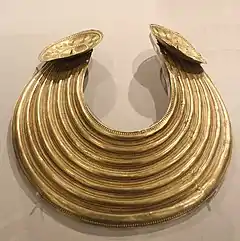 The Gleninsheen gorget, c. 800-700 BC
_in_National_Museum_Dublin.jpg.webp) Dress fasteners, Clones, County Monaghan (800-700 BC)
Dress fasteners, Clones, County Monaghan (800-700 BC)_in_National_Museum_Dublin.jpg.webp) Box from Killymoom Demesne in County Tyrone (800-700 BC)
Box from Killymoom Demesne in County Tyrone (800-700 BC)
Bog bodies (Iron age)
The museum contains many well-preserved Irish bog bodies, found between the 19th century and present day. A number are believed to have been ritualistically sacrificed.[16][17] Eamonn Kelly (former Keeper of Irish Antiquities) developed the theory that the bog bodies were tribal kings sacrificed by the community, having failed in their kingship, in pools of water at the boundary points of the tribal territory.[18] Some seem to exhibit evidence of the so called threefold death practice. The bog bodies in the collection are Gallagh Man (470-120 BC),[19] Baronstown West Man (242 to 388 BC), Clonycavan Man (392 to 201 BC), and Old Croghan Man (362 to 175 BC).[18]
The withy hoop found around Gallagh Man's neck was probably used as a garrotte to strangle him, probably during a ritual involving human sacrifice,[18] given that most of such bodies from this period are young males aged 25 to 40 years old, and like many of the victims, his hair had been closely cropped.[20] It is also possible that he was a criminal who was put to death.[21] However, the willow rope strongly suggests ritual sacrifice; they often appear for this purpose in early Irish mythological stories such as that of the Táin Bó Cúailnge.[22]
Alongside the bodies are examples of the material culture of the Celtic Iron Age period in which they lived. These include metal weapons and horse trappings as well as wooden and leather pieces. The Petrie crown (named for George Petrie) is part of a high-status headdress made in the La Tène artistic style. The section also contains Ralaghan Man, a carved wooden figure believed to be a boundary marker and examples of bog butter, which is ancient butter preserved in the bog in containers such as wooden buckets. The museum also possesses several other bog bodies not currently displayed, such as the Cashel Man (discovered 2011, dated to ~2000 BC), believed to be the oldest fleshed bog body found in Europe.[23]
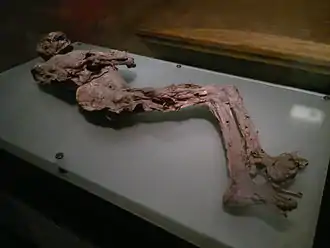 Gallagh Man, 470-120 BC, found in County Galway, 1821
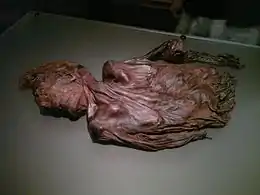 Clonycavan Man, 392 to 201 BC, County Meath
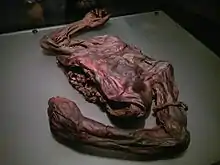 Old Croghan Man, 362 to 175 BC, County Offaly
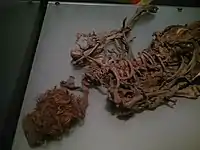 Baronstown West Man, 242 to 388 BC, County Kildare
Medieval (Insular) period
The museum's treasury room exhibits early medieval Christian and secular Irish metalwork dating from the late Iron Age to the end of the Middle Ages, and contains important pieces from both the La Tène and Insular periods.[24] Examples include the Ardagh Chalice, Tara Brooch, the Broighter Gold, the Derrynaflan Hoard and the Cross of Cong. The exhibition area consists of three main gallerys. Gallery One contains art works from the Iron Age to the twelfth century AD, with the displays arranged chronologically, including the Rinnegan Crucifixion Plaque is one of the earliest extant representations of the crucifixion in Irish art, and outside of illuminated manuscripts, a rare example of both representation and a narrative scene in early Irish Insular art.[25]
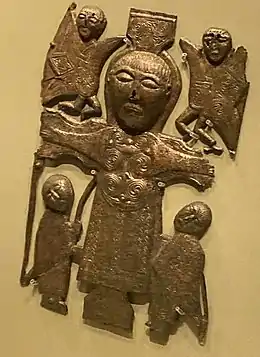 The Rinnegan Crucifixion Plaque (or Athlone Crucifixion Plaque), late 7th or early 8th century. Outside of illuminated manuscripts, a rare example of representation in early Insular art
.jpg.webp)
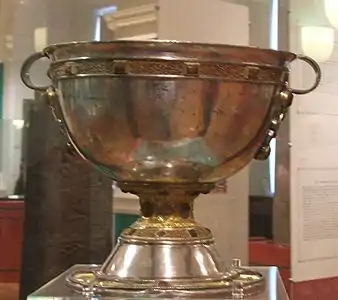 Derrynaflan Chalice, 8th- or 9th-century. Found as part of the Derrynaflan Hoard of five liturgical vessels in 1980 near Killenaule, County Tipperary.[27]
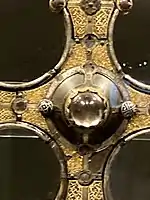 The Cross of Cong, the most highly decorated of the early 12th-century Irish Christian ornamented processional crosses.
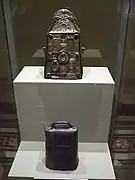 St. Patrick's bell (below) and bell-shrine (above), c. 1100
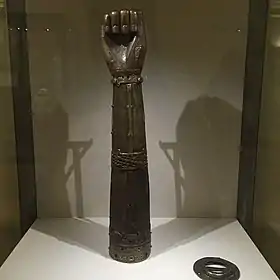 Shrine of Saint Lachtin's Arm, c. 1118–1121. A reliquary made of wood and metal shaped as an outstretched forearm and clenched fist.[28]
Gallery Two holds the Faddan More Psalter (c. 800 AD) discovered in a bog in July 2006, in the townland of Faddan More in north County Tipperary. Gallery Three is devoted to Irish metalwork.[29]
Brooches
Celtic brooches (more properly called penannular brooches) are types of brooch clothes fasteners, especially associated with the beginning of the Early Medieval period in the British Isles. Beginning as utilitarian fasteners in the Iron Age and Roman period, they are especially associated with the highly ornate brooches produced in precious metal for the elites of Ireland and Scotland from about 700 to 900, which are popularly known as Celtic brooches or similar terms.
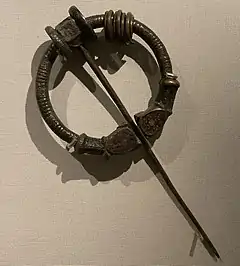 Ballinderry Brooch, c. 600, considered one of the most complexly designed of the surviving brooches[30]
.jpg.webp) The Tara Brooch, c. 710-750, generally considered as "the pinnacle of early medieval Irish metalworkers’ achievement".
The Tara Brooch, c. 710-750, generally considered as "the pinnacle of early medieval Irish metalworkers’ achievement".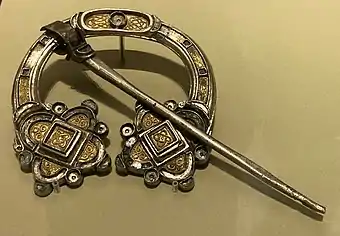
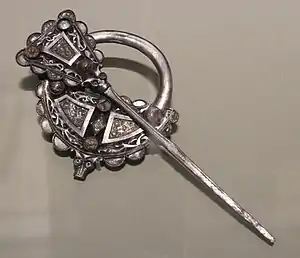 The Roscrea Brooch, 9th century, whose craftsmen had absorbed elements of Scandinavian imagery and metalwork techniques
Brooches are the most significant objects in high-quality secular metalwork from Early Medieval Insular art, and were worn by the emerging middle-classes, more often by men than women however, but rises in general wealth across centuries generated demand and demand for the format in precious metals flourished. The most well known examples would have been produced for the upper strata of their communities only.
Shrines
Most surviving examples Irish shrines in metalwork amd date from the peak age of Irish monasticism before 800, and the extant cumdachs date from after 1000, although it is clear the form dates from considerably earlier. The most well known examples of this type are the 11th century Soiscél Molaisse, Cathach of St. Columba and Shrine of Miosach cumdachs, and the 14th century Domnach Airgid.[34] The majority are held in the NMI, with other examples at the British Museum and National Museum of Scotland.
Cumdachs
Cumdachs (or book shrines) are elaborate ornamented metal reliquary box or case used to hold Early Medieval Irish manuscripts or relics. They are typically later than the book they contain, often by several centuries.[35] In most surviving examples the book comes from the peak age of Irish monasticism before 800, and the extant cumdachs date from after 1000, although it is clear the form dates from considerably earlier. They are mostly of Irish origin, and consist of a protective enclosures intended to permanently seal off a manuscript or relic.[36] The usual form is a design based on a cross on the main face, with use of large gems of rock crystal or other semi-precious stones, leaving the spaces between the arms of the cross for more varied decoration. Several were carried on a metal chain or leather cord, often worn off the belt, or suspended around the neck, placing them next to the heart and thus offering spiritual and perhaps medical benefits. They were also used to bring healing to the sick or dying, or more formally, as witness contracts. Many had hereditary lay keepers from among the chiefly families who had formed links with monasteries.[37]
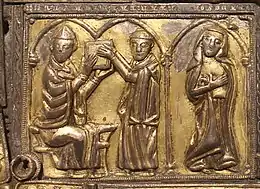 Panel from the Domnach Airgid, an 8th-century wooden reliquary reworked between the 13th and 15th centuries.[38]
.jpg.webp) The c. 1026 cumdach for the Stowe Missal, a small Irish illuminated manuscript written mainly in Latin and Old Irish in the late eighth or early ninth century.[39]
The c. 1026 cumdach for the Stowe Missal, a small Irish illuminated manuscript written mainly in Latin and Old Irish in the late eighth or early ninth century.[39].jpg.webp) Shrine of Miosach, 11th century. May have once contained a manuscript with psalms or extracts from a Gospel[40]
Shrine of Miosach, 11th century. May have once contained a manuscript with psalms or extracts from a Gospel[40].jpg.webp) The Soiscél Molaisse, an 11th century book shrine known with a 9th century inner wooden casing.[41]
The Soiscél Molaisse, an 11th century book shrine known with a 9th century inner wooden casing.[41]
Although most of the extant book-shaped protective shrines are mentioned in Irish annals, they were not properly described until the early 19th century, when antiquarians and collectors such as George Petrie began to seek them out from heredity collections. Most are badly damaged, including due to general wear and tear over the centuries, fires at their holding location, or more usually, having elements such as their gemstones removed for sale by their owners. A majority are now in the NMI.[42]
House-shaped shrines
House (or tomb)-shaped shrines originate from both Ireland and Scotland and mostly date from the 8th or 9th centuries. Typical examples consist of a wooden core covered with silver and copper alloy plates, and were built to hold relic] of saints or martyrs from the early Church era;[43] a number held corporeal remains when found in the modern period, presumably they were parts of the saint's body.[44] Others, including the now badly damaged Breac Maodhóg, held manuscripts associated with the commemorated saint.[45][46] Like many Insular shrines, they were heavily reworked and embellished in the centuries following their initial construction, often with metal adornments or figures influenced by Romanesque sculpture.[47]
The Breac Maodhóg was probably used as a battle standard, when it would have been carried onto the battlefield by a cleric so as to offer protection to the troops and perhaps bring victory. A medieval text on the life of the patron saint of the kings of Leinster, St Maedoc of Ferns, records that the kings of Breifne sought that "the famous wonder-working Breac [was] carried thrice around them" during battle.[48]
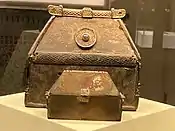
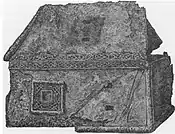 Drawing of a shrine found in the River Shannon
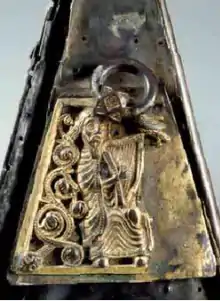 Gable of the badly damaged but important Breac Maodhóg, showing the figure of a harpist. Late 11th century[51]
.jpg.webp)
Croziers
Insular croziers are types of processional bishop's staff (crozier) produced in Ireland and Scotland between c. 800 and 1200. They can be distinguished from mainland European types by their curved crooks and drop (that is, the hollow box-like extension at the end of the crook).[53][54] Symbols of office for bishops or abbots, their form is based on the idea of the shepherd as pastor of his flock. Although their production end c. 1200, they continued in use and were often refurbished and added to up to the late medieval period. Of the some 50 extant Insular croziers (including some 30 fragments), the majority are held at the NMI.[55] In craftmanship and ornamentation, the late 11th century Clonmacnoise Crozier is considered the finest of the fully intact example, followed in quality by the 11th century River Laune and c. 1100 Lismore croziers.
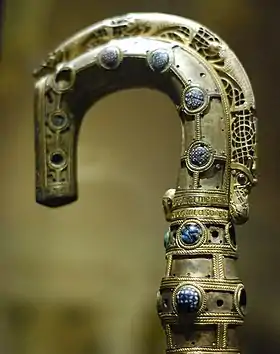 Lismore Crozier, c. 1100
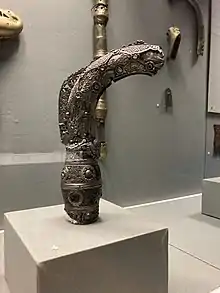 Crozier head (fragment)
.jpg.webp) Crook of the Clonmacnoise Crozier, late 11th century (with the Cross of Cong in the background)
Crook of the Clonmacnoise Crozier, late 11th century (with the Cross of Cong in the background)_Crozier_Drop_1.jpg.webp) Drop-plate of the River Laune Crozier, late 11th century
Drop-plate of the River Laune Crozier, late 11th century
They are often ornamented with interlace designs, geometric patterns and zoomorphic (portraying humans as non-human animals) figures. The animal designs in the earliest example, including the 9th century Prosperous Crozier, are depicted in a naturalistic manner, while many of the later examples, such as the Lismore Crozier, bear influence from both the Ringerike and later Urnes styles of Viking art.[56][57] Some of the Ringerike style animals bear close resemblance to figures on the margins of ninth-century Insular brooches.[58]
References
- "Archived copy". Archived from the original on 2010-08-27. Retrieved 2010-11-25.CS1 maint: archived copy as title (link)
- "1877-1899: The Science and Art Museum, Dublin". NMI. Retrieved 15 August 2021
- Kelly (2007), p. 4
- Reilly, Jerome. Manuscript dug from bog rates among our top 10 biggest finds". Irish Independent, 5 September 2010. Retrieved 30 May 2021
- Permanent exhibitions National Museum of Ireland – Archaeology
- Ancient Egypt, NMI
- Ceramics and Glass from Ancient Cyprus". National Museum of Ireland. Retrieved 31 May 2021
- Guide to the National Museum of Ireland Archaeology
- Knowth Macehead newgrange.com
- Prehistoric Ireland exhibit museum.ie
- Kelly (2007), p. 9
- Kelly (2007), p. 19
- Kelly (2007), pp. 10–11
- Ór - Ireland's Gold museum.ie
- A Late Bronze Age gold necklace from Tumna, Co. Roscommon Irish Archaeology
- Kelly (2007), pp. 78-79
- "Bog Bodies of the Iron Age: Gallagh Man". PBS. Retrieved 14 May 2021
- "Kingship and Sacrifice". National Museum of Ireland, 2012. Retrieved 3 December 2021
- "Ancient bog body found in Meath". TheJournal.ie, 10 December 2020. Retrieved 30 May 2021
- Bentley (2015), p. 36
- Haughton (2019), p. 108
- Kelly (Scéal na Móna, 2006), p. 58
- Cashel Man: Ireland's Oldest Bog Body museum.ie
- Kelly (2007), p. 21
- O'Toole (2013)
- "Tully Lough Cross". visual-arts-cork.com. Retrieved 24 November 2021
- "Derrynaflan Chalice". National Museum of Ireland . Retrieved 24 November 2021
- Moss (2014), p. 291
- "The Treasury". National Museum of Ireland. Retrieved 26 June 2021
- Youngs (1989), p. 41
- Ó Floinn; Wallace (2002), p. 185
- Swift, Catherine. "English and Pictish Terms for Brooch in an 8th-century Irish Law-Text". Medieval Archaeology, 2004
- Henderson; Henderson (2004), p. 116
- Moss (2014), pp. 286, 294
- Warner (1906), xliv
- Moss (2014), p. 294
- Antiquities, 262
- Moss (2014), pp. 48, 67, 113
- O'Neill (2014), 18
- Petrie, George. "Exhibition of the Missagh, or Miosach". Proceedings of the Royal Irish Academy (1836–1869), volume 5, 1850–1853. p. 464. JSTOR 20489800
- Mullarkey, Paul, in: Moss, Rachel (2014), p. 300
- Crawford (1923), p. 75
- Ó Floinn (1990), p. 49
- "Reliquary casket ("Emly Shrine"). Early medieval: late 7th–early 8th century". Museum of Fine Arts, Boston. Retrieved 24 November 2021
- Murray (2005), p. 136
- Moss (2014), pp. 286-293
- Murray (2021)
- Lucas (1986), p. 19
- "Lough Erne Shrine: early 20th century (original dated 11th century)". Metropolitan Museum of Art. Retrieved 23 July 2021
- Moss (2014), p. 288
- O'Toole (2013), p. 86
- Murray, Griffin. "St Manchán's Shrine: Art and Devotion in Twelfth Century Ireland (video lecture)". Offaly History, 17 May 2021. Retrieved 24 November 2021
- Youngs (1989), p. 214
- Murray (2007 a), p. 81
- Moss (2014), p. 83
- Bourke (1985), p. 151
- Ó Floinn; Wallace (2002), p. 220
- Bourke (1985), p. 153
Sources
- "Antiquities": Wallace, Patrick, O Floinn, Raghnall (eds). Treasures of the National Museum of Ireland: Irish Antiquities. Dublin: Gill & Macmillan, 2002. ISBN 0-7171-2829-6
- Arnold, Matthew. The Study of Celtic Literature. London: Smith, Elder, & Co, 1891
- Bourke, Marie. The Story of Irish Museums 1790-2000: Culture, Identity and Education. Cambridge University Press, 2011. ISBN 978-1-8591-8475-2
- Casey, Christine. Dublin: The Buildings of Ireland (Pevsner Architectural Guides: Buildings of Ireland). London: Yale University Press, 2005. ISBN 978-0-3001-0923-8
- Crawford, Henry. "A Descriptive List of Irish Shrines and Reliquaries. Part I". The Journal of the Royal Society of Antiquaries of Ireland, 6th series, volume 13, no. 1, June 1923. JSTOR 25513282
- Crooke, Elizabeth. Politics, Archaeology and the Creation of a National Museum of Ireland: An Expression of National Life. Dublin: Irish Academic Press, 2001. ISBN 978-0-7165-2729-9
- Cone, Polly. Treasures of early Irish art, 1500 B.C. to 1500 A.D: From the collections of the National Museum of Ireland, Royal Irish Academy, Trinity College Dublin. NY: Metropolitan Museum of Art, 1977. ISBN 978-0-8709-9164-6
- Haughton, Brian. Hidden History: Lost Civilizations, Secret Knowledge, and Ancient Mysteries. Franklin Lakes, NJ: New Page Books, 2019. ISBN 978-1-5641-4897-1
- Hourihane, Colum. The Grove Encyclopedia of Medieval Art and Architecture, Volume 1. Oxford: Oxford University Press, 2012. ISBN 978-0-1953-9536-5
- Kelly, Eamonn. "Guide to the National Museum of Ireland – Archaeology". Dublin: National Museum of Ireland, 2007
- Kelly, Eamonn. "Bodies from the Bog: New Insights into Life and Death in Pagan Celtic Ireland." In: Fagan, Brian (ed), Unearthing the Bodies from the Bog: New Insights into Life and Death in Pagan Celtic Ireland. London: Thames and Hudson, 2007. ISBN 978-0-5000-5149-8
- O'Neill, Timothy. The Irish Hand: Scribes and Their Manuscripts From the Earliest Times. Cork: Cork University Press, 2014. ISBN 978-1-7820-5092-6
- Mitchell, Frank (ed.). Treasures of Early Irish Art, 1500 B.C. to 1500 A.D. NY: Metropolitan Museum of Art, 2013. ISBN 978-0-3002-0170-3
- Moss, Rachel. Medieval c. 400—c. 1600: Art and Architecture of Ireland. Yale University Press, 2014. ISBN 978-03-001-7919-4
- Murray, Griffin. "Insular-type crosiers: their construction and characteristics". Making and Meaning in Insular Art: Proceedings of the Fifth International Conference on Insular Art, 2007
- Ó Floinn, Raghnal; Wallace, Patrick. Treasures of the National Museum of Ireland: Irish Antiquities. National Museum of Ireland, 2002. ISBN 978-0-7171-2829-7
- O'Toole, Fintan. A History of Ireland in 100 Objects. Dublin: Royal Irish Academy, 2013. ISBN 978-1-9089-9615-2
- The Stowe Missal: MS. D. II. 3 in the Library of the Royal Irish Academy, Dublin, edited by George F. Warner (1906), from the Internet Archive
- Youngs, Susan (ed.). "The Work of Angels": Masterpieces of Celtic Metalwork, 6th—9th centuries AD. London: British Museum Press, 1989. ISBN 0-7141-0554-6
External links
 |
Wikimedia Commons has media related to National Museum of Ireland, Kildare Street. |