Chalking the door
Chalking the door is one of the Christian Epiphanytide traditions used to bless one's home, as well as a Scottish custom of landlord and tenant law.[1]
Epiphanytide
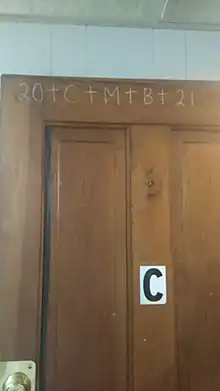
Either on Twelfth Night (5 January), the twelfth day of Christmastide and eve of the feast of the Epiphany, or on Epiphany Day (6 January) itself, many Christians (including Anglicans, Lutherans, Methodists, Presbyterians and Roman Catholics, among others) write on their doors with chalk in a pattern such as 20 ✝ C ✝ M ✝ B ✝ 21, with the numbers referring "to the calendar year (20 and 21, for instance, for this year, 2021); the crosses stand for Christ; and the letters have a two-fold significance: C, M and B are the initials for the traditional names of the Magi (Caspar, Melchior and Balthazar), but they are also an abbreviation of the Latin blessing Christus mansionem benedicat, which means, May Christ bless this house."[2] Another form, for Three Kings day, is to mark the door with IIIK (the Roman numeral three followed by "K" for "Kings").
Chalking the door is done most commonly on Epiphany Day itself, although it can be done on any day of the Epiphany season.[3] In some localities the chalk used to write the Epiphanytide pattern is blessed by a Christian priest or minister on Epiphany Day, then taken home to write the pattern.[4]
The Christian custom of chalking the door has a biblical precedent as the Israelites in the Old Testament marked their doors in order to be saved from death; likewise, the Epiphanytide practice serves to protect Christian homes from evil spirits until the next Epiphany Day, at which time the custom is repeated.[5] Families also perform this act to represent the hospitality of the Holy Family to the Magi (and all Gentiles); it thus serves as a house blessing to invite the presence of God in one's home.[6]
From the Catholic Congregation for Divine Worship and the Discipline of the Sacraments:
The blessing of homes, on whose lintels are inscribed the Cross of salvation, together with the indication of the year and the initials of the three wise men (C+M+B), which can also be interpreted to mean Christus mansionem benedicat, written in blessed chalk; this custom, often accompanied by processions of children accompanied by their parents, expresses the blessing of Christ through the intercession of the three wise men and is an occasion for gathering offerings for charitable and missionary purposes.[7]
Gallery: Epiphany season door chalking
 Epiphany season door chalking at the Villa Reepschlägerbahn in Germany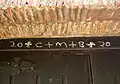
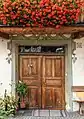 Epiphany door chalking in Sexten, Italy
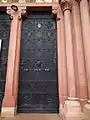 Epiphany door chalking in Heidelberg, Germany
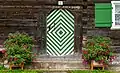 Epiphany door chalking in Mittelberg, Austria
References
- One or more of the preceding sentences incorporates text from a publication now in the public domain: Chisholm, Hugh, ed. (1911). "Chalking the Door". Encyclopædia Britannica. 5 (11th ed.). Cambridge University Press. p. 807.
- Essick, Amber; Essick, John Inscore (2011). "Distinctive Traditions of Epiphany" (PDF). Center for Christian Ethics at Baylor University. Retrieved 6 February 2016.
- "An Epiphany Blessing of Homes and Chalking the Door". Discipleship Ministries. May 7, 2007.
- The Encyclopedia Americana. Grolier. 1988. p. 512. ISBN 9780717201198.
- Pennick, Nigel (21 May 2015). Pagan Magic of the Northern Tradition: Customs, Rites, and Ceremonies. Inner Traditions – Bear & Company.
- Mazar, Peter (2015). To Crown the Year: Decorating the Church through the Seasons (Second ed.). LiturgyTrainingPublications. p. 241. ISBN 9781616711894.
- Congregation for Divine Worship and the Discipline of the Sacraments (December 2001). "Directory on Popular Piety and the Liturgy. Principles and Guidelines". Vatican City. Retrieved 3 January 2020.
External links
- Epiphany Door Chalking by Christ the King Anglican Church
- An Epiphany Blessing of Homes and Chalking the Door by Discipleship Ministries of The United Methodist Church
- Chalking the Door: An Epiphany House Blessing 2016 by the Roman Catholic Order of Carmelites
| Calendar |
|
|---|---|
| Topics | |
| Traditions | |
| Hymns and carols |
|
| Noted works | |
| |
