Chemical industry in the United Kingdom
The chemical industry in the United Kingdom is one of the UK's main manufacturing industries. At one time, the UK's chemical industry was a world leader. The industry has also been environmentally damaging, and includes radioactive nuclear industries.
History

Sir William Henry Perkin FRS discovered the first synthetic dye mauveine in 1856, produced from aniline, having tried to synthesise quinine at his home on Cable Street in east London. Perkin's work, alone, led the way to the British chemical industry.
21% of the UK's chemical industry is in North West England, notably around Runcorn and Widnes. The chemical industry is 6.8% of UK manufacturing; around 85% of the UK chemical industry is in England.
It employs 500,000, including 350,000 indirectly.
It accounts for around 20% of the UK's research and development.
Output
In 2015, the UK chemical industry exported £50bn of products.[1] The industry employs about 30,000 in research and development.
Regulation
Regulation of the UK chemical industry is largely under the European Chemicals Agency (ECHA) and the Registration, Evaluation, Authorisation and Restriction of Chemicals legislation (REACH).
Chemical plants
Teesside and Cheshire are areas with an established chemical industry. Significant chemical plants in the UK include:
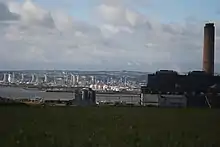

- Battery Works at Stallingborough in North East Lincolnshire, built by Taylor Woodrow Construction in 1950 for Laporte Industries
- Billingham Manufacturing Plant, former ICI plant that makes nitrate fertiliser[2]
- Ineos Grangemouth chemicals plant, the propylene plant began in 1949, being opened at Grangemouth, Stirlingshire in May 1951[3] for British Petroleum Chemicals, which had been formed jointly between The Distillers Company and the Anglo-Iranian Oil Company (known as BP from 1954) in 1948. It would later have a crude oil feed from the Forties Oil Field
- North Tees Works, former ICI near Seal Sands, east of Billingham in Stockton. Announced in June 1964, to make cyclohexane and aromatics. Made 400,000 tonnes a year, to be the biggest aromatics plant in Europe, opened 1966, built by Procon[4] By 1970, would be the biggest aromatics plant in the world, when expanded south of the Tees, with a pipeline connecting the two sites. ICI jointly operated two neighbouring oil refineries. Shell had a refinery at Teesport
- Wilton International, built by ICI
Former chemical plants
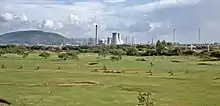
- Baglan Bay Works, built similar to the Grangemouth plant for British Hydrocarbon Chemicals (from 1956) by George Wimpey,[5] from 1961 between Port Talbot and Neath in south Wales, it had a light distillate feed from the nearby Llandarcy Oil Refinery, with a steam cracker.[6] British Hydrocarbon Chemicals became BP Chemicals in 1967. It was demolished in 2003.
- Grimsby Works, built for Courtaulds
Companies
Significant chemical companies in the UK have been:
- Fisons, a significant East of England fertiliser company, bought in 1995
- Ineos, it took over many production sites of ICI
- Unilever, with a main detergent site in Warrington and home care manufacture and research on the Wirral
Organisations
Relevant organisations related to the UK chemical industry are the Institution of Chemical Engineers (IChemE), the Chemical Industries Association, and the Society of Chemical Industry. The chemical industry in Europe is represented by the European Chemical Industry Council or CEFIC.
References
- CIA 2015 report
- UK Government chmical sector report 2017
- Times Wednesday 28 November 1951, page 8
- Times Tuesday 2 June 1964, page 7
- Times Friday 17 April 1964, page 22
- Times Tuesday 18 April 1961, page 18
External links
Chemical engineering topics | ||
|---|---|---|
| History |  | |
| Concepts | ||
| Unit operations | ||
| Unit process | ||
| Branches | ||
| Others | ||
| ||