Chevrolet Eagle
The Chevrolet Master Eagle (Series CA) is an American vehicle manufactured by Chevrolet in 1933 to replace the 1932 Series BA Confederate. The Eagle was produced early in the 1933 production year. When it was joined by the cheaper Chevrolet Mercury later in 1933 the Eagle name was changed to Master to provide Chevrolet with a two-car range, and the first time in ten years they manufactured two models on different wheelbases. The Mercury was also known as the Standard series.[1] Starting in 1929, GM introduced the short lived General Motors Companion Make Program where Oakland, Oldsmobile, Buick and Cadillac had "junior" models added to each division, but weren't labeled according to their "senior" brand. The only division that didn't get a "junior" brand was Chevrolet. Two different models were introduced as Chevrolet to determine which one the market liked better, and sold better.[2]
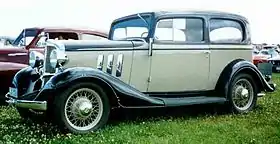
Total the earlier Eagle and later Master combined sold 450,435 vehicles, an increase of nearly 140,000 the previous year's Series BA sales of 313,395, and ensured that Chevrolet was able to retain their number one spot in American car sales. The Eagle saw the end of two-seater cars from Chevrolet, and the new Town Sedan included an integral trunk.
There are several differences between the Eagle and Master. The easiest to identify is the post between the front door vent windows and the roll down windows. On the Eagle the chrome divider between these two windows goes down as the window goes down, where as on the Master this divider remains fixed and does not go down with the window. The Eagle and Master's wheelbase increased an inch to 110 in (2,794.0 mm) compared to the Series BA, and was three inches longer than the new Mercury.
It was powered by a larger version of the "Stovebolt Six", 206 cu in (3,380 cc) six-cylinder engine, producing 65 hp (48 kW).[3] A smaller 181 cu in (2,970 cc) six-cylinder was used in the Mercury, producing 60 hp (45 kW)
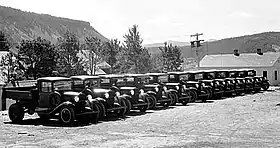
GM also used the Eagle chassis and platform for trucks branded as both Chevrolet and GMC. In May of 1925 the Chevrolet Export Boxing plant at Bloomfield, New Jersey was repurposed from a previous owner where Knock-down kits for Chevrolet, Oakland, Oldsmobile, Buick and Cadillac passenger cars, and both Chevrolet and GMC truck parts were crated and shipped by railroad to the docks at Weehawken, New Jersey for overseas GM assembly factories.[2]
See also
- 1933 Cadillac Series 355
- 1933 LaSalle Series 303
- 1933 Oldsmobile F-Series
- 1933 Buick Series 50
- 1933 Pontiac
References
- Notes
- "1933 Chevrolet Eagle and Mercury". How Stuff Works. Archived from the original on 5 November 2012. Retrieved 3 January 2013.
- Kimes, Beverly R. (1996). Clark, Henry A. (ed.). The Standard Catalog of American Cars 1805-1945. Kraus Publications. pp. 283–302. ISBN 0873414780.
- "1933 Chevrolet Master Eagle Series CA Cabriolet". Bonhams. Retrieved 3 January 2013.
- Sources
 |
Wikimedia Commons has media related to Chevrolet Master Eagle. |
Established in 1911, a division of General Motors since 1917 | |||||||||||||||||||||
| Current |
|  | |||||||||||||||||||
| Former models |
| ||||||||||||||||||||
| Concept cars |
| ||||||||||||||||||||
| |||||||||||||||||||||
| Divisions and subsidiaries |
|  | ||||||
|---|---|---|---|---|---|---|---|---|
| Shareholdings |
| |||||||
| Products and technologies |
| |||||||
| Former divisions, joint ventures and subsidiaries |
| |||||||
| Places | ||||||||
| People |
| |||||||
| Sponsorship |
| |||||||
| General topics | ||||||||
| ||||||||
Automotive marques of General Motors | ||||||||
|---|---|---|---|---|---|---|---|---|
| Wholly owned |
|  | ||||||
| Shareholdings and joint ventures |
| |||||||
 Category Category | ||||||||