List of ethnic groups in China
Multiple ethnic groups populate China, the area claimed by both the People's Republic of China (China) and the Republic of China (Taiwan).
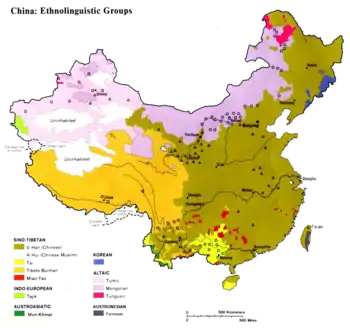
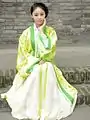
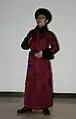
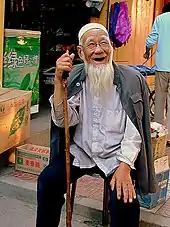
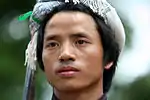
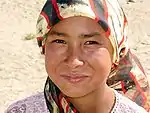
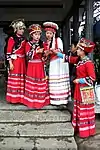
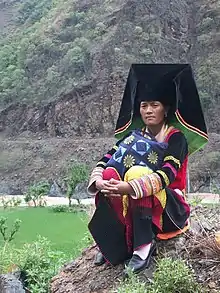
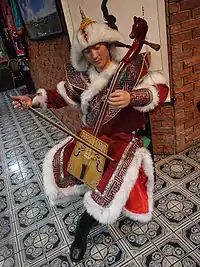
The Han people are the largest ethnic group in mainland China. In 2010, 91.51% of the population were classified as Han (~1.2 billion).[1] Besides the Han Chinese majority, 55 other ethnic (minority) groups are categorized in present China, numbering approximately 105 million people (8%), mostly concentrated in the bordering northwest, north, northeast, south and southwest but with some in central interior areas.
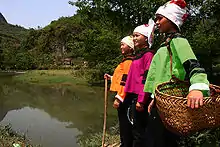
The major minority ethnic groups in China are Zhuang (16.9 million), Hui (10.5 million), Manchu (10.3 million), Uyghur (10 million), Miao (9.4 million), Yi (8.7 million), Tujia (8.3 million), Tibetan (6.2 million), Mongol (5.9 million), Dong (2.8 million), Buyei (2.8 million), Yao (2.7 million), Bai (1.9 million), Korean (1.8 million), Hani (1.6 million), Li (1.4 million), Kazakh (1.4 million) and Dai (1.2 million).[2] At least 126,000 people from Canada, the US and Europe are living in Mainland China.[3] In addition, there are also unrecognized ethnic groups, for example: Chuanqing people (穿青人), and others, who comprise over 730,000 people.
Ethnic groups recognized by the People's Republic of China
The following are the 56 ethnic groups (listed by population) officially recognized by the People's Republic of China (39 in 1954; 54 by 1964; with the most recent addition the Jino people in 1979).[4]
| English Name |
Standard Romanization |
CodeA |
Mandarin Pinyin |
Simplified Chinese |
2010 National Shares | 2010 PopulationB |
2000 PopulationB |
1990 PopulationB |
Year of recognitionC |
|---|---|---|---|---|---|---|---|---|---|
| Han Chinese1 | Han | HA | Hànzú | 汉族 | 91.6474% | 1,220,844,520 | 1,139,773,008 | 1,042,482,187 | 1954 |
| Zhuang | Zhuang | ZH | Zhuàngzú | 壮族 | 1.2700% | 16,926,381 | 16,187,163 | 15,489,630 | 1954 |
| Hui2 | Hui | HU | Huízú | 回族 | 0.7943% | 10,586,087 | 9,828,126 | 8,602,978 | 1954 |
| Manchu | Man | MA | Mǎnzú | 满族 | 0.7794% | 10,387,958 | 10,708,464 | 9,821,180 | 1954 |
| Uyghur | Uygur | UG | Wéiwú'ěrzú | 维吾尔族 | 0.7555% | 10,069,346 | 8,405,416 | 7,214,431 | 1954 |
| Miao3 | Miao | MH | Miáozú | 苗族 | 0.7072% | 9,426,007 | 8,945,538 | 7,398,035 | 1954 |
| Yi | Yi | YI | Yízú | 彝族 | 0.6538% | 8,714,393 | 7,765,858 | 6,572,173 | 1954 |
| Tujia | Tujia | TJ | Tǔjiāzú | 土家族 | 0.6268% | 8,353,912 | 8,037,014 | 5,704,223 | 1964 |
| Tibetan4 | Zang | ZA | Zàngzú | 藏族 | 0.4713% | 6,282,187 | 5,422,954 | 4,593,330 | 1954 |
| Mongol | Mongol | MG | Měnggǔzú | 蒙古族 | 0.4488% | 5,981,840 | 5,827,808 | 4,806,849 | 1954 |
| Dong5 | Dong | DO | Dòngzú | 侗族 | 0.2161% | 2,879,974 | 2,962,911 | 2,514,014 | 1954 |
| Bouyei | Bouyei | BY | Bùyīzú | 布依族 | 0.2153% | 2,870,034 | 2,973,217 | 2,545,059 | 1954 |
| Yao | Yao | YA | Yáozú | 瑶族 | 0.2098% | 2,796,003 | 2,638,878 | 2,134,013 | 1954 |
| Bai | Bai | BA | Báizú | 白族 | 0.1451% | 1,933,510 | 1,861,895 | 1,594,827 | 1954 |
| Korean | Chosŏn | CS | Cháoxiǎnzú | 朝鲜族 | 0.1374% | 1,830,929 | 1,929,696 | 1,920,597 | 1954 |
| Hani6 | Hani | HN | Hānízú | 哈尼族 | 0.1246% | 1,660,932 | 1,440,029 | 1,253,952 | 1954 |
| Li | Li | LI | Lízú | 黎族 | 0.1098% | 1,463,064 | 1,248,022 | 1,110,900 | 1954 |
| Kazakh | Kazak | KZ | Hāsàkèzú | 哈萨克族 | 0.1097% | 1,462,588 | 1,251,023 | 1,111,718 | 1954 |
| Dai7 | Dai | DA | Dǎizú | 傣族 | 0.0946% | 1,261,311 | 1,159,231 | 1,025,128 | 1954 |
| She | She | SH | Shēzú | 畲族 | 0.0532% | 708,651 | 710,039 | 630,378 | 1964 |
| Lisu | Lisu | LS | Lìsùzú | 傈僳族 | 0.0527% | 702,839 | 635,101 | 574,856 | 1954 |
| Dongxiang | Dongxiang | DX | Dōngxiāngzú | 东乡族 | 0.0466% | 621,500 | 513,826 | 373,872 | 1954 |
| Gelao | Gelao | GL | Gēlǎozú | 仡佬族 | 0.0413% | 550,746 | 579,744 | 437,997 | 1964 |
| Lahu | Lahu | LH | Lāhùzú | 拉祜族 | 0.0365% | 485,966 | 453,765 | 411,476 | 1954 |
| Wa | Wa | WA | Wǎzú | 佤族 | 0.0322% | 429,709 | 396,709 | 351,974 | 1954 |
| Sui | Sui | SU | Shuǐzú | 水族 | 0.0309% | 411,847 | 407,000 | 345,993 | 1954 |
| Nakhi8 | Naxi | NX | Nàxīzú | 纳西族 | 0.0245% | 326,295 | 309,477 | 278,009 | 1954 |
| Qiang | Qiang | QI | Qiāngzú | 羌族 | 0.0232% | 309,576 | 306,476 | 198,252 | 1954 |
| Tu | Tu | TU | Tǔzú | 土族 | 0.0217% | 289,565 | 241,593 | 191,624 | 1954 |
| Mulao9 | Mulao | ML | Mùlǎozú | 仫佬族 | 0.0162% | 216,257 | 207,464 | 159,328 | 1964 |
| Xibe | Xibe | XB | Xībózú | 锡伯族 | 0.0143% | 190,481 | 189,357 | 172,847 | 1954 |
| Kyrgyz | Kirgiz | KG | Kē'ěrkèzīzú | 柯尔克孜族 | 0.0140% | 186,708 | 160,875 | 141,549 | 1954 |
| Jingpo10 | Jingpo | JP | Jǐngpōzú | 景颇族 | 0.0111% | 147,828 | 132,158 | 119,209 | 1954 |
| Daur | Daur | DU | Dáwò'ěrzú | 达斡尔族 | 0.0099% | 131,992 | 132,747 | 121,357 | 1964 |
| Salar | Salar | SL | Sālāzú | 撒拉族 | 0.0098% | 130,607 | 104,521 | 87,697 | 1954 |
| Blang | Blang | BL | Bùlǎngzú | 布朗族 | 0.0090% | 119,639 | 91,891 | 82,280 | 1964 |
| Maonan11 | Maonan | MN | Máonánzú | 毛南族 | 0.0076% | 101,192 | 107,184 | 71,968 | 1964 |
| Tajik12 | Tajik | TA | Tǎjíkèzú | 塔吉克族 | 0.0038% | 51,069 | 41,056 | 33,538 | 1954 |
| Pumi | Pumi | PM | Pǔmǐzú | 普米族 | 0.0032% | 42,861 | 33,628 | 29,657 | 1964 |
| Achang | Achang | AC | Āchāngzú | 阿昌族 | 0.0030% | 39,555 | 33,954 | 27,708 | 1964 |
| Nu | Nu | NU | Nùzú | 怒族 | 0.0028% | 37,523 | 28,770 | 27,123 | 1964 |
| Evenki | Ewenki | EW | Èwēnkèzú | 鄂温克族 | 0.0023% | 30,875 | 30,545 | 26,315 | 1954 |
| Vietnamese13 | Gin | GI | Jīngzú | 京族 | 0.0021% | 28,199 | 22,584 | 18,915 | 1964 |
| Jino | Jino | JN | Jīnuòzú | 基诺族 | 0.0017% | 23,143 | 20,899 | 18,021 | 1979 |
| De'ang14 | Deang | DE | Dé'ángzú | 德昂族 | 0.0015% | 20,556 | 17,935 | 15,462 | 1964 |
| Bonan | Bonan | BO | Bǎo'ānzú | 保安族 | 0.0015% | 20,074 | 16,505 | 12,212 | 1954 |
| Russian | Russ | RS | Éluósīzú | 俄罗斯族 | 0.0012% | 15,393 | 15,631 | 13,504 | 1954 |
| Yugur | Yugur | YG | Yùgùzú | 裕固族 | 0.0011% | 14,378 | 13,747 | 12,297 | 1954 |
| Uzbek | Uzbek | UZ | Wūzībiékèzú | 乌孜别克族 | 0.0008% | 10,569 | 12,423 | 14,502 | 1954 |
| Monba | Monba | MB | Ménbāzú | 门巴族 | 0.0008% | 10,561 | 8,928 | 7,475 | 1964 |
| Oroqen | Oroqen | OR | Èlúnchūnzú | 鄂伦春族 | 0.0006% | 8,659 | 8,216 | 6,965 | 1954 |
| Derung | Derung | DR | Dúlóngzú | 独龙族 | 0.0005% | 6,930 | 7,431 | 5,816 | 1964 |
| Hezhen15 | Hezhen | HZ | Hèzhézú | 赫哲族 | 0.0004% | 5,354 | 4,664 | 4,245 | 1964 |
| Gaoshan16 | Gaoshan | GS | Gāoshānzú | 高山族 | 0.0003% | 4,009 | 4,488 | 2,909 | 1954 |
| Lhoba | Lhoba | LB | Luòbāzú | 珞巴族 | 0.0003% | 3,682 | 2,970 | 2,312 | 1965 |
| Tatars | Tatar | TT | Tǎtǎ'ěrzú | 塔塔尔族 | 0.0003% | 3,556 | 4,895 | 4,873 | 1954 |
| Undistinguished | — | none | Wèi Shìbié Mínzú | 未识别民族 | 0.0480% | 640,101 | 734,438 | 749,341 | — |
| Naturalized Citizen | — | none | Wàiguórén Jiārù Zhōngguójí | 外国人加入中国籍 | 0.0001% | 1,448 | 941 | 3,421 | — |
AGB 3304-91 "Names of ethnicities of China in romanization with codes";[5]
BThe population only includes mainland China and Taiwan;
CFor ethnic groups officially recognised in 1964 or earlier, this is the year of first inclusion in the national census, which were in 1954[6] and 1964;[7]
1Also included are the Chuanqing;
2Also includes Utsuls of Hainan, descended from Cham refugees;
3One subset of which is also known as Hmong and other include Hmu, Xong and A-Hmao. Some of the related languages and groups of peoples are not necesarilly classified under the "Miao" umbrella, which makes this term somewhat vague.
4including Amdowa and Khampa, as well as roughly half of Pumi speakers, the remainder of whom are classified as a separate Pumi ethnicity;
5Also known as Kam;
6Also included are the Sangkong;
7This category includes several different Tai-speaking groups historically referred to as Bai-yi [in fact, the Dai nationalities are actually speakers of Shan languages varieties -for example : Tai Lue and Tai Nuea peoples are actually Shan peoples subgroups]. Although that, the speakers of Bumang are also included in this Dai nationality. ;
8Also included are the Mosuo;
9Also included are the Qago (木佬人);
10Known as Kachin in Myanmar;
11Also included are the Then;
12Actually not Tajik people but Pamiri people;
13The same group as Vietnamese or Kinh people in Sino-Vietnamese;
14Known as Palaung in Myanmar;
15The same group as Nanai on the Russian side of the border;
16A collective name for all Taiwanese aborigine groups in Taiwan. In fact, the numbers of Gaoshan in census covers only those who lives in Mainland China (mainly in Fujian) and consists of Amis (autonym : Pangcah), Paiwan and Bunun peoples
Taiwanese aborigines
The People's Republic of China government officially refers to all Taiwanese Aborigines (Chinese: 原住民族; pinyin: Yuánzhùmínzú), as Gaoshan (Chinese: 高山族; pinyin: Gāoshānzú), whereas the Republic of China (Taiwan) recognizes 16 groups of Taiwanese aborigines. The term Gaoshan has a different connotation in Taiwan than it does in mainland China.
"Unrecognized" ethnic minority groups
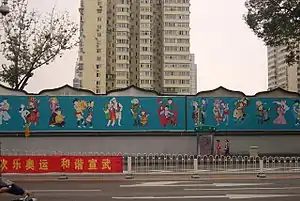
This is a list of ethnic groups in China that are not officially recognized by the government of the People's Republic of China.
- Äynu (艾努人 Àinǔrén)
- Altaians (Oirots) are classified as Mongols[8]
- Fuyu Kyrgyz are classified as Kyrgyz
- Gejia (
 家人 Gèjiārén)
 - Bajia (八甲人 Bājiǎrén)
- Deng (僜人 Dèngrén)
- Hu (户人 Hùrén)
- Khmu (克木人 Kèmùrén)
- Kucong (Yellow Lahu / Lahu Shi; 苦聪人 / 苦聰人 Kǔcōngrén)
- Mang (芒人 Mángrén)
- Ili Turks (土尔克人 / 土爾克人)
- Sherpas (夏尔巴人 / 夏爾巴人 Xià'ěrbārén)
- Tankas (疍家人 / 蜑家人 Dànjiārén) including Fuzhou Tanka
- Tebbu (迭部人 Diébùrén)
- Tuvans (图瓦人 Túwǎrén) are considered part of the Mongol ethnicity[9]
- Waxiang (瓦乡人 Wǎxiāng rén)
- Jews (犹太人 / 猶太人 Yóutàirén) (Jewish people of China and Jews in general)
- Macanese (土生葡人 Tǔshēng púrén), mixed race Catholic Portuguese speakers who lived in Macau since 16th century of various ethnic origins
- Utsuls (回辉人 Huíhuīrén), descendants of Cham Muslims who fled Vietnamese invasions of Champa
- Han subgroups such as Hakka, Hoklo, Hainanese, Gaoshan Han, Hui'an and Tunbaos.
During the Fifth National Population Census of the People's Republic of China (2000), 734,438 persons in the Chinese mainland, 97% of them in Guizhou, were specifically recorded as belonging to "Undistinguished ethnic groups".[10] Presumably, other members of such groups may have been counted within larger "recognized" groups.
Ethnic groups in Hong Kong and Macau
Hong Kong and Macau are special administrative regions of the People's Republic of China. The governments of Hong Kong and Macau do not use the official PRC ethnic classification system, nor does the PRC's official classification system take ethnic groups in Hong Kong and Macau into account. Minority groups such as Europeans (mainly English and Portuguese), and South or Southeast Asians (mainly Filipinos, Indians, Indonesians, Nepalese, and Pakistanis) live in Hong Kong.
See also
- Affirmative action in China
- Demographics of China
- Demographics of Taiwan
- Taiwanese people
- Ethnic minorities in China
- Han Chinese subgroups
- Hua–Yi distinction
- Languages of China
- List of endangered languages in China
- Tai–Kadai ethnic groups in China
- Taiwanese aborigines
- Unrecognized ethnic groups in China
- Zhonghua minzu
References
- "Han Chinese proportion in China's population drops: census data (2011-04-28)". Xinhua News (English). Archived from the original on 11 July 2016. Retrieved 1 September 2015.
- "index". www.stats.gov.cn.
- http://www.beijingrelocation.com/blog/expats-in-china-nationalities-and-in-which-cities-they-settle/
- 胡鸿保; 张丽梅 (2009). 民族识别原则的变化与民族人口. Southwest University for Nationalities University Press (4).
- GB 3304-91 Names of nationalities of China in romanization with codes Archived 2009-11-01 at the Wayback Machine.
- First National Population Census of the People's Republic of China
- Second National Population Census of the People's Republic of China
- Olson, James S. (1998). "Altai". An Ethnohistorical Dictionary of China. Westport, Conn: Greenwood Press. pp. 9–11. ISBN 0-313-28853-4.
- Mongush, M. V. (1996). "Tuvans of Mongolia and China". International Journal of Central Asian Studies (1): 225–243.
- 第五次人口普查数据(2000年). 表1—6. 省、自治区、直辖市分性别、民族的人口 ( Fifth National Population Census of the People's Republic of China (2000). Table 1-6: Population of provinces, autonomous regions, and municipalities by ethnicity). (in Chinese)
Further reading
- Olson, James S. (1998). An Ethnohistorical Dictionary of China. Westport, Conn: Greenwood Press. ISBN 0-313-28853-4.
- Schwars, Henry G. (1984). The Minorities of Northern China: A Survey.
External links
 |
Wikimedia Commons has media related to Ethnic groups in China. |
- "Chinese ethnic odyssey" - collection of articles from the People's Daily
- Family album of Chinese 56 ethnic groups
- nytimes.com
- Map share of ethnic by county of China
- Map share of dominate ethnic by county of China
| Sino-Tibetan |
| ||||||||||
|---|---|---|---|---|---|---|---|---|---|---|---|
| Austroasiatic | |||||||||||
| Austronesian | |||||||||||
| Hmong-Mien | |||||||||||
| Mongolic | |||||||||||
| Tai-Kadai | |||||||||||
| Tungusic | |||||||||||
| Turkic | |||||||||||
| Indo-European | |||||||||||
| Others | |||||||||||
| Unrecognized | |||||||||||


| Countries and regions | .svg.png.webp) | |
|---|---|---|
| Ethnic groups | ||
| Culture |
| |
| Environment | ||
| Economy and Politics | ||
| History |
| |
| Sports | ||
| Education | ||
| Military | ||
| Science and technology |
| |
| |||||||||||||||
| |||||||||||||||
| |||||||||||||||
| |||||||||||||||


Authority control  | |
|---|---|
| National libraries | |
| Other | |