Mongolic peoples
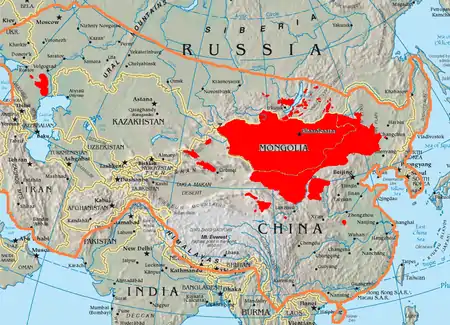
The Mongolic peoples are a collection of East Asian and some other areas ethnic groups, who speak Mongolic languages. Their ancestors are referred to as Proto-Mongols. The largest contemporary Mongolic ethnic group is the Mongols.[1][2]
 |
Wikimedia Commons has media related to Mongolic peoples. |
List of ethnic groups
Contemporary ethnic groups
In addition, Mongolized Soyots live in Buryatia. Their population is 3600 people. A number of orientalists (Nanzatov, Baldaev and others) traditionally consider modern Soyots as a sub-ethnos within the Buryat people.[3][4]
General characteristic
Languages
Languages of the Mongolic peoples belong to the Mongolic language family.[5]
The Mongolic ethnicities possibly related to the Turkic and Tungusic peoples whom languages together would include into the hypothetical Altaic language family.[6]
Religions
The Mongolic peoples are predominantly followers of Tibetan Buddhism. In 1576 the Gelug Tibetan school which was founded by the half-Mongol Je Tsongkhapa became the state religion of the Mongolia. Some groups such as Dongxiangs and Bonan people adopted Sunni Islam, as did Moghols in Afghanistan and Mughals in India. Among a part of the population, the ethnic religion, namely Tengrism (Mongolian shamanism) is preserved. A small number of Christians emerged under the influence of the Russian Church and Western missionaries.
Notes
- Such subgroups of the Mongols as the Buryats and the Kalmyks are recognized in Russia as distinct ethnolinguistic groups (see 2010 Census and other).
References
Footnotes
- Zhukovskaia 2007, p. 354.
- Nimaev 2011.
- Нанзатов Б. З. (2003). "Племенной состав бурят в XIX веке" (in Russian) (Народы и культуры Сибири. Взаимодействие как фактор формирования и модернизации ed.): 15–27. Cite journal requires
|journal=(help)CS1 maint: date and year (link) - Балдаев С. П. (1970). Родословные легенды и предания бурят. Ч. 1. Улан-Удэ. p. 166.
- Janhunen 2003.
- Starostin, George (2016-04-05). "Altaic Languages". Oxford Research Encyclopedia of Linguistics. Oxford University Press. doi:10.1093/acrefore/9780199384655.013.35.
Bibliograohy
- Janhunen, Juha, ed. (2003). The Mongolic languages. Routledge Language Family Series. London; New York: Routledge. ISBN 978-0-7007-1133-8.
- Nimaev, Daba (2011). Монгольские народы: Этническая история и современные этнокультурные процессы [The Mongolic Peoples: Ethnic History and Contemporary Ethnocultural Processes] (in Russian). Lambert Academic Publishing. ISBN 978-3843324403.
- Zhukovskaia, Natalia L. (2007) [1998]. "Монгольские народы" [Mongolic peoples]. In L.M. Mints (ed.). Народы мира: Энциклопедия [Peoples of the World: an Encyclopedia] (in Russian). Moscow: OLMA Media Group. pp. 354–356. ISBN 978-5-373-01057-3.