Choeropotamidae
Choeropotamidae, also known as aplobunodontids (Haplobunodontidae), are a family of extinct mammals, extinct herbivores, belonging to artiodactyls.[1] [2] They lived between the lower/middle Eocene and lower Oligocene (about 48 - 30 million years ago) and their remains were found in Europe and Africa.
| Choeropotamidae Temporal range: | |
|---|---|
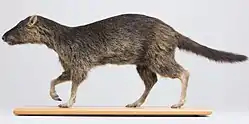 | |
| Model of Amphirhagatherium | |
Scientific classification  | |
| Kingdom: | Animalia |
| Phylum: | Chordata |
| Class: | Mammalia |
| Order: | Artiodactyla |
| Family: | †Choeropotamidae Owen, 1845 |
Description
Choeropotamidae had the classic archaic appearance of primitive artiodactyls, with an unspecialized body and relatively small size. However, since the middle Eocene, cheropotamides began to develop some characteristics that will be found, more accentuated, in the suiforms: bunodonti molars (low and wide crown) and short legs. Partially complete fossils with shapes such as Amphirhagatherium indicate that these animals still had a relatively elongated tail, slender legs shorter than those of other archaic artiodactyls, an elongated and flexible body, and a long snout. The length of these animals would not exceed 1 meter, and the weight was around 5 to 10 kilograms.
Classification
Choeropotamides are mainly known in numerous European Eocene deposits, and only a few fossils of dubious identity have been found in Egypt and Turkey. Choeropotamides are clearly derived from primitive forms of artiodactyls such as Diacodexis, and yet they already show some specializations that recall the suiforms, although they are not their direct ancestors. Among the various generas belonging to this family are Haplobunodon, Masillabune, Choeropotamus, Tapirulus, Amphirhagatherium and Rhagatherium.