Circuit de Barcelona-Catalunya
The Circuit de Barcelona-Catalunya (Catalan pronunciation: [siɾˈkujd də bəɾsəˈlonə kətəˈluɲə]) is a motorsport race track in Montmeló, Catalonia, Spain. With long straights and a variety of corners, the Circuit de Barcelona-Catalunya is seen as an all-rounder circuit. The track has stands with a capacity of 140,700.[1] The circuit has FIA Grade 1 license.
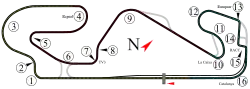 Configuration for FIA sanctioned events
| |
| Location | Montmeló, Catalonia, Spain |
|---|---|
| Time zone | UTC+01:00 |
| Coordinates | 41°34′12″N 2°15′40″E |
| Capacity | 140,700 |
| FIA Grade | 1 |
| Opened | 1991 |
| Major events | Formula One Spanish Grand Prix (1991–present) MotoGP Catalan motorcycle Grand Prix (1996–present) ELMS 4 Hours of Barcelona (2019, 2021) FIM Superbike World Championship (2020–present) World RX of Spain (2015–present) GT World Challenge Europe Endurance Cup (2017-present) 1992 Summer Olympics |
| Grand Prix Circuit (2021) | |
| Length | 4.675 km (2.905 mi) |
| Turns | 16 |
| Race lap record | 1:18.149 ( Max Verstappen, Red Bull Racing, 2021) Max Verstappen, Red Bull Racing, 2021) |
| Motorcycle Circuit (2021) | |
| Length | 4.657 km (2.894 mi) |
| Turns | 16 |
| Race lap record | 1:39.939 ( Johann Zarco, Pramac Racing, 2021) Johann Zarco, Pramac Racing, 2021) |
| Grand Prix Circuit (2007–2020) & Motorcycle Circuit (2016–2017) | |
| Length | 4.655 km (2.892 mi) |
| Turns | 16 |
| Race lap record | 1:18.183 ( Valtteri Bottas, Mercedes, 2020) Valtteri Bottas, Mercedes, 2020) |
| Motorcycle Circuit (2018–2020) & Grand Prix Circuit (2004–2006) | |
| Length | 4.627 km (2.875 mi) |
| Race lap record | 1:15.641 ( Giancarlo Fisichella, Renault, 2005) Giancarlo Fisichella, Renault, 2005) |
| Motorcycle Circuit (1995–2016) & Grand Prix Circuit (1995–2003) | |
| Length | 4.730 km (2.939 mi) |
| Race lap record | 1:20.143 ( Rubens Barrichello, Ferrari, 2003) Rubens Barrichello, Ferrari, 2003) |
| Original Layout with Nissan Chicane (1994) | |
| Length | 4.745 km (2.948 mi) |
| Race lap record | 1:25.155 ( Michael Schumacher, Benetton, 1994) Michael Schumacher, Benetton, 1994) |
| Original Layout (1991–1993) | |
| Length | 4.747 km (2.950 mi) |
| Race lap record | 1:20.989 ( Michael Schumacher, Benetton, 1993) |
| Website | www |
Until 2013 the track was known only as the Circuit de Catalunya, before a sponsorship deal with Barcelona City Council added Barcelona to the track's title.[2]
History
.jpg.webp)
The Circuit de Barcelona-Catalunya was built in 1991 and began hosting the Spanish Grand Prix that same year. Construction also coincided with the Olympic Games scheduled to take place in Barcelona[3] the next year, where the circuit acted as the start and finish line for the road team time trial cycling event.[4] The Circuit de Barcelona-Catalunya should not be confused with the Montjuïc circuit, which hosted the Spanish Grand Prix four times between 1969 and 1975 and, unlike the Circuit de Barcelona-Catalunya, is actually located within the city of Barcelona.
Because so much testing is done at this circuit, Formula One drivers and mechanics are extremely familiar with it. This has led to criticism that drivers and mechanics are too familiar with Catalunya, reducing the amount of on-track action.
When first used, overtaking was frequent as cars could follow closely through the last two corners and slipstream down the long straight. As aerodynamic balance became more critical, this overtaking method drastically decreased as the cars were unable to follow each other through the fast final corner due to turbulence created by the leading car.[3] The 2007 season saw the first of the two final sweepers replaced with a slow chicane in an effort to improve overtaking. The chicane has been criticised for failing at this goal and causing congestion during qualifying sessions.[5] The chicane reduces speeds through the final corner, where serious accidents could occur.[6]
The Circuit de Barcelona-Catalunya has hosted a motorcycle Grand Prix since 1992, originally the European motorcycle Grand Prix from 1992 and later the Catalan motorcycle Grand Prix since 1996. There are at least five points on the track (turns 1, 2, 4, 10, 14) where riders are known to overtake. As in Formula 1, Turn 1 is arguably the most popular place for overtaking. The circuit is not known to produce copious amounts of overtaking, despite the long straights. Originally, the Formula 1 circuit changes were not instituted for MotoGP; however, after a fatal crash in the 2016 MotoGP round involving a Moto2 rider, Luis Salom, the Formula 1 layout was implemented to slow down riders for safety purposes. The FIM made a further change to the chicane for 2017 by moving up the chicane to prevent riders from cutting the pit lane entrance, but that was abandoned because the motorcycle chicane had a surface change that created more safety issues with the transition. Further changes were made to the circuit in December 2017 as grandstands were removed to add additional runoff that allowed the FIM to eliminate that chicane (although the Turn 10 hairpin was kept).
The track was resurfaced in 2018 as a result of calls by MotoGP riders to improve the amount of grip on the surface. Previously the track had been resurfaced in 2004.
The circuit hosted many other international racing series, including the FIA Sportscar Championship (1999–2002), European Touring Car Championship (2003), FIA GT Championship (2003), Deutsche Tourenwagen Masters (2006–2011), European Le Mans Series (2008–2009, 2019, 2021-present), and World Series by Renault (2002–2004, 2006–2011), GT World Challenge Europe Endurance Cup (2017-present), 24h de Barcelona Trofeu Fermí Vélez. FIA World Rallycross Championship currently visits Catalunya since 2015.
Since 2016, the racetrack hosts the 24h BiCircuit Festival, an ultra-distance cycling event featuring 24-hour, 12-hour and 6-hour races for soloists and relay teams up to 8 riders.[7][8]
For the 2020 Formula One season Liberty Media expected the calendar would consist of twenty-one Grands Prix and that any new races would come at the expense of existing events, in particular the Dutch Grand Prix in Zandvoort replacing the Spanish Grand Prix on Circuit de Barcelona,[9] but later negotiated an agreement with the teams to allow up to twenty-two Grands Prix, salvaging the Spanish Grand Prix.
Barcelona has the 3-star FIA Environmental Accreditation and the ISO 14001 certification. In a 2021 report, it was ranked the second most sustainable racetrack in the world, together with Circuit Paul Ricard and behind Mugello Circuit.[10]
Layout
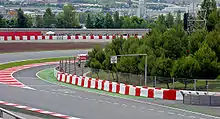
The track is demanding of a car's aerodynamic qualities.[11] The wind direction at the circuit can change drastically during the day, a significant factor given the importance[12][13] of aerodynamics to modern Formula One cars. It is then hard to find a good setup since cars can have massive aerodynamic drag and understeer on one part of the circuit in the morning, but suffer oversteer at the same part of the circuit in the afternoon. A given tyre compound can work well when tested, but not so well a couple of months later. These changeable conditions can make for unexpected performances from some teams during the race. The changeable wind conditions have also caused accidents at the circuit, with Fernando Alonso's testing accident in 2015 partly blamed on the severity of the wind.
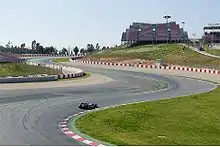
Through 2015, the MotoGP layout used the 1995-2003 version of the Grand Prix circuit. This was originally the same layout as Formula One, but in 2004 a new, slower La Caixa turn was built; the motorcycles continued to use the old version, and they also ignored the shorter Europcar turn and RACC chicane. The F1 layout was implemented for MotoGP originally in 2016 following the fatal accident of Luis Salom in Europcar corner on 3 June 2016. Race control switched to the F1 circuit for qualifying and the race on 5 June 2016. On 15 December 2016, the FIM announced the change was permanent by announcing plans for a chicane ahead of the current car chicane. However, during the 2017 race, the new chicane was deemed dangerous by riders because of a surface change, and the car chicane was used during that event. After changes to the track in the off-season including removing grandstands in Turn 12, creating additional runoff and a complete repaving of the circuit, the F1 layout from 2004-06, including the new La Caixa hairpin instead of the long sweeper, was used, eliminating the chicane.
For 2021, the La Caixa hairpin was remodelled again, slower than the original one but faster than the F1 one. The alterations were done to improve safety for the drivers.[14]
The World RX of Spain uses parts of the track near turns 11–15, with two additional gravel sections.
A lap in a Formula One car
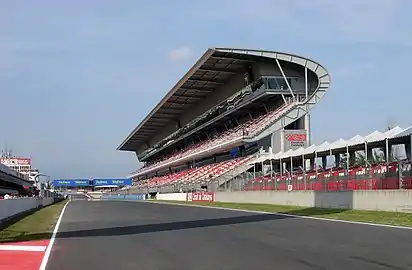
Turn 1 is the main overtaking point at Catalunya, as it is a braking zone at the end of a long DRS straight. The inside and outside are equally difficult for overtaking; drivers who can hold the line around the outside of turn one, can get the inside line for turn two. The corners themselves make up a medium-speed chicane – drivers brake rather late for turn one (Elf)[15] and shift down to gear two, and turn two is almost full throttle as they try to gain as much exit speed as possible. Turn 3 (Renault)[15] is a long, flat-out (in most cars) right-hander that has a g-force of about four,[15] and it leads to a short straight before turn 4, the Repsol[15] curve. Another right-hander, turn four is similar to Monza's Curva Parabolica – drivers brake and take an early apex (in third gear), carrying great speed out of the exit. Turn 5 (Seat)[15] comes immediately after and is a slow left-hander taken in second gear which drops rapidly downhill towards the left kink of turn 6 which is ignored by F1 cars. Turns 7 and 8 make up a medium-speed, uphill, left-right chicane. Drivers brake and shift down to gear three, and must not run too wide as turn eight has a large kerb on its apex which could potentially damage cars' suspensions. Turn 9, Campsa Corner, is a very fast, sixth-gear right-hander which is made incredibly difficult by being completely blind (drivers cannot see the apex on approach). It is initially quite steep uphill but the exit is then downhill, so it is quite easy to run wide onto the astroturf.[15] The long back straight leads into turn 10 (La Caixa), a second-gear, left-hand corner, then turns 11 and 12, a left kink before a long, slow, third-gear right. The next section has been redesigned by German engineer Hermann Tilke to lower speeds onto the 1,047 m (1,145 yd) pit straight – which in turn increases overtaking opportunities and safety.[16] Turn 13 is a tight, third-gear right-hander and drivers have to cross the track quickly to take the racing line through the slow left-right chicane of turns 14 and 15, taken in second gear. Good traction is needed here as it determines speed down the pit straight.[15] Turn 16 (New Holland)[15] is a flat-out right-hander which takes cars across the start/finish line.
Racing history
The circuit has been the site of some memorable moments. In 1991, Ayrton Senna and Nigel Mansell went down the entire front straight side-by-side while dueling for second place, with Mansell eventually taking the position and ultimately the race itself.[3] In 1994, Michael Schumacher managed to finish in second place despite driving over half the race with only fifth gear. In 1996, Schumacher took his first win as a Ferrari driver, after a dominant performance during a torrential rainstorm. In 2001, Mika Häkkinen suffered a clutch failure while leading the race on the last lap, handing the win to Schumacher. At the 2006 event, Fernando Alonso became the first Spanish Formula One driver to win at his home country's track.[3]
In 2008, Heikki Kovalainen left the track at 240 km/h (149 mph) after a wheel rim failure at turn 9. He managed to decelerate to 130 km/h (81 mph) when he hit the tyre barrier. He was temporarily unconscious and suffered a minor concussion,[17] but a few minutes later, spectators were relieved when he gave a thumbs up.
The circuit has been the scene of two debut wins in Formula One. Pastor Maldonado took his first and only Grand Prix victory here in 2012, and in 2016 Max Verstappen won his first Grand Prix. As a result, he became the youngest driver to ever win an F1 Grand Prix race.
At the 2009 motorcycle Grand Prix, teammates Valentino Rossi and Jorge Lorenzo fought all race long for first place, culminating in an overtake on the final corner by Rossi. Riders and pundits described the race as "historic" and "genius".[18]
On 3 June 2016, during Moto2 Free Practice for the 2016 Catalan motorcycle Grand Prix, Luis Salom crashed in turn 12, resulting in the session being red-flagged. After being transferred to the local Hospital General de Catalunya, Salom died of the injuries sustained in the crash. Upon hearing this, FIM decided to change the current layout of the track to the same layout as the one used in Formula One. After off-season discussions, the FIM announced that the track layout would be slightly modified in that the chicane would be moved up a few metres.
Layout history
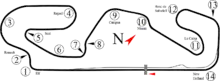 Original Grand Prix Circuit (1991–1994)
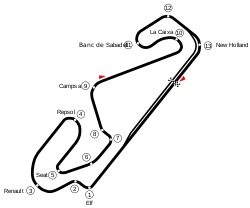 Grand Prix Circuit (1995–2003)
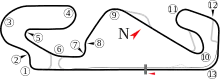 Motorcycle Circuit (1995–2016)
.svg.png.webp) Grand Prix Circuit (2004–2006)
Grand Prix Circuit (2004–2006)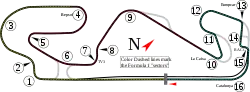 Grand Prix Circuit (2007–2020) & Motorcycle Circuit (2016–2017)
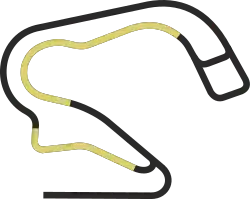 World RX Layout (2015-present)
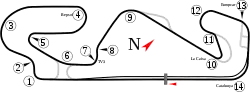 Motorcycle Circuit (2018–2020)
- Grand Prix Circuit (2021)
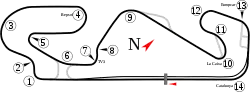 Motorcycle Circuit (2021)
Lap records
The official lap record for the current Grand Prix circuit layout is 1:18.149, set by Max Verstappen driving for Red Bull Racing in the 2021 Spanish Grand Prix. The official race lap records at the Circuit de Barcelona-Catalunya are listed as:
Financial problems
The public attendance at the Spanish Grand Prix, and at the Catalan motorcycle Grand Prix, have fallen significantly since 2007, which has complicated the economic solvency of this circuit.[44][45][46][47]
At least since 2009, the circuit is economically deficient, and in the period 2009–2018, €50.5m of losses were generated. The economic survival of the Circuit is only guaranteed by large volumes of public money, which both the Provincial Deputation of Barcelona and the Generalitat de Catalunya provide in the form of grants and rinsing of losses.[48][49][50][51]
Given these poor results, even some senior officials of the Generalitat de Catalunya have sometimes considered eliminating Formula One in this Circuit. Due to the irregularities detected in the last audit, the City Council of Barcelona decided to cancel the economic grant that the circuit received until now, which has aggravated its economy.[52] Recently, some more irregularities have been detected, even by the Generalitat de Catalunya.[53]
Noise pollution
The Circuit is located in an elevated area with respect to its environment, and without protective measures to minimize the noise pollution produced by cars, motorbikes and other vehicles. Therefore, it is an important source of acoustic disturbances, because the noise produced during many days during the year is noticeable in many kilometers around, especially in the adjacent municipalities, which is recognized by the Generalitat itself, the main owner of the Circuit.[54]
References
- "Stadiums in Spain - Catalonia". Archived from the original on 15 March 2010. Retrieved 28 November 2009.
- "Circuit de Catalunya includes Barcelona in its name". Circuit de Barcelona-Catalunya. 2 September 2013. Archived from the original on 7 September 2013. Retrieved 4 September 2013.
- Furnell, Claire (November 2009). "Circuit de Catalunya". en.espnf1.com. ESPN EMEA Ltd. Retrieved 13 August 2010.
- 1992 Summer Olympics official report. Volume 2. pp. 305–7.
- Boxall-Legge, Jake (10 May 2021). "The changes Barcelona needs to provide a modern-day F1 spectacle". Autosport. Retrieved 10 May 2021.
- Smith, Damian (11 August 2020). "How the Circuit de Barcelona-Catalunya brought F1 to life in Spain". Motor Sport magazine. Retrieved 12 May 2021.
- BiCircuit Festival at the Circuit de Barcelona-Catalunya official website
- 24h BiCircuit Festival official website
- Collantine, Keith (9 May 2019). "Sainz fears it's "too late" to save Spanish GP for 2020". Racefans.net. Retrieved 29 February 2020.
- Racing towards a sustainable future - A Review of the sustainability performance of international racing circuits - Enovation Consulting Ltd and Right Hub Srl, June 2021
- "Spanish Grand Prix: All you need to know after Lewis Hamilton takes pole". BBC Sport. 12 May 2018. Retrieved 13 May 2018.
- "Aerodynamics". Formula One World Championship Limited. Retrieved 27 June 2016.
Ask any engineer in the pit lane and they'll tell you that the most important consideration in F1 car design [...] is aerodynamics.
- "Aerodynamics in racing". f1technical.net. 14 May 2009. Retrieved 27 June 2016.
Nowadays, aerodynamics is the utmost important factor in Formula One car performance.
- "Circuit de Barcelona-Catalunya complete remodelling of Turn 10". formula1.com. 1 February 2021. Retrieved 1 February 2021.
- "Catalunya track guide". F1 Fanatic. Archived from the original on 24 September 2015. Retrieved 23 December 2012.
- "How Hermann Tilke conquered the F1 calendar". F1 Fanatic. Retrieved 23 December 2012.
- Andrew Baker; Charlie Caroe (28 April 2008). "Heikki Kovalainen: I don't remember accident". telegraph.co.uk. Telegraph Media Group Limited. Retrieved 13 August 2010.
- "Catalunya 2009 Motogp 'Rossi teaches Lorenzo a lesson!'".
- "2021 4 Hours of Barcelona Classification" (PDF). Retrieved 18 April 2021.
- "2021 Euroformula Open Championship Catalunya Session Facts". Retrieved 24 October 2021.
- "2021 Michelin Le Mans Cup Barcelona Round Final Classification" (PDF). Retrieved 18 May 2021.
- "2021 FREC Catalunya Results Race 2". Retrieved 19 September 2021.
- "2021 International GT Open Barcelona Race 2 Results" (PDF). Retrieved 24 October 2021.
- "2021 F4 Spain Barcelona Carrera 3 (25' +1 Lap) Final Classification" (PDF). Retrieved 16 November 2021.
- "2021 GT4 European Series Race 2 Barcelona" (PDF). Retrieved 11 October 2021.
- "2021 TCR Spain Barcelona Carrera 3 (20' +1 Lap) Final Classification" (PDF). Retrieved 16 November 2021.
- "World SBK Hyundai N Catalunya Round, 17-19 September 2021 Results Tissot Superpole Race" (PDF). Retrieved 19 September 2021.
- "World SSP Hyundai N Catalunya Round, 17-19 September 2021 Results Race 2" (PDF). Retrieved 19 September 2021.
- "Supersport 300 Hyundai N Catalunya Round, 17-19 September 2021 Results Race 2" (PDF). Retrieved 19 September 2021.
- "2013 Formula Renault 3.5 Catalunya Session Facts". Retrieved 16 March 2021.
- "Catalunya 1000 Kilometres 2008". Retrieved 9 May 2021.
- "2018 GP3 Series Catalunya Session Facts". Retrieved 14 March 2021.
- "2019 4 Hours of Barcelona Classification By Class" (PDF). Retrieved 13 March 2021.
- "2019 Michelin Le Mans Cup Barcelona Round Final Classification" (PDF). Retrieved 18 May 2021.
- "2018 Formula Renault 2.0 Euro Catalunya Session Facts". Retrieved 14 March 2021.
- "TCR Europe Circuit de Barcelona-Catalunya". Retrieved 9 May 2021.
- "2009 Deutsche Tourenwagen Masters Catalunya Session Facts". Retrieved 9 May 2021.
- "2006 GP2 Series Catalunya Session Facts". Retrieved 14 March 2021.
- "2004 F3000 International Championship Barcelona Session Facts". Retrieved 9 May 2021.
- "2020 Superbike World Championship Barcelona-Catalunya Session Facts". Retrieved 14 March 2021.
- "World SSP Acerbis Catalunya Round, 18 - 20 September 2020 Results Race 1" (PDF). Retrieved 18 April 2021.
- "Supersport 300 Acerbis Catalunya Round, 18 - 20 September 2020 Results Race 2" (PDF). Retrieved 19 September 2021.
- "2002 F3000 International Championship Barcelona Session Facts". Retrieved 9 May 2021.
- "ANÁLISIS: La asistencia al GP de España desde su llegada a Montmeló en 1991". THEBESTF1.Es. Retrieved 14 January 2020.
- "La asistencia al Circuit de Montmeló sigue bajando con 87.511 espectadores en carrera". europapress/deportes/fórmula 1. Retrieved 14 January 2019.
- "Evolución de los asistentes al GP de Catalunya de Moto GP en Montmeló". LA VANGUARDIA. Retrieved 14 January 2020.
- De Arístegui, Diego. "Baja asistencia al GP de Catalunya: ¿cuáles son los motivos?". Auto.Bild-Es. Retrieved 14 January 2019.
- [Baja asistencia al GP de Catalunya: ¿cuáles son los motivos? "Pressupostos-2019"] Check
|url=value (help). Diputació de Barcelona. Retrieved 14 January 2019. - "PRESSUPOSTOS DE LA GENERALITAT DE CATALUNYA PER A L'ANY 2017" (PDF). Generalitat de Catalunya. Retrieved 14 January 2019.
- "Las subvenciones públicas de 2018 que no pudieron salvar Circuits de Cataluña". Crónica global-El español. Retrieved 14 January 2020.
- "El circuito de Montmeló pierde otros diez millones". ED-Economía Digital. Retrieved 14 January 2020.
- "Una auditoría halla medio millón en retribuciones irregulares en el Circuito de Montmeló". EL MUNDO. Retrieved 14 January 2020.
- Corderp, Dani (9 January 2020). "La Generalitat halla múltiples irregularidades en la gestión del circuito de Cataluña". EL PAÍS-Cataluña.
- "Pla director urbanístic" (PDF). Generalitat de Catalunya-Departament de Territori i Sostenibilitat. Retrieved 14 January 2020.
External links
 |
Wikimedia Commons has media related to Circuit de Catalunya. |
- Official website
- Circuit de Catalunya at Official Formula 1 website
- Circuit de Barcelona-Catalunya on Google Maps (Current Formula 1 Tracks)

_pictogram.svg.png.webp)

