Yunjian
Cloud collar, also known as yunjian (simplified Chinese: 云肩; traditional Chinese: 雲肩; pinyin: Yúnjiān) which is lit. translated as "cloud shoulder",[1][2] is a Chinese term which can refer to: (1) a 4-lobed pattern and more rarely for an 8-lobed pattern,[3] and (2) to a traditional Chinese shoulder adornment,[4][3] which is typically found in 4-lobed design although multi-lobed design also existed.[5]
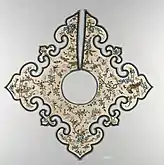
The cloud collar is typically a detachable collar with cloud patterns;[6] however, it could also be used as a clothing motif which would fell around the collar of the robes onto the chest and shoulder region,[1] or as a clothing appliqué.[4] In China, the cloud collar has both ceremonial and practical uses when used in clothing.[4] The cloud collar also started to be worn by the Non-Chinese, the Tartars of northern China and Manchuria in the later medieval period.[3] The cloud collar was an important clothing element for Chinese women, especially in the Ming and Qing dynasties.[7]
The use of cloud collar was spread across China where it became associated with the Han Chinese's wedding clothing.[4] In Henan, brides would wear cloud collars decorated with hanging ribbons and bells.[4] It also had the practical use of preventing clothing from being dirty and oily by covering up the clothes and by covering up the stains.[4] The multi-layered cloud collar worn by Chinese brides on the day of their wedding is sometimes known as "phoenix collar".[8][9]
The cloud collar motif was also used in Chinese ceramic work around the necks of vases and jars;[3] mainly in the ceramics of the Yuan, Ming, and Qing dynasty period.[6]
Symbolism
The cloud collar motif was originally used as a cosmic symbol in China.[3]
When used on clothing, the cloud shape is a symbolism which represent abundance while the neck opening is a symbolism for the "Sky gate" (i.e. the entrance to heaven).[10] The lobes which point in 4-directions (typically) represents the universe.[10]
In the Song dynasty, the human body was perceived as the "axis column of the universe" and was considered an extension from the earth to the sky since the post-Han dynasty period while a robe was considered as the "enveloping canopy of the Universe" which is the sky.[3] The hole around at the neck of the sky-resembling robe may be been perceived as a symbolism of the "Sky gate" through which the axis column (i.e. the human body) is believed to penetrate through the "Sky gate".[3]
In Qing dynasty, this cosmological concept was maintained and could be seen in the cloud-studded upper part of the clothing, especially on the dragon robes.[3] On the dragon robes, the cloud collar represented the sky which was supported on the world; the world was represented by the motifs of mountains and seas which were decorating the base of the dragon robe.[3]
In the recent centuries, the cloud collar motif has been mainly perceived as a purely decorative motif.[3] In the late Ming and Qing dynasties, the cosmological was largely forgotten as the people became more materialistic, and by then, the cloud collar motif became mainly an ornamental design.[3]
When the lobes of the cloud collar were no longer perceived as representing the 4-directions, the number of lobes started to vary.[3] The number of lobes were sometimes 3, 5, 6, 8 instead of the traditional use of the 4-lobes.[3]
Terminology
The cloud collar is named after the shape of the collar's lobes,[10] which looks like a 'quadruple-cloud' in design when laid flat.[11]
History
.jpg.webp)
The origins of the cloud collar appears to have been derived from multiple origins.[12]
The earliest forms of the cloud collar motif appeared on the Chinese bronze mirrors found at the end of the Zhou dynasty (c. 4th and 3rd centuries BC).[3] However, the Zhou dynasty cloud collar motif was not fully evolved; it was only during the Eastern Han dynasty (c. 1st century AD) that the cloud collar motif evolved fully.[3] The cloud collar motif may have been derived from the cosmological decoration on the backs of mirrors dating from the Han dynasty.[12]
In the Medieval periods, the cloud collar motif appears to have been derived from the eight-petal lotus and the Buddhist Mandala.[12]
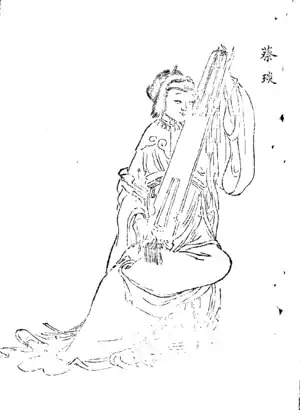
The cloud collar motif appears to have later been adapted to develop the actual collar.[3]
The cloud collar was developed in the Sui dynasty from a feather coat.[6] Other sources indicate however that it first appeared in the Tang dynasty[13] and was an element of the Chinese court dress since Tang dynasty.[14] The cloud collar appears to have already been known in China as early as the Song dynasty and since then, they have used extensively in their robes patterns.[15]
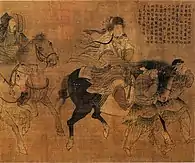
It also had origins in the Jin dynasty;[1] where it is attested that it was first used on robes.[12] The first pictorial evidence of the cloud collar pattern usage on robes is from the Jin dynasty in the painting Lady Wenji Returns to Han while the term "yunjian" (雲肩) was also first document in the Jin shi in the description of the Jin dynasty imperial dress.[16] The imperial dress was described to be yellow imperial robe decorated with dragon motifs which is worn with a cloud collar decorated with the sun and moon.[3]
Mongol period and Yuan dynasty
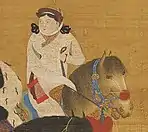
Prior to the conquest of the Song dynasty, the Mongols had already adopted the wearing of cloud collars motifs.[3]
The cloud collar motif was popular in the Yuan dynasty and became a signature motif on both men's and women's clothing and could also be found on both ceramic and metal work.[1][16] In Yuan, the pattern consisted of a 4-lobed cruciform-shaped design and would be found around the robe's collar covering the chest and shoulders areas.[1]
In the Yuan dynasty painting Khubilai Khan Hunting, Empress Chabi is depicted wearing a white robe which is decorated with a cloud-collar motif on her chest and shoulders.[17]
The cloud collar no more appeared on the official robes after the fall of the Yuan dynasty in China proper.[3]
Ming dynasty
.jpg.webp)
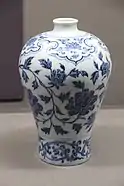
In Ming dynasty, the cloud collar appears to have been popular in both China and Mongolia in this period.[15] The Ming court once sent a cloud collar with the design of gold-brocaded tiger and flower to a Mongolian chieftain.[15] The 4-lobed cloud collar continued to be work around the collars of the Ming dynasty ceremonial robe.[3]
The use of the cloud collar motif on ceramic works appears to more commonly on the Ming dynasty ceramics although this ceramic design could have already been developed during the Yuan dynasty.[3] The cloud collar motif used around the necks of Chinese jars and vases could have been derived from the cloud collar (clothing item) or may have been developed independently from the actual collar as the jars and vases were themselves perceived as a miniature version of the universe.[3]
Qing dynasty
The cloud collar survived into the Qing dynasty period and was used in Chinese women's clothing.[3] It became very popular and it could be found many forms and styles.[7]
In the 17th and 18th century AD, the cloud collar was one of the most common Han Chinese women fashion in China, along with ruqun, taozi (绦子; i.e. a ribbon around the arm), beizi and bijia.[18] The cloud collar could be sometimes be used as a detachable collar or could be found woven into the women's robe.[3] More often however, the cloud collar was found on the women's robe as an appliqué.[3] The practical use and the ceremonial associations of the cloud collar may have contributed to the use of cloud collar appliqué on the ao or shan (i.e. a type of Chinese jackets) in the 19th century.[4]
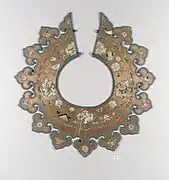 Qing dynasty cloud collar.
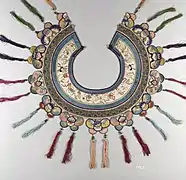 Qing dynasty cloud collar.
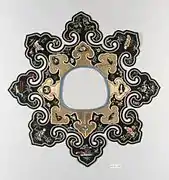 Qing dynasty cloud collar.
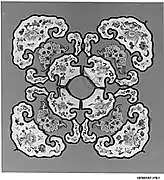 Qing dynasty cloud collar.
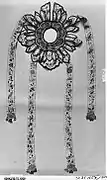 Qing dynasty cloud collar.
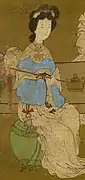 Woman wearing cloud collar in a painting, d. 1700–1825.
%252C_early_19th_century_(CH_18565493).jpg.webp) Woman's Short Coat (China) with a cloud collar appliqué, early 19th century (front view).
Woman's Short Coat (China) with a cloud collar appliqué, early 19th century (front view).%252C_early_19th_century_(CH_18565493-2).jpg.webp) Woman's Short Coat (China) with a cloud collar appliqué, early 19th century (back view).
Woman's Short Coat (China) with a cloud collar appliqué, early 19th century (back view)..jpg.webp) Multi-layered cloud collar (section view).
Multi-layered cloud collar (section view).%252C_19th_century_(CH_18397795).jpg.webp) yunjian in 19th century
yunjian in 19th century
In Qing, the cloud collar became an indispensable item for women's wedding clothing,[7] and by the 19th century, it was an important central element to the Han Chinese women's celebratory clothing.[4] The cloud collar worn by the Han Chinese as ceremonial clothing and for wedding was a detachable collar which was worn on top of the mang ao (i.e. the dragon jacket) and the Qing dynasty xiapei (a type of stole).[5]
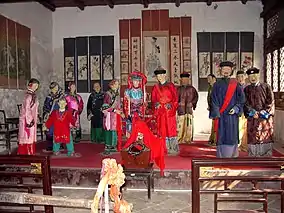
The yunjian was also worn in Chinese opera costumes.[19]
 Picture depicting makeup for characters in the Peking opera, Qing dynasty.
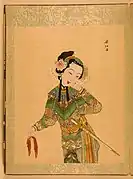 Picture depicting makeup for characters in the Peking opera, Qing dynasty.
 宮衣-Theatrical Robe for the Role of a Princess with a cloud collar motif.
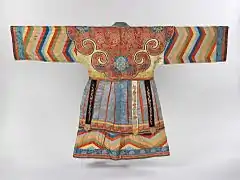 Theatrical Robe with a cloud collar.
Republic of China
The cloud collar continued to appear in the Chinese robes during the Republic of China.
.jpg.webp) Chinese long robe with cloud collar motif.
Chinese long robe with cloud collar motif.
Influences and derivatives
Islamic Cultural sphere
During the Mongol invasion of Eurasia, the Mongols brought new artistic concepts to the Islamic cultural sphere,[21] including Persia, and in Central Asia.[3] It continued to appears in the arts of the Timurid and Safavid period.[3]
In manuscript paintings of the Ilkhanate, the yunjian, which were one of the distinctive Mongol fashion accessories, is depicted.[21]
Drawings of cloud collars were also produced in western Iran during the second half of the 1400s under the patronage of the Turkmen; the drawing traditional was developed through the interactions with the Chinese models.[22]
The Timurid sent items to the Chinese court which was accepted as tributes.[23] The Chinese also sent a cloud-collar made of gold brocade with tiger design, as well as royal robes and garments, to Sharukh.[23]
Japan
The Chinese cloud collar was also introduced in the arts of Japan where it is depicted on the image of the bodhisattva Manjusri.[3]
Mexico
Some Mexican artists borrowed the cloud collar motif which was frequently used on the Chinese vases and adapted it in their own ceramic work.[24][25] This can be seen from a Mexican vase dating from the late 17th-18th century where the Mexican artist expanded the cloud collar motif until it almost covered the entire surface of the vase.[24]
Nestorian art
Some Nestorian arts depict the cloud collar; for example, a Nestorian headstone which was discovered at the site of Xia Shrine (a district once reserve for Muslim and Christian burial) depict an angel dressed in Mongol style wearing a yunjian.[26]
Southeast Asia
In Southeast Asia, the Chinese yunjian appears to have directly influenced the scalloped collars which are one of the most prominent features on Southeast Asian aristocratic ceremonial clothing, and in particular, the court dancers clothing.[14] These Southeast Asian cloud collar, which are also worn around the breasts and collar area, are ornamented with gold and silver, with embroidery, and contained gold leaf glue-work; they are often styled in Indianized forms of jewellery while the gold and silver decorations on the collars (especially found in the Malay Peninsula, Sumatra, and Java) are the results of the Chinese influence and Chinese craftsmanship.[14]
.png.webp)
In Thailand, the Thai royal and theatrical clothing also included a form of cloud collar-like ornament which form peaked at the shoulders.[14]
In Burma, the Burmese officials used to wear court clothing which contained a tiered and peaked cloud collar.[14]
The Indonesian lengkung léhér (i.e. a ceremonial collar) worn by Palembang brides and court dancers, and similar cloud collars worn in the Malay peninsula appears to be a reflection of the historical presence of the Chinese brides in the Malay court.[14]
The Peranakan Chinese brides wear cloud collars,[27] which is sometimes referred as the "phoenix collar",[28] as part of their wedding set of attire.[9][29][30] The phoenix collar is multi-layered and the overlapping layers are movable which represent the feathers of a phoenix.[29][27] The Peranakans are the descendants of the late 15th and 16th century AD Chinese traders who brought their culture to Southeast Asia, including Chinese traditions and clothing.[29] The phoenix is the symbol of the empress and is an auspicious symbol for the Peranakan community.[27] Following the Malay tradition, the couples were allowed to be treated like royalty on the day of their wedding.[27]
The Chinese yunjian was also worn by the Chinese immigrants in Java in 1900s.[14]
References
- Shea, Eiren L. (2020-02-05). Mongol Court Dress, Identity Formation, and Global Exchange. Routledge. pp. 51–52. doi:10.4324/9780429340659. ISBN 978-0-429-34065-9. S2CID 213078710.
- Kadoi, Yuka (2009). Islamic chinoiserie : the art of Mongol Iran. Edinburgh: Edinburgh University Press. p. 32. ISBN 978-0-7486-3583-2. OCLC 608497183.
- Cammann, Schuyler (1951). "The Symbolism of the Cloud Collar Motif". The Art Bulletin. 33 (1): 1–9. doi:10.2307/3047324. JSTOR 3047324.
- Silberstein, Rachel (2020). A fashionable century : textile artistry and commerce in the late Qing. Seattle. pp. 33–35. ISBN 978-0-295-74719-4. OCLC 1121420666.
- Garrett, Valery (2012). Chinese Dress : From the Qing Dynasty to the Present. New York: Tuttle Pub. ISBN 978-1-4629-0694-9. OCLC 794664023.
- Yang, Shaorong (2004). Traditional Chinese clothing : costumes, adornments & culture (1st ed.). San Francisco: Long River Press. p. 41. ISBN 1-59265-019-8. OCLC 52775158.
- Li, Wen-Jiao; Tao, Hui (2017). "Relationship between Cloud Pattern and Female during the Ming and Qing Dynasties". Advances in Social Science, Education and Humanities Research. Atlantis Press. 90: 90–94. doi:10.2991/sschd-17.2017.18. ISBN 978-94-6252-401-9.
- "Chinese Bride's Phoenix Collar". emuseum.aberdeencity.gov.uk. Retrieved 2021-05-17.
- hermes (2019-03-16). "Wedding fit for an empress". The Straits Times. Retrieved 2021-05-17.
- "Collection – Textile Museum of Canada". Retrieved 2021-05-16.
- Zhongguo xie zhen hua. Shanming Guan, 關善明 (Di 1 ban ed.). Xianggang: Mu wen tang mei shu chu ban she you xian gong si. 2003. ISBN 988-97206-2-0. OCLC 56424659.CS1 maint: others (link)
- Shea, Eiren L. (2020). Mongol court dress, identity formation, and global exchange. New York, NY. p. 69. ISBN 978-0-429-34065-9. OCLC 1139920835.
- Hua, Mei (2011). Chinese clothing (Updated ed.). Cambridge, United Kingdom. p. 50. ISBN 978-0-521-18689-6. OCLC 781020660.
- Maxwell, Robyn J. (2003). Textiles of Southeast Asia : tradition, trade, and transformation (Rev. ed.). [Hong Kong]: Periplus. pp. 253–256. ISBN 978-1-4629-0698-7. OCLC 815509769.
- Tō, Sugimura (1986). The Encounter of Persia with China: Research Into Cultural Contacts Based on Fifteenth Century Persian Pictorial Materials. 18–19. National Museum of Ethnology. p. 87.
- Shea, Eiren L. (2020). Mongol court dress, identity formation, and global exchange. New York, NY. p. 79. ISBN 978-0-429-34065-9. OCLC 1139920835.
- Shea, Eiren L. (2020). Mongol court dress, identity formation, and global exchange. New York, NY. p. 88. ISBN 978-0-429-34065-9. OCLC 1139920835.
- Wang, Anita Xiaoming (2018). "The Idealised Lives of Women: Visions of Beauty in Chinese Popular Prints of the Qing Dynasty". Arts Asiatiques. 73: 61–80. doi:10.3406/arasi.2018.1993. ISSN 0004-3958. JSTOR 26585538.
- Bonds, Alexandra B. (2019). Beijing opera costumes : the visual communication of character and culture. New York, NY. ISBN 978-1-138-06942-8. OCLC 1019842143.
- "Classic Chinese Hanfu: Shoulder Accessories - Yunjian". www.newhanfu.com. 2019. Retrieved 2021-05-16.
- A companion to Islamic art and architecture. Finbarr Barry Flood, Gülru Necipoğlu. Hoboken. 2017. p. 637. ISBN 978-1-119-06857-0. OCLC 963439648.CS1 maint: others (link)
- Roxburgh, David J. (2005). The Persian album, 1400-1600 : from dispersal to collection. New Haven: Yale University Press. p. 298. ISBN 0-300-10325-5. OCLC 56517836.
- Roxburgh, David J. (2005). The Persian album, 1400-1600 : from dispersal to collection. New Haven: Yale University Press. p. 340. ISBN 0-300-10325-5. OCLC 56517836.
- Mexico : splendors of thirty centuries. Metropolitan Museum of Art, San Antonio Museum of Art, Los Angeles County Museum of Art. New York: Metropolitan Museum of Art. 1990. p. 471. ISBN 0-87099-595-2. OCLC 21593549.CS1 maint: others (link)
- Kuwayama, George (1997). Chinese ceramics in colonial Mexico. Los Angeles County Museum of Art. Los Angeles: Los Angeles County Museum of Art. p. 84. ISBN 0-87587-179-8. OCLC 37259299.
- Y., Watt, James C. (2010). The world of Khubilai Khan : Chinese art in the Yuan Dynasty. Metropolitan Museum of Art. pp. 174–. ISBN 978-1-58839-402-6. OCLC 696014331.
- "Cloud collar". www.roots.gov.sg. Retrieved 2021-05-17.
- Malaysia, Cultural Associations Group 1 : Baba Chinese community Region: Malacca /. "Cloud or phoenix collar for a bride". Item held by National Gallery of Australia. Retrieved 2021-05-19.
- "Manek-Manek Beads | Helena Tang-Lim The Phoenix Collar - JEWELRY - Gallery". www.manek-manek.com. Retrieved 2021-05-17.
- "Guo Pei: Chinese Art & Couture". www.roots.gov.sg. Retrieved 2021-05-17.
