Collin County, Texas
Collin County is located in the U.S. state of Texas. It is part of the Dallas-Fort Worth-Arlington metropolitan statistical area, and a small portion of the city of Dallas is in the county. At the 2020 United States census, the county's population is 1,064,465, making it the sixth-most populous county in Texas and the 43rd-largest county by population in the United States.[1] Its county seat is McKinney.[2]
Collin County | |
|---|---|
| Collin County | |
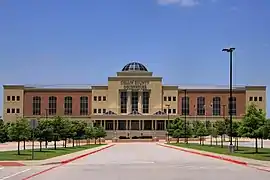 The Collin County Courthouse in McKinney | |
 Flag  Seal | |
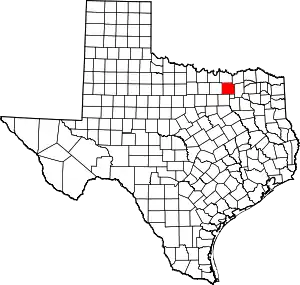 Location within the U.S. state of Texas | |
 Texas's location within the U.S. | |
| Coordinates: 33°11′N 96°35′W | |
| Country |  United States United States |
| State |  Texas Texas |
| Founded | 1846 |
| Named for | Collin McKinney |
| Seat | McKinney |
| Largest city | Plano |
| Area | |
| • Total | 886 sq mi (2,290 km2) |
| • Land | 841 sq mi (2,180 km2) |
| • Water | 45 sq mi (120 km2) 5.1%% |
| Population (2020) | |
| • Total | 1,064,465 |
| • Density | 1,265/sq mi (488/km2) |
| Time zone | UTC−6 (Central) |
| • Summer (DST) | UTC−5 (CDT) |
| Congressional districts | 3rd, 4th, 32nd |
| Website | www |
History
Both the county and the county seat were named after Collin McKinney (1766-1861),[3] one of the five men who drafted the Texas Declaration of Independence and the oldest of the 59 men who signed it.
Geography
According to the U.S. Census Bureau, the county has an area of 886 square miles (2,290 km2), of which 841 square miles (2,180 km2) is land and 45 square miles (120 km2) (5.1%) is covered by water.[4]
Lakes
Major highways


Neighboring counties
- Grayson County (north)
- Fannin County (northeast)
- Hunt County (east)
- Rockwall County (southeast)
- Dallas County (south)
- Denton County (west)
Communities
Cities (multiple counties)
- Carrollton (mostly in Dallas and Denton counties)
- Celina (small part in Denton County)
- Dallas (mostly in Dallas County with small parts in Denton, Kaufman, Rockwall and Collin counties)
- Frisco (partly in Denton County)
- Garland (mostly in Dallas County and a small part in Rockwall County)
- Josephine (small part in Hunt County)
- Plano (small part in Denton County)
- Prosper (partly in Denton County)
- Richardson (mostly in Dallas County)
- Royse City (mostly in Rockwall County and partly Hunt County)
- Sachse (mostly in Dallas County)
- Van Alstyne (mostly in Grayson County)
- Wylie (small parts in Rockwall and Dallas counties)
Cities
- Allen
- Anna
- Blue Ridge
- Celina
- Farmersville
- Lavon
- Lowry Crossing
- Lucas
- McKinney (County Seat)
- Melissa
- Murphy
- Nevada
- Parker
- Princeton
- Weston
Towns
- Fairview
- Hebron (mostly in Denton County)
- New Hope
- St. Paul
Census-designated places
Other unincorporated communities
- Altoga
- Arnold
- Beverly Hill
- Bloomdale
- Branch
- Buckner
- Chambersville
- Chambliss
- Clear Lake
- Climax
- Collin
- Copeville
- Cowley
- Culleoka
- Deep Water Point Estates
- Desert
- Fayburg
- Forest Grove
- Frognot
- Kelly
- Lavon Beach Estates
- Lavon Shores Estates
- Little Ridge
- Marilee
- Milligan
- Millwood
- New Mesquite
- Pebble Beach Sunset Acres
- Pecan Grove
- Pike
- Rhea Mills
- Rockhill
- Roland
- Sedalia
- Snow Hill
- Trinity Park
- Valdasta
- Verona
- Walnut Grove
- Wetsel
- Winningkoff
- Yucote Acres
Ghost towns
Demographics
| Historical population | |||
|---|---|---|---|
| Census | Pop. | %± | |
| 1850 | 1,950 | — | |
| 1860 | 9,264 | 375.1% | |
| 1870 | 14,013 | 51.3% | |
| 1880 | 25,983 | 85.4% | |
| 1890 | 36,736 | 41.4% | |
| 1900 | 50,087 | 36.3% | |
| 1910 | 49,021 | −2.1% | |
| 1920 | 49,609 | 1.2% | |
| 1930 | 46,180 | −6.9% | |
| 1940 | 47,190 | 2.2% | |
| 1950 | 41,692 | −11.7% | |
| 1960 | 41,247 | −1.1% | |
| 1970 | 66,920 | 62.2% | |
| 1980 | 144,576 | 116.0% | |
| 1990 | 264,036 | 82.6% | |
| 2000 | 491,675 | 86.2% | |
| 2010 | 782,341 | 59.1% | |
| 2020 | 1,064,465 | 36.1% | |
| U.S. Decennial Census[5] 1850–2010[6] 2010–2019[7] | |||
In 2000, 491,675 people resided in Collin County.[8] With the economic and population growth of the DFW metroplex, its population increased to 1,064,465 at the 2020 U.S. census.[1] The population density as of 2019 was 1,229.8 people per square mile.[9]
Among the population, its median age was 37.3, up from the statewide median age of 35.1. Linguistically, 11.6% of the county spoke Spanish as their household language, followed by Asian and Pacific Islander languages.[10] Altogether 29.7% of Collin County spoke a language other than English at home, contributed in part by its large foreign-born population which made up 22% of the population.[11]
The median income for a household in the county was $96,134, up from $70,835 in 2000.[12] Families had a median household income of $113,471, married-couple families $127,575, and non-family households $53,986. An estimated 6.3% of Collin County's residents lived at or below the poverty line from 2014 to 2019.[13] In 2000, about 3.30% of families and 4.90% of the population lived at or below the poverty line, including 5.10% of those under age 18 and 7.10% of those aged 65 and older.
Of its residential properties, the median value of an owner-occupied housing unit was $354,100 in 2019, with a total of 8% of owner-occupied housing units ranging from less than $100,000 up to $200,000.[9] In 2007, Collin County was ranked No. 21 for high property taxes in the U.S. as percentage of the homes' value on owner-occupied housing.[14] It also tanked in the top 100 for amount of property taxes paid and for percentage of taxes of income. Part is this is due to the Robin Hood plan school financing system in Texas.[15]
Race and ethnicity
At the 2000 census, the racial and ethnic makeup of the county was 81.39% White, 4.79% Black or African American, 0.47% Native American, 6.92% Asian, 0.05% Pacific Islander, 4.26% from other races, and 2.11% from two or more races; 10.27% of the population were Hispanic or Latino American of any race. In 2019, the American Community Survey estimated its non-Hispanic white population declined to 55%, reflecting a national demographic trend of diversification.[9][16] The Black or African American population grew to 10%, Asian Americans made up 16% of the population, and Hispanic or Latino Americans increased to 16% of the total population in 2019; multiracial Americans made up an estimated 2% of the county population.[9] The largest European ancestry groups from 2014 to 2019 were Germans, English Americans, and Irish and Italian Americans.[11]
Religion
Christianity has historically been the predominant religious affiliation among the county's residents. According to the 2020 Public Religion Research Institute study, non-Christian religions are present and have been growing due to conversions and immigration; among the non-Christian population, 3% were Hindu, 2% Muslim and 2% Jewish.[17]
Government, courts, and politics
Government
Collin County, like all counties in Texas, is governed by a Commissioners Court. The court is chaired by a county judge (equivalent to a county executive in other states) who is elected county-wide, and four commissioners who are elected by the voters in each of four precincts.[18]
County Commissioners
| Office[19] | Name | Party | |
|---|---|---|---|
| County Judge | Chris Hill | Republican | |
| Commissioner, Precinct 1 | Susan Fletcher | Republican | |
| Commissioner, Precinct 2 | Cheryl Williams | Republican | |
| Commissioner, Precinct 3 | Darrell Hale | Republican | |
| Commissioner, Precinct 4 | Duncan Webb | Republican | |
County Officials
| Office[19] | Name | Party | |
|---|---|---|---|
| County Clerk | Stacey Kemp | Republican | |
| Criminal District Attorney | Greg Willis | Republican | |
| District Clerk | Lynne Finley | Republican | |
| Sheriff | Jim Skinner | Republican | |
| Tax Assessor-Collector | Kenneth Maun | Republican | |
Politics
From the 1960s through the early 2000s, Collin County was a Republican stronghold in presidential and congressional elections. The last Democrat to win the county was Lyndon Johnson in 1964. Two factors caused Collin to swing hard to the Republican Party in the 1960s and 1970s: the party realignment brought about by the civil rights movement, and the expansion of the Dallas suburbs into Collin County. No Democrat has represented any part of Collin County in the Texas Legislature since 1994.[20]
However, since the early 2000s, Collin County has been slowly moving towards the Democratic Party, particularly in Plano and Frisco. After giving George W. Bush over 70 percent in his two runs for president, it gave John McCain only 62 percent in 2008. Mitt Romney took 64 percent in 2012, but Donald Trump got only 55.2 percent in 2016. In 2020, Trump's support dwindled further, to 51.2 percent, the worst showing for a Republican in the county since 1968. At the same time, Joe Biden became the first Democrat to win 40 percent of the county's vote since Johnson, and the first non-Texan to do so since John F. Kennedy.
The county is considered a bellwether polity.[21] Factors causing this shift include an influx of Democratic-voting younger professionals and families from states such as California, as well as a more diverse population (with increasing numbers of African-Americans along with recent immigrants and their children). Many other suburban Texas counties, including its immediate neighbors in Denton County and Tarrant County as well as those around Houston and Austin, showed similar swings since 2016.
In spite of this shift, Republicans still control every countywide office and all of the county's seats in the State Legislature. Congressman Colin Allred, who represents its southern edge as part of the 32nd congressional district, is the only elected Democrat representing any part of the county above the municipal level.
| Year | Republican | Democratic | Third party | |||
|---|---|---|---|---|---|---|
| No. | % | No. | % | No. | % | |
| 2020 | 252,318 | 51.26% | 230,945 | 46.92% | 8,953 | 1.82% |
| 2016 | 201,014 | 55.16% | 140,624 | 38.59% | 22,792 | 6.25% |
| 2012 | 196,888 | 64.86% | 101,415 | 33.41% | 5,264 | 1.73% |
| 2008 | 184,897 | 62.16% | 109,047 | 36.66% | 3,513 | 1.18% |
| 2004 | 174,435 | 71.15% | 68,935 | 28.12% | 1,784 | 0.73% |
| 2000 | 128,179 | 73.07% | 42,884 | 24.45% | 4,357 | 2.48% |
| 1996 | 83,750 | 63.01% | 37,854 | 28.48% | 11,321 | 8.52% |
| 1992 | 60,514 | 46.97% | 24,508 | 19.02% | 43,811 | 34.01% |
| 1988 | 67,776 | 74.29% | 22,934 | 25.14% | 520 | 0.57% |
| 1984 | 61,095 | 81.64% | 13,604 | 18.18% | 139 | 0.19% |
| 1980 | 36,559 | 67.88% | 15,187 | 28.20% | 2,115 | 3.93% |
| 1976 | 21,608 | 60.02% | 14,039 | 39.00% | 353 | 0.98% |
| 1972 | 17,667 | 78.04% | 4,783 | 21.13% | 187 | 0.83% |
| 1968 | 6,494 | 39.93% | 5,918 | 36.39% | 3,850 | 23.67% |
| 1964 | 3,341 | 29.85% | 7,833 | 69.98% | 19 | 0.17% |
| 1960 | 3,865 | 42.20% | 5,229 | 57.10% | 64 | 0.70% |
| 1956 | 3,823 | 41.84% | 5,280 | 57.79% | 34 | 0.37% |
| 1952 | 4,037 | 40.57% | 5,906 | 59.36% | 7 | 0.07% |
| 1948 | 1,155 | 15.93% | 5,516 | 76.08% | 579 | 7.99% |
| 1944 | 974 | 11.67% | 6,574 | 78.79% | 796 | 9.54% |
| 1940 | 1,028 | 12.22% | 7,373 | 87.65% | 11 | 0.13% |
| 1936 | 531 | 8.55% | 5,669 | 91.29% | 10 | 0.16% |
| 1932 | 589 | 8.79% | 6,059 | 90.46% | 50 | 0.75% |
| 1928 | 3,476 | 50.55% | 3,377 | 49.11% | 23 | 0.33% |
| 1924 | 1,981 | 21.15% | 7,215 | 77.04% | 169 | 1.80% |
| 1920 | 1,338 | 23.16% | 4,045 | 70.01% | 395 | 6.84% |
| 1916 | 594 | 12.04% | 4,141 | 83.94% | 198 | 4.01% |
| 1912 | 342 | 9.08% | 3,187 | 84.58% | 239 | 6.34% |
State Board of Education member
| District | Name[23] | Party | |
|---|---|---|---|
| District 12 | Pam Little | Republican | |
Texas State Representatives
| District[23] | Name | Party | Residence | |
|---|---|---|---|---|
| District 33 | Justin Holland | Republican | Heath | |
| District 66 | Matt Shaheen | Republican | Plano | |
| District 67 | Jeff Leach | Republican | Plano | |
| District 70 | Scott Sanford | Republican | McKinney | |
| District 89 | Candy Noble | Republican | Lucas | |
Texas State Senators
| District[23] | Name | Party | Residence | |
|---|---|---|---|---|
| District 8 | Angela Paxton | Republican | N/A | |
| District 30 | Drew Springer | Republican | N/A | |
United States House of Representatives
| District[23] | Name | Party | Residence | |
|---|---|---|---|---|
| Texas's 3rd congressional district | Van Taylor | Republican | Plano | |
| Texas's 4th congressional district | Pat Fallon | Republican | Sherman | |
| Texas's 32nd congressional district | Colin Allred | Democrat | Dallas | |
Education
K-12 education
The following school districts lie entirely within Collin County:
- Allen Independent School District
- Anna Independent School District
- Farmersville Independent School District
- Lovejoy Independent School District
- McKinney Independent School District
- Melissa Independent School District
- Plano Independent School District
- Princeton Independent School District
- Wylie Independent School District
The following districts lie partly within the county:
- Bland Independent School District (very small part only)
- Blue Ridge Independent School District
- Celina Independent School District
- Community Independent School District
- Frisco Independent School District
- Leonard Independent School District (very small part only)
- Prosper Independent School District
- Royse City Independent School District
- Trenton Independent School District (very small part only)
- Van Alstyne Independent School District (very small part only)
- Whitewright Independent School District (very small part only)
In the 1990s Plano ISD received many non-Hispanic white families leaving urban areas. From circa 1997 and 2015 the number of non-Hispanic white children in K-12 schools in the county increased by 40,000 as part of a trend of white flight and suburbanization by non-Hispanic white families; however the same number of Plano ISD in particular decreased by 10,000 in that period.[24]
Colleges and universities
Collin College[25] opened its first campus on Highway 380 in McKinney in 1985. The college has grown to seven campuses/locations—two in McKinney and two in Plano and as well as Frisco, Allen and Rockwall. Dallas Baptist University[26] also has an extension site in Frisco, DBU Frisco. The majority of the University of Texas at Dallas campus in Richardson, Texas lies within Collin County.[27]
Parks
Media
Collin County is part of the Dallas/Fort Worth DMA. Local media outlets are: KDFW-TV, KXAS-TV, WFAA-TV, KTVT-TV, KERA-TV, KTXA-TV, KDFI-TV, KDAF-TV, and KFWD-TV. Other nearby stations that provide coverage for Collin County come from the Sherman/Denison market and they include: KTEN-TV and KXII-TV.
Newspapers in the Collin County area include the Allen American, Celina Record, Frisco Enterprise, McKinney Courier-Gazette, and the Plano Star-Courier. Nearby publications The Dallas Morning News and the Fort Worth Star-Telegram also provide news coverage of cities in the county.
Notable people
- The Texas rancher and gunfighter King Fisher was born in Collin County in 1854.
- Frank Shelby Groner (1877-1943) Lawyer, pastor, and educator.
See also
- Texas portal
References
- "2020 Population and Housing State Data". United States Census Bureau. Retrieved 2021-08-20.
- "Find a County". National Association of Counties. Archived from the original on 2011-05-31. Retrieved 2011-06-07.
- Gannett, Henry (1905). The Origin of Certain Place Names in the United States. Govt. Print. Off. p. 87.
- "2010 Census Gazetteer Files". United States Census Bureau. August 22, 2012. Retrieved April 21, 2015.
- "U.S. Decennial Census". United States Census Bureau. Retrieved April 21, 2015.
- "Texas Almanac: Population History of Counties from 1850–2010" (PDF). Texas Almanac. Retrieved April 21, 2015.
- "State & County QuickFacts". United States Census Bureau. Archived from the original on July 8, 2011. Retrieved December 9, 2013.
- "U.S. Census website". United States Census Bureau. Retrieved 2011-05-14.
- "Census profile: Collin County, TX". Census Reporter. Retrieved 2021-10-21.
- "2019 Household Languages". data.census.gov. Retrieved 2021-10-21.
- "2019 Selected Social Characteristics". data.census.gov. Retrieved 2021-10-21.
- "2019 Annual Income Statistics". data.census.gov. Retrieved 2021-10-21.
- "2019 Poverty Statistics". data.census.gov. Retrieved 2021-10-21.
- "Tax Foundation". Tax Foundation.
- Postrel, Virginia (2004-10-07). "A Public Policy Failure". The New York Times.
- "Census data: US is diversifying, white population shrinking". AP NEWS. 2021-08-13. Retrieved 2021-10-21.
- "Americans make use of their religious freedom". Dallas News. 2021-08-11. Retrieved 2021-10-21.
Collin County scored slightly lower on the PRRI religious diversity scale than Dallas, but Collin County is 3% Hindu, 2% Muslim, and 2% Jewish, compared to 1% for those religions in Dallas County.
- "Commissioners Court". www.collincountytx.gov. Retrieved 2017-11-03.
- "Government". www.collincountytx.gov. Retrieved 2017-12-04.
- "Legislative Reference Library | Legislators and Leaders | Texas Legislators: Past & Present". lrl.texas.gov. Retrieved 2021-09-09.
- David Wasserman (October 6, 2020), "The 10 Bellwether Counties That Show How Trump Is in Serious Trouble", Nytimes.com
- Leip, David. "Dave Leip's Atlas of U.S. Presidential Elections". uselectionatlas.org. Retrieved 2018-07-20.
- "Texas Redistricting". www.tlc.state.tx.us. Archived from the original on 2017-10-19. Retrieved 2017-11-03.
- Nicholson, Eric (2016-05-03). "In Dallas, White Flight Never Ends". Dallas Observer. Retrieved 2019-10-29.
- "Homepage - Collin College". www.collin.edu.
- "DBU Off-Campus Sites | Dallas Baptist University".
- "Archived copy". Archived from the original on 2012-11-19. Retrieved 2015-10-18.CS1 maint: archived copy as title (link)
External links
 |
Wikimedia Commons has media related to Collin County, Texas. |
- Collin County government's website
- 1846 Plat of Buckner the first county seat of Collin County, from the Collin County Historical Society, hosted by the Portal to Texas History
- Life in Collin County
- Collin County in Handbook of Texas Online at the University of Texas
- Collin Chronicles hosted by the Portal to Texas History
- Texas State Election History
- Collin County, Texas at Curlie
Places adjacent to Collin County, Texas | ||||||||||||||||
|---|---|---|---|---|---|---|---|---|---|---|---|---|---|---|---|---|
| ||||||||||||||||


Municipalities and communities of Collin County, Texas, United States | ||
|---|---|---|
| Cities | Collin County map | |
| Towns | ||
| CDPs | ||
| Other communities |
| |
| Historical communities | ||
| Ghost towns | ||
| Footnotes | ‡This populated place also has portions in an adjacent county or counties | |
| ||
Authority control  | |
|---|---|
| General | |
| National libraries | |
| Other | |