Commodore Submarine Service
Commodore Submarine Service is a post in the Royal Navy which involves command of the Royal Navy Submarine Service. It evolved from the post of Inspecting Captain of Submarines in 1901 and would later evolve to become the post of Flag Officer Submarines in 1944.
| Commodore Submarine Service | |
|---|---|
 Ensign of the Royal Navy | |
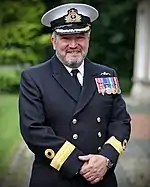 Commodore James Perks CBE since 2020 | |
| Ministry of Defence | |
| Member of | Board of Admiralty, Admiralty Board |
| Reports to | Fleet Commander |
| Nominator | Secretary of State for Defence |
| Appointer | Prime Minister Subject to formal approval by the Queen-in-Council |
| Term length | Not fixed (typically 2–3 years) |
| Inaugural holder | Rear-Admiral Douglas Dent |
| Formation | 1901 |
History
In 1904 the Admiralty created the post of Inspecting Captain of Submarines which lasted until August 1912 when Captain Roger J. B. Keyes was appointed Commodore, Submarine Service. He held that position until February 1919[1] when the post holder was renamed Chief of the Submarine Service. It was for many years located at HMS Dolphin in Hampshire.[2]
On 30 August 1939 Rear Admiral Submarines, Rear Admiral Bertram Watson, moved his headquarters from Gosport to Aberdour, Scotland, though the administrative staff remained at Gosport. The RN started the Second World War with 60 submarines.[3] On 31 August 1939 the Second Submarine Flotilla at Dundee (Forth and ten submarines) and the Sixth Submarine Flotilla at Blyth (Titania and six submarines) were part of the Home Fleet. The submarines Clyde and Severn, part of the Seventh Submarine Flotilla, were at Freetown under the orders of the Commander-in-Chief, South Atlantic. Ten submarines were in the Mediterranean along with the depot ship Maidstone (First Submarine Flotilla); and the submarine depot ship Medway and the Fourth Submarine Flotilla were under the Commander-in-Chief, China, split between Singapore and Hong Kong.[4] Roskill writes that the effective naval strength of the British Empire on the outbreak of war included 38 submarines.
During the war the major operating arenas were the Norwegian waters; the Mediterranean where the Tenth Submarine Flotilla fought a successful battle against the Axis replenishment route to North Africa; and the Far East where Royal Navy submarines disrupted Japanese shipping operating in the Malacca Straits.[5]
In January 1940, Vice-Admiral Max Horton was made Rear Admiral Submarines. Horton's biographer, Rear Admiral William S. Chalmers, cites the opinion that a new regulation, which required the post holder to be an officer who had served aboard submarines in the Great War, was forced through for the sole purpose of ensuring that Horton was on a very short list of qualifiers for this post, almost ensuring his rapid transfer to Aberdour, so great was the desire of some within the Admiralty to have Horton revitalize the submarine arm.[6]
From 1953 the Flag Officer Submarines was dual-hatted as NATO Commander Submarine Force Eastern Atlantic (COMSUBEASTLANT) under Commander Submarine Allied Command Atlantic (COMSUBACLANT), a major command of Supreme Allied Commander Atlantic. Flag Officer Submarines moved from Dolphin to the Northwood Headquarters in 1978.[7] From 1993 the post of Flag Officer Submarines was dual-hatted with the post of Commander Operations.[8] In 2020 following changes to the structure of the Submarine Service the post once again became Commodore Submarine Service.
Current status
In 2020, Commodore James Perks was appointed Commodore Submarine Service.[9]
Commanding
Post holders have included:[8]
Inspecting Captain of Submarines
- Captain Reginald H. S. Bacon, 20 August 1901 – 21 October 1904 [10]
- Captain Edgar Lees, 21 October 1904, (later RAdm.) [10]
- Captain Sydney S. Hall, 12 November 1906 – 14 November 1910 (later Adm.) [11]
- Captain Roger J. B. Keyes, 14 November 1910 - July 1912 [10]
Commodore Submarine Service
- Commodore Roger J. B. Keyes, August 1912 – February 1915[10]
Chief of the Submarine Service
- Rear-Admiral Douglas Dent (1919–1921)
- Rear-Admiral Hugh Sinclair (1921–1923)
- Vice-Admiral Wilmot Nicholson (1923–1925)
- Rear-Admiral Vernon Haggard (1925–1927)
- Rear-Admiral Henry Grace (1927–1929)
Rear-Admiral Submarines
- Rear-Admiral Martin Dunbar-Nasmith (1929–1931)
- Rear-Admiral Charles Little (1931–1932)
- Rear-Admiral Noel Laurence (1932–1934)
- Rear-Admiral Cecil Talbot (1934–1936)
- Rear-Admiral Robert Raikes (1936–1938)
- Rear-Admiral Bertram Watson (1938–1940)
- Vice-Admiral Sir Max Horton (1940–1942)
- Rear-Admiral Claud Barry (1942–1944)
Flag Officer Submarines
- Rear-Admiral George Creasy (1944–1946)
- Vice-Admiral Sir John Mansfield (1946–1948)
- Rear-Admiral Guy Grantham (1948–1950)
- Rear-Admiral Sydney Raw (1950–1952)
- Rear-Admiral George Simpson (1952–1954)
- Rear-Admiral George Fawkes (1954–1955)
- Rear-Admiral Wilfrid Woods (1955–1957)
- Rear-Admiral Bertram Taylor (1957–1959)
- Rear-Admiral Arthur Hezlet (1959–1961)
- Rear-Admiral Hugh Mackenzie (1961–1963)
- Rear-Admiral Horace Law (1963–1965)
- Rear-Admiral Ian McGeoch (1965–1967)
- Vice-Admiral Sir Michael Pollock (1967–1969)
- Vice-Admiral Sir John Roxburgh (1969–1972)
- Vice-Admiral Anthony Troup (1972–1974)
- Vice-Admiral Sir Iwan Raikes (1974–1976)
- Vice-Admiral John Fieldhouse (1976–1978)
- Vice-Admiral Robert Squires (1978–1981)
- Vice-Admiral Sir Peter Herbert (1981–1983)
- Vice-Admiral Sir John Woodward (1983–1984)
- Rear-Admiral Richard Heaslip (1984–1987)
- Rear-Admiral Frank Grenier (1987–1989)
- Vice-Admiral Sir John Coward (1989–1991)
- Rear-Admiral Niall Kilgour (2001–2004)
Rear-Admiral Submarines
- Rear-Admiral Ian Corder (2011-2013)
- Rear-Admiral Matthew Parr (2013-2015)
- Rear-Admiral Robert Tarrant (2015)
- Rear Admiral John Weale (2015-2020)
Commodore Submarine Service current
- Commodore James Perks CBE (2020–Present)
References
- Harley, Simon; Lovell, Tony. "Inspecting Captain of Submarines - The Dreadnought Project". www.dreadnoughtproject.org. Harley and Lovell, 3 November 2015. Retrieved 15 March 2018.
- "Submarine School". Retrieved 6 September 2015.
- "Royal, Dominion & Allied Navies in World War II: Beginning and End, 1939 and 1945". Naval-history.net. 2010.
- Roskill, Stephen W. (1954). "Chapter 4: Allied and Enemy War Plans and Dispositions". History of the Second World War: The War at Sea 1939-1945: The Defensive. London: HMSO. pp. 47–49.
- "Submarine History: Submarine Service: Operations and Support". Royal Navy. 2008. Archived from the original on 13 September 2008.
- Chalmers (1954), Chapter X.
- Conley, p. 136
- "Senior Royal Navy Appointments" (PDF). Retrieved 6 September 2015.
- "Submarine Service | Royal Navy".
- Harley and Lovell. 2015
- Harley and Lovell. 2015
Sources
- Conley, Dan (2014). Cold War Command: The Dramatic Story of a Nuclear Submariner. Seaforth Publishing. ISBN 9781848327696.

| political head ministers |
|
|---|---|
| governance | |
| military head | |
| office of the first sea lord |
|
| under Vice & Deputy Chief of Naval Staff |
|
| Air, Operations, Plans, Policy requirements, warfare |
|
| naval staff directorates offices & branches |
|
| naval personnel | |
| naval personnel department |
|
| controller | |
| controllers department navy controllerate |
|
| naval supplies and transport fleet support hq naval support command | |
| under naval supplies and transport fleet support hq naval support command |
|
| chief scientists department |
|
| under chief scientists department |
|
| naval home command | |
| Shore units under Naval Home Command |
|
| Fleets | |
| under c-in-c, fleet |
|
| under c-in-c home fleet, far east fleet mediterranean fleet, western fleet |
|
| civil administration navy department | |
| under civil administration |
|
| Naval Legal | |