Comparison of Catharism and Protestantism
The Cathars or Albigenses have been indentified as Proto-Protestant by people such as: Jean Duvernoy, John Foxe[1][2] among others.[3] The debate over the relationship with Albigenses and Protestants has been a matter of theological intrest and controversy in history.[3] The comparison of Protestantism and Albigensianism was mainly important among French Protestants while German Protestants rarely discussed the Cathars.[3] affiliations with Catharism and Protetantism have been criticized by Catholic historians.[3]

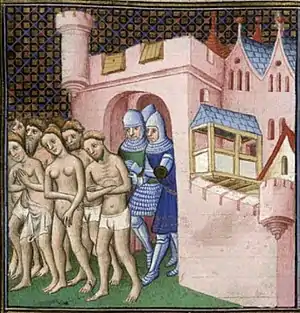
John Foxe believed that the Albigenses were similar to reformed theology, he praised the Albigenses as martyrs.[4] Today the Cathars are still seen as protestant precursors by some Baptists.[5]
Points of Comparison
What has appealed to some Protestants about the Albigenses was the rejection of transubstantiation, purgatory, crucifix, prayer for the dead, invocation of saints also that the Cathars held scripture in high esteem.[3] Cathars also read the bible in the vernacular languages and rejected most Catholic sacraments.[6]
The Reformation also spread successfully in areas previously inhabited by Cathars, as an example Protestantism was successful in Toulouse, which was also a stronghold of Albigensianism. Jean Carbonnier used this as evidence of Cathars holding reformations ideas, he argued that "people living in Cévennes have held reformation views for several centuries".[3]
Dualism
The Cathar views on dualism were against both Roman Catholic and Protestant teachings, still Crespin and Perrin tried to argue against Albigensian dualism, most often with very unconving arguments. Other Protestant historians have insisted that the charges of dualism and docetism were not authentic, only hostile claims,[7][8] such as Basnage, Mosheim and Shroeck, with such arguments being criticized by Charles Schmidt.[3]
Arguments against Catharic dualism were the following: there were possibly other neo-Manichean dualists in the Middle Ages, but they were not Cathars or that the accusation of their dualism was merely a hostile false claim.[3] Catholic historians have criticized Protestant attempts in seeing neo-Manichaean dualist groups as their spiritual ancestors.[3]
Criticism
Graham Hancock and Robert Bauval wrote that the Cathars had no more in common with Protestantism than they had with Catholicism, and belonged firmly into the Gnostic tradition.[9]
References
- Pegg, Mark Gregory (2009-01-10). The Corruption of Angels: The Great Inquisition of 1245-1246. Princeton University Press. ISBN 978-1-4008-2475-5.
- Milbank, Alison (2018-10-18). God & the Gothic: Religion, Romance, & Reality in the English Literary Tradition. Oxford University Press. ISBN 978-0-19-255785-8.
- Walther, Daniel (1968-01-01). "Were the Albigenses and Waldenses Forerunners of the Reformation?". Andrews University Seminary Studies (AUSS). 6 (2). ISSN 0003-2980.
- Foxe, John. Foxe's Book of Martyrs.
The Albigenses were a people of the reformed religion, who inhabited the country of Albi. They were condemned on the score of religion, in the council of Lateran, by order of Pope Alexander III. Nevertheless, they increased so prodigiously, that many cities were inhabited by persons only of their persuasion, and several eminent noblemen embraced their doctrines. Among the latter were Raymond earl of Thoulouse, Raymond earl of Foix, the earl of Beziers, &c.
- Hisel, Berlin (2017). Baptist History Notebook. pp. 157–165.
- McGlynn, Sean (2015-06-01). Kill Them All: Cathars and Carnage in the Albigensian Crusade. History Press. ISBN 978-0-7509-5194-4.
- Stojanov, Juri P.; Stoyanov, Yuri (2000-08-11). The Other God: Dualist Religions from Antiquity to the Cathar Heresy. Yale University Press. ISBN 978-0-300-08253-1.
- Sennis, Antonio (2016). Cathars in Question. Boydell & Brewer. ISBN 978-1-903153-68-0.
- Hancock, Graham; Bauval, Robert (2004-05-27). Talisman: Sacred Cities, Secret Faith. Penguin Books Limited. ISBN 978-0-14-190671-3.
| 800-1100ad |
|  | ||||
|---|---|---|---|---|---|---|
| 1100-1400ad |
| |||||
| 1400-1500ad | ||||||
| Events | ||||||
| Literature | ||||||
| Other | ||||||
| ||||||