Cosmophasis lami
Cosmophasis lami, also known as the Lami Beach northern jumping spider, is a species of jumping spider in the genus Cosmophasis, probably native to South East Asia and some pacific islands, and possibly introduced to Japan and Okinawa Islands by humans.[1] It was first described by Berry, Beatty & Prószynski in 1997 and has one synonym, Cosmophasis squamata.[2][3][4] Both the female and the male have been described.
| Cosmophasis lami | |
|---|---|
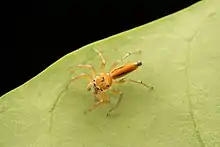 | |
| Male C. lami | |
Scientific classification  | |
| Kingdom: | Animalia |
| Phylum: | Arthropoda |
| Subphylum: | Chelicerata |
| Class: | Arachnida |
| Order: | Araneae |
| Infraorder: | Araneomorphae |
| Family: | Salticidae |
| Subfamily: | Salticinae |
| Genus: | Cosmophasis |
| Species: | C. lami |
| Binomial name | |
| Cosmophasis lami Berry, Beatty & Prószyński, 1997 | |
Description
Exact description may vary, but the species displays sexual dimorphism, with females' coloration being more vibrant. Adult C. lami's carapace is orange-brown,[5] the males having a dark-brown area around the eyes, and coated in orange hairs and the clypeus is orange-brown. The males' abdomen is orange and slender, with a black apex and spinnerets.[2] Females are almost similar, with the only difference being a grayish brown sternum and different abdominal markings.[2] It is similar to C. hortoni, but is smaller, the chelicerae shorter, with a longer embolus of the male palp, which is southeast from the bulb.[6]
Range
Considered the most widely distributed salticid from Cosmophasis, Cosmophasis lami was first seen in Fiji and is currently expanding its range to South East Asia, Seychelles and some islands in the Pacific Ocean.[1] [7][8] In 2013, it was first recorded in Japan by Tatsumi Suguro.[2] Eight years later, it was recorded in Okinawa Island on roadside vegetation in an residential area, probably by artificial introduction.[2]
Taxonomy
Cosmophasis lami has no subspecies.
Entomology
The first recorded specimen of C. lami is a male collected on 3 May 1987 by Joseph Beatty and E.R. Berry from Fiji on shrub foliage in Lami, Fiji and the species was named after it (the location). The name was first published in January 1997 along with Ascyltus similis, Ascyltus rhizophora, Bavia fedor, Bavia sonsorol, Cosmophasis arborea, Cosmophasis muralis, Flacillula nitens, Ligurra opelli, Thorelliola dumicola, and Trite ponapensis.[7]
Relations with humans
Cosmophasis lami is called homura-haetori (flame fly-removal) in Japanese,[2] and is not considered a pest.
Ecology
Cosmophasis lami are peridomestic carnivorous arthropod predators.[9]
References
- Citizen science observations for Cosmophasis lami at iNaturalist
- Suguro, Tatsumi (2013). "The first record of Cosmophasis lami (Araneae: Salticidae) from Japan". Acta Arachnologica. 62 (1): 19–22. doi:10.2476/asjaa.62.19. ISSN 0001-5202.
- "Cosmophasis lami". Global Biodiversity Information Facility. Retrieved 27 October 2021.
- Bern, Natural History Museum. "NMBE - World Spider Catalog". wsc.nmbe.ch. Retrieved 2021-10-24.
- Saaristo, Michael.I (2002). New species and interesting new records of spiders from Seychelles (Arachnida, Areneaea). p. 24.
- "Cosmophasis lami Berry, Beatty & Prószyński, 1997 Lami Beach Cosmophasis". www.arachne.org.au. Retrieved 2021-10-25.
- Berry, James; Beatty, Joseph; Proszynski, Jerzy (1997-01-01). "Salticidae of the pacific islands. II. Distribution of nine genera, with descriptions of eleven new species". 25. Cite journal requires
|journal=(help) - Tiziano Hurni-Cranston and David E. Hill (3 February 2021). "Three new jumping spiders of the genus Cosmophasis from Wallacea (Araneae: Salticidae: Chrysillini". Peckhamia.
- https://biodiversity.org.au/afd/taxa/Cosmophasis_lami