Criticism of modern Paganism
Modern Paganism, also known as Contemporary Paganism[1] and Neopaganism,[2] is a collective term for religious movements influenced by or derived from the various historical pagan beliefs of pre-modern peoples. Although they share similarities, contemporary Pagan religious movements are diverse, and do not share a single set of beliefs, practices, or texts.[3]
| This article is of a series on |
| Criticism of religion |
|---|
Due to its diversity many criticisms are directed towards specific Neopagan groups while not necessarily applying to all Neopagan groups. Criticisms range from gender essentialism to connections with racial supremacy to criticisms of the worldly focuses of pagan organizations
Criticism of historicity
Many pagan traditions have been criticized on the basis of bearing little resemblance to the historical practices they claim to be revivals of.
Gerald Gardner, founder of Wicca claimed it to be a continuation of an ancient persecuted Witch cult.[4] A widely discredited notion[5]
Kemetic Orthodoxy has been criticized for being more based on contemporary revelation than historical continuity. Kemetism as a whole has been criticized over a lack of historical continuity, with most practices having little archaeological support or support from primary sources
Romuva has been highly praised for maintaining historical continuity by contrast
Neo-pagans have been repeatedly criticized for pseudohistorical and pseudolinguistic activities, promotion of pseudoscience (see for example, The Veles Book).[6]
Many researchers,[7] such as O. V. Kutarev believe that "old paganism in its fullness in Europe is essentially unknown... (except the beliefs of Mari and Udmurts)", and "the restoration of "pure" paganism as it was in antiquity - impossible".[8]
Criticism of Pagan communities and hierarchies
The decentralized nature of many pagan communities has led many to demonstrate traits very different from traditional organized religions. Some scholars have argued that the lack of religious hierarchies leads to an increase in political extremism on both the right and left, or that it leads to members feeling lost and unable to find spiritual guidance
Many pagans have expressed little interest or even opposition to the development of more robust organizational structures. Many express their paganism as a manifestation of a rejection of organized religion. This is especially true among more progressive pagan groups.
This is not a universal ideal with many pagans citing a disillusionment with Christian theology but a desire for Christian-like organizational structure. This issue continues to be subject to much debate and self-criticism in pagan circles
Rodnovery and Kemetic Orthodoxy have been relatively free of this criticism due to their more robust organizational structures
Racial issues
Germanic occultism and neopaganism emerged in the early 20th Century and became influential, with beliefs such as Ariosophy, combining with the far-right Völkisch movement which eventually culminated in Nazism. Post-WWII continuations of similar beliefs have given rise to the Wotansvolk, a white nationalist neopagan movement, in the late 20th Century.[9][10]
Modern white supremacism and Neo-Nazism with all the racist, antisemitic, and anti-LGBTQ beliefs of those ideologies have either continued, infiltrated, and co-opted many Germanic and Norse Heathen traditions such as Ásatrú (sometimes called Odinism). These groups believe that these Norse-Germanic beliefs form the true Caucasian-European ethnoreligious group.[9][10]
The question of race represents a major source of division among Heathens, particularly in the United States.[11] Within the Heathen community, one viewpoint holds that race is entirely a matter of biological heredity, while the opposing position is that race is a social construct rooted in cultural heritage. In U.S. Heathen discourse, these viewpoints are described as the folkish and the universalist positions, respectively.[12] These two factions—which Kaplan termed the "racialist" and "nonracialist" camps—often clash, with Kaplan claiming that a "virtual civil war" existed between them within the American Heathen community.[13] The universalist and folkish division has also spread to other countries,[14] although has had less impact in the more ethnically homogenous Iceland.[15] A 2015 survey revealed a greater number of Heathens subscribed to universalist ideas than folkish ones.[16]
Contrasting with this binary division, Gardell divides Heathenry in the United States into three groups according to their stances on race: the "anti-racist" group which denounces any association between the religion and racial identity, the "radical racist" faction which sees it as the natural religion of the Aryan race that should not be followed by members of any other racial group, and the "ethnic" faction which seeks a middle-path by acknowledging the religion's roots in Northern Europe and its connection with those of Northern European heritage.[17] The religious studies scholar Stefanie von Schnurbein adopted Gardell's tripartite division, although referred to the groups as the "a-racist", "racial-religious", and "ethnicist" factions respectively.[18]
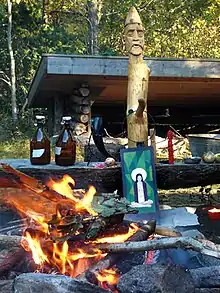
Exponents of the universalist, anti-racist approach believe that the deities of Germanic Europe can call anyone to their worship, regardless of ethnic background.[19] This group rejects the folkish emphasis on race, believing that even if unintended, it can lead to the adoption of racist attitudes toward those of non-Northern European ancestry.[20] Universalist practitioners such as Stephan Grundy have emphasized the fact that ancient Northern Europeans were known to marry and have children with members of other ethnic groups, and that in Norse mythology the Æsir also did the same with Vanir, Jötun, and humans, thus using such points to critique the racialist view.[21] Universalists welcome practitioners of Heathenry who are not of Northern European ancestry; for instance, there are Jewish and African American members of the U.S.-based Troth, while many of its white members have spouses from different racial groups.[22] While sometimes retaining the idea of Heathenry as an indigenous religion, proponents of this view have sometimes argued that Heathenry is indigenous to the land of Northern Europe, rather than indigenous to any specific race.[23] Universalist Heathens often express frustration that some journalists depict Heathenry as an intrinsically racist movement,[24] and use their online presence to stress their opposition to far-right politics.[25]
Folkish practitioners deem Heathenry to be the indigenous religion of a biologically distinct race,[26] which is conceptualised as being "white", "Nordic", or "Aryan".[27] Some practitioners explain this by asserting that the religion is intrinsically connected to the collective unconscious of this race,[28] with prominent American Heathen Stephen McNallen developing this into a concept which he termed "metagenetics".[29] McNallen and many others in the "ethnic" faction of Heathenry explicitly deny that they are racist, although Gardell noted that their views would be deemed racist under certain definitions of the word.[30] Gardell considered many "ethnic" Heathens to be ethnic nationalists,[31] and many folkish practitioners express disapproval of multiculturalism and the mixture of different races in modern Europe, advocating racial separatism.[26] This group's discourse contains much talk of "ancestors" and "homelands", concepts that may be very vaguely defined.[32] Ethno-centrist Heathens are heavily critical of their universalist counterparts, often declaring that the latter have been misled by New Age literature and political correctness.[33] Those adopting the "ethnic" folkish position have been criticized by both universalist and ethno-centrist factions, the former deeming "ethnic" Heathenry a front for racism and the latter deeming its adherents race traitors for their failure to fully embrace white supremacism.[34]
Some folkish Heathens are white supremacists and explicit racists,[35] representing a "radical racist" faction that favours the terms Odinism, Wotanism, and Wodenism.[36] These individuals inhabit "the most distant reaches" of modern Paganism, according to Kaplan.[37] The borders between this form of Heathenry and National Socialism (Nazism) are "exceedingly thin",[38] with its adherents having paid tribute to Adolf Hitler and Nazi Germany,[38] claimed that the white race is facing extinction at the hands of a Jewish world conspiracy,[39] and rejected Christianity as a creation of the Jews.[40] Many in the inner circle of The Order, a white supremacist militia active in the U.S. during the 1980s, called themselves Odinists,[41] and various racist Heathens have espoused the Fourteen Words slogan developed by the Order member David Lane.[42] Some white supremacist organisations, such as the Order of Nine Angles and the Black Order, combine elements of Heathenism with Satanism,[43] although other racist Heathens, such as Wotansvolk's Ron McVan, reject the integration of these differing religions.[44]
In his 1997 manifesto Vargsmål, Norwegian metal musician and racial pagan Varg Vikernes, claimed homosexuality a type of "spiritual defects" that results from men "develop[ing] womanly instincts" and women "who think they are men", but regarded female bisexuality as "natural" provided it doesn't reject attraction to men.[45] In 2005, Vikernes claimed on his personal website that "you cannot be Pagan and homosexual or even tolerate homosexuality."[46]
Lack of Spirituality
Many involved in the New Age have expressed criticism of Paganism for emphasizing the material world over the spiritual.[47]
Modern Pagans frequently seek to distance themselves from New Age identity and some communities use the term "New Age" as an insult.[48] Their recurring criticism of New Age ethos and practice includes accusations of charging too much money, of thinking in simplistic ways and of engaging in escapism.[49] They reject the common New Age metaphor of a battle between the forces of light and darkness, arguing that darkness represents a necessary part of the natural world which should not be viewed as evil.[50]
New Agers criticise modern Pagans for placing too much emphasis on the material world and for lacking a proper spiritual perspective.[51] There has been New Age criticism of how some modern Pagans embrace extravagant subcultures, such as adopting dark colour schemes and imagery.[49] People from both movements have accused the other of egocentrism and narcissism.[51]
Neopagans are often called "larpers" in online communities for being perceived as valuing aesthetics over spirituality
Philosophical criticism
Beliefs and practices vary widely among different Pagan groups; however, there are a series of core principles common to most, if not all, forms of modern paganism.[52] The English academic Graham Harvey noted that Pagans "rarely indulge in theology".[53]
Neopagan theology has been criticized for its lack of coherence. Proponents often argue that this incoherence is not an issue with the religion as it is more based on Orthopraxy than Orthodoxy. Criticisms have also been made on the lack of Orthopraxy as many rituals have very little standardization across different communities
LGBT Issues
Gender dualism, essentialism, and sexual orientation
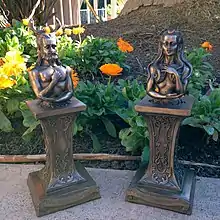
Ideological issues that affect LGBTQ perception and interaction within the modern pagan community often stem from a traditionally dualistic cosmology, a view which focuses on two overarching and often oppositional categories. In modern paganism, this is traditionally seen surrounding sexuality, particularly heterosexuality, based on a gender binary which is assigned via genitalia at birth (in other words, gender essentialism.)[55][56][57]
Binary gender essentialism is highly present in neopagan communities and their respective theological/philosophical belief systems.[58] Pagan sources themselves, such as the Pagan Federation of the U.K., express views concurring with this academic understanding.[59] The basis of the difference is commonly reflected in discussion about spiritual energy, which is traditionally believed to be intrinsically masculine or feminine in type and inherently possessed by those born into either binary gender.[60]
A preeminent example of this belief is the duotheistic veneration of a God-Goddess pairing, often the Triple Goddess and Horned God, a pairing used by Wiccans.[61] The Goddess (representing the feminine) is traditionally seen as receptive, fertile, nurturing, and passive (cast as the Moon), while the God (representing the masculine) as impregnative, a hunter, and active/aggressive (cast as the Sun).[62][63] Janet Farrar, a notable Wiccan priestess and author, described this as an adoption of yin and yang in Western pagan practice.[64]
This dual-gender archetype is traditionally regarded in a heterosexual manner, a belief which is reflected in the theology of many neopagan belief systems[65]as well as practices such as magic and spellcraft, which traditional sects require heterosexual-based dynamics to perform.[66] This can be a struggle for LGBTQ pagans who find the exemplified duality not reflective of their own feelings and desires.[57]
The liturgy of the deity pair is often associated in essentialist ways. The Triple Goddess is associated with the reproductive development and cessation of cisgender woman in her three aspects Maiden, Mother, and Crone. Beginning life, the Maiden (young woman) represents virginal preadolescence. Upon menarche, the woman comes of age and transforms into the Mother (adult woman) aspect, now ostensibly capable of reproduction. Upon menopause, the woman loses her reproductive capacity she once carried, transforming into the Crone (mature woman) aspect. The Moon is believed to represent the menstrual cycle and many pagans believe the two are linked.[67] Likewise, The Horned God is associated with the reproductive capability of cisgender men. Phallic symbology, such as the eponymous horns, represent the penis and the associated reproductive function.[68]
Recent historical views on sexuality and gender
In the mid-20th century dawn of Neopaganism, heterosexual dualism was most exemplified in the "Great Rite" of British Traditional Wicca, one of the first notable neopagan ideological groups. In this Rite, a priest and priestess "were cast into rigidly gendered, heteronormative roles" in which the pairing performed a symbolic or literal representation of heterosexual intercourse which was considered vital for venerating supernatural entities and performing magic. It is notable that early neopagan views on sex were radical for their time in their sex positivity and tacit acceptance of BDSM.[69]
Later in the 20th Century, as Wicca spread to North America, it incorporated countercultural, second-wave feminist, and LGBTQ elements. The essentialist rigidity fluctuated under the influence of Carl Jung's notions of anima and animus and non-heterosexual orientations became more acceptable.[70][71] By the 1980s and 1990s, figures like Vivianne Crowley and Starhawk continued the evolving beliefs. Crowley associated the Jungian binary with classical elements possessed by all—the feminine/anima with water and the masculine/animus with fire.[71] Starhawk, espousing views similar to Crowley in her 1979 edition of her seminal book The Spiral Dance, began calling into question the masculine-feminine divisions entirely by the 1999 edition, and instead focusing on traits instead of gender archetypes.[70][72]
At the dawn of the 21st century, queer neopagans and their sects began to assert themselves more publicly. These LGBTQ-aligned groups "challenged the gender essentialism remaining in the sexual polarity still practiced" which remained in certain Wicca and feminist neopagan enclaves. Greater exploration and acceptance of queer and transgender figures began not only for adherents but deities and mythological figures as well. In addition, sex positivity and BDSM were brought back into active exploration and acceptance.[73]
Gardnerian Wicca
Gerald Gardner, the eponymous founder of Gardnerian Wicca, particularly stressed heterosexual approaches to Wicca. This practice may stem from Gardner's text (ostensibly quoting a witch, but perhaps in his own words):[74]
"The witches tell me 'The law always has been that power must be passed from man to woman or from woman to man, the only exception being when a mother initiates her daughter or a father his son, because they are part of themselves' (the reason is that great love is apt to occur between people who go through the rites together.) They go on to say: 'The Templars broke this age-old rule and passed the power from man to man: this led to sin and in doing so it brought about their downfall.' ... For this reason, they say, the goddess has strictly forbidden a man to be initiated by or to work with a man, or a woman to be initiated by or to work with a woman, the only exceptions being that a father may initiate his son and a mother her daughter, as said above; and the curse of the goddess may be on any who break this law."
— Gerald Gardner, Witchcraft Today (1954)
Gardner was accused of homophobia by Lois Bourne, one of the High Priestesses of the Bricket Wood coven:
"Gerald was homophobic. He had a deep hatred and detestation of homosexuality, which he regarded as a disgusting perversion and a flagrant transgression of natural law... 'There are no homosexual witches, and it is not possible to be a homosexual and a witch' Gerald almost shouted. No one argued with him."[75]
However, the legitimacy of Gardner's rumored homophobia is disputable because Gardner showed much more evidence of an open and accepting attitude about practices in his writing which would not be characterized by the hatred or phobia which was common in the 1950s:
"Also, though the witch ideal is to form perfect couples of people ideally suited to each other, nowadays this is not always possible; the right couples go together and the rest go singly and do as they can. Witchcraft today is largely a case of 'make do'."[76]
Criticism from Abrahamic religions
In the Islamic World, Pagans are not considered people of the book, so they are not protected under Islamic religious law.
Regarding to European paganism, In Modern Paganism in World Cultures: Comparative Perspectives Michael F. Strmiska writes that "in Pagan magazines, websites, and Internet discussion venues, Christianity is frequently denounced as an antinatural, antifemale, sexually and culturally repressive, guilt-ridden, and authoritarian religion that has fostered intolerance, hypocrisy, and persecution throughout the world."[77] Further, there is a common belief in the pagan community that Christianity and Paganism are opposing belief systems.[77] This animosity is flamed by historical conflicts between Christian and pre-Christian religions, as well as the perceived ongoing Christian disdain from Christians.[77] Some Pagans have claimed that Christian authorities have never apologized for the religious displacement of Europe's pre-Christian belief systems, particularly following the Roman Catholic Church's apology for past anti-semitism in its A Reflection on the Shoah.[78] They also express disapproval of Christianity's continued missionary efforts around the globe at the expense of indigenous and other polytheistic faiths.[79]
Some Christian authors have published books criticizing modern Paganism, [80] while other Christian critics have equated Paganism with Satanism, which is often portrayed as such in mainstream entertainment industry.[81]
In areas such as the US Bible Belt, where conservative Christian dominance is strong, Pagans have faced continued religious persecution.[79] For instance, Strmiska highlighted instances in both the US and UK in which school teachers were fired when their employers discovered that they were Pagan.[79] Thus, many Pagans keep their religion private to avoid discrimination and ostracism.[82]
Patriarch of Moscow and All Russia Alexy II at the opening of the Archbishops Council in 2004 called the spread of neo-paganism one of the main threats of the 21st century, placing it on a par with terrorism and "other pernicious phenomena of our time".[83] In this regard, Circle of Pagan Tradition sent an open letter to the Holy Synod of the Russian Orthodox Church, which was forwarded on October 18, 2004 to the Department for External Church Relations Moscow Patriarchate.[84] This open letter stated that statements that offend the honor and dignity of modern pagans and violate the laws "On Freedom of Conscience and on Religious Associations" and "On Counteracting Extremist Activity" were inadmissible.
In publications of figures of the Russian Orthodox Church the unscientific approach of Rodnovers to reconstruction of ancient Slavic beliefs is especially noted.[85]
Patriarch of Moscow and All Russia Kirill stated in an interview in 2009 that the devil has appeared to peoples in various ways - for example, through pagan gods. He called paganism a delusion through which people unconsciously and irrationally worship a dark force.[86]
References
- Doyle White 2016, p. 6.
- Adler 2006, p. xiii.
- Carpenter 1996, p. 40.
- Simpson 1994, p. 89.
- Hutton 1999, p. 362; Russell & Alexander 2007, p. 154.
- Schnerelman, Victor (2015-12-11). Aryan myth in the modern world (in Russian). New Literary Review. ISBN 978-5-4448-0422-3.
- Gaidukov 2016.
- Vladislavovich, Oleg (2016-06-05). "Neopaganism of Europe". Pantheon (in Russian). Archived from the original on 2021-10-02. Retrieved 2021-10-03.
- "New Brand of Racist Odinist Religion on the March". Southern Poverty Law Center. Archived from the original on 14 January 2020. Retrieved 2019-12-11.
- Berlet, Chip; Vysotsky, Stanislav (2006). "Overview of U.S. White Supremacist Groups". Journal of Political and Military Sociology. DeKalb: University of Indiana – Department of Sociology. 34 (1): 11–48. ISSN 0047-2697. ProQuest 206662818 – via ProQuest.
- Kaplan 1996, p. 202; Gardell 2003, p. 153; Strmiska & Sigurvinsson 2005, p. 134; Blain 2005, p. 193.
- Strmiska & Sigurvinsson 2005, pp. 134–135; Adler 2006, pp. 29–294; Blain & Wallis 2009, p. 422; Schnurbein 2016, p. 128; Snook, Horrell & Horton 2017, p. 52.
- Kaplan 1997, p. 78.
- Schnurbein 2016, p. 128.
- Strmiska & Sigurvinsson 2005, p. 165.
- Cragle 2017, p. 90.
- Gardell 2003, p. 153.
- Schnurbein 2016, pp. 6–7.
- Strmiska & Sigurvinsson 2005, pp. 134–135.
- Harvey 2007, p. 67.
- Kaplan 1997, p. 77; Gardell 2003, p. 163.
- Kaplan 1996, p. 224; Gardell 2003, p. 164; Strmiska & Sigurvinsson 2005, p. 128.
- Blain 2005, p. 193.
- Cragle 2017, p. 89.
- Doyle White 2017, p. 257.
- Harvey 2007, p. 66.
- Doyle White 2017, pp. 242–243.
- Kaplan 1997, p. 81; Harvey 2007, pp. 66–67.
- Kaplan 1997, pp. 80–82; Gardell 2003, pp. 269–273; Schnurbein 2016, p. 130.
- Gardell 2003, p. 271.
- Gardell 2003, p. 278.
- Strmiska & Sigurvinsson 2005, p. 137.
- Gardell 2003, p. 165.
- Gardell 2003, pp. 273–274.
- Strmiska & Sigurvinsson 2005, p. 136; Schnurbein 2016, p. 129.
- Gardell 2003, p. 165; Doyle White 2017, p. 254.
- Kaplan 1997, pp. 69–70.
- Kaplan 1997, p. 85.
- Kaplan 1997, p. 86.
- Goodrick-Clarke 2003, p. 257.
- Gardell 2003, pp. 196–197.
- Kaplan 1997, p. 94.
- Gardell 2003, pp. 292–293.
- Gardell 2003, pp. 320–321.
- Vikernes, Varg (1997). Vargsmål. Integral Tradition Publishing. Retrieved 21 August 2021.
- Vikernes, Varg (6 January 2005). "Paganism: Part I - The Ancient Religion". Retrieved 21 August 2021.
- Doyle White 2016, p. 9.
- Harvey 2004, p. 245; Partridge 2004, p. 78.
- Pike 2004, p. 22.
- Partridge 2004, p. 79; York 1995, p. 123.
- York 1995, p. 167.
- Adler 2006, p. 22.
- Harvey 2007, p. 1.
- Coles (2017).
- Kraemer (2012); Oboler (2011); Neitz (2000); Mueller (2017).
- Coles, Donyae (2017-06-19). "Beyond the gender binary in Pagan practice". Spiral Nature Magazine. Archived from the original on 15 April 2019. Retrieved 2019-09-10.
- Faerywolf, Storm (21 October 2000). "The Queer Craft". WitchVox. Archived from the original on 24 January 2020. Retrieved 11 September 2019.
- Kraemer (2012), p. 390; Oboler (2011), p. 168.
- "The Pagan Federation - Male Spirit". paganfed.org. Archived from the original on 7 December 2019. Retrieved 2019-09-10."The Pagan Federation - Female Spirit". paganfed.org. Archived from the original on 23 September 2019. Retrieved 2019-09-10.
- Kraemer (2012), p. 391; Oboler (2011), p. 168; Neitz (2000), p. 383.
- Coles (2017); Mueller (2017), p. 254.
- Kraemer (2012), p. 391; Oboler (2011), p. 167.
- Farrar, Janet (1989). The Witches' god: Lord of the Dance. London: Robert Hale. ISBN 0-7090-3319-2.
- Farrar, Janet; Farrar, Stewart (1984). The witches' way : principles, rituals and beliefs of modern witchcraft. London: Hale. p. 166. ISBN 0-7090-1293-4. OCLC 59691718.
- Neitz (2000), pp. 379–80.
- Kraemer (2012), p. 391; Oboler (2011), p. 170.
- Kraemer (2012), p. 395; Mueller (2017), p. 253; Oboler (2011), pp. 170–172.
- Oboler (2011), pp. 167; Kraemer (2012), pp. 396.
- Kraemer (2012), p. 391.
- Kraemer (2012), p. 392.
- Crowley, Vivianne. (1996). Wicca : the old religion in the new millennium. London: Thorsons. pp. 129–130. ISBN 0-7225-3271-7. OCLC 34190941.
- Starhawk (1979). The spiral dance : a rebirth of the ancient religion of the great goddess (1st ed.). San Francisco. ISBN 0-06-067535-7. OCLC 5334164. Starhawk (1999). The spiral dance : a rebirth of the ancient religion of the great goddess (20th Anniversary, with new introd. and chapter-by- chapter commentary ed.). [San Francisco]: HarperSanFrancisco. ISBN 0-06-250815-6. OCLC 41488828.
- Kraemer 2012.
- Gardner, Gerald B (1954). Witchcraft today (1st ed.). London: London Rider. p. 69. OCLC 901306023.
- Bourne, Lois Dancing with Witches. (2006) London: Robert Hale. ISBN 0-7090-8074-3. p.38. (Hardback edition first published 1998).
- Gardner, Gerald. Witchcraft Today (1954) London: Rider. p. 125
- Strmiska 2005, p. 29.
- Strmiska 2005, p. 30.
- Strmiska 2005, p. 31.
- Strmiska 2005, p. 8.
- Strmiska 2005, p. 34.
- Strmiska 2005, p. 32.
- www.religare.ru http://www.religare.ru/print10557.htm. Retrieved 2021-11-15. Missing or empty
|title=(help) - "Открытое письмо язычников к РПЦ от 18.10.04". slavya.ru. Retrieved 2021-11-15.
- "В данной статье термин «неоязычество» будет употребляться лишь по отношению к попыткам реанимации дохристианских богов Древней Руси". veruem.narod.ru. Retrieved 2021-11-15.
- "- YouTube". www.youtube.com. Retrieved 2021-11-15.