Cube (1997 film)
Cube is a 1997 Canadian independent science fiction horror film directed and co-written by Vincenzo Natali.[7] A product of the Canadian Film Centre's First Feature Project,[8] Nicole de Boer, Nicky Guadagni, David Hewlett, Andrew Miller, Julian Richings, Wayne Robson and Maurice Dean Wint star as individuals trapped in a bizarre and deadly labyrinth of cube-shaped rooms.
| Cube | |
|---|---|
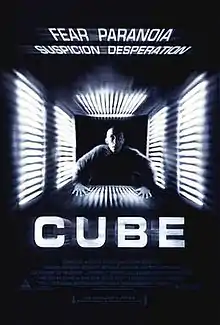 Theatrical release poster | |
| Directed by | Vincenzo Natali |
| Written by |
|
| Produced by |
|
| Starring | |
| Cinematography | Derek Rogers[1] |
| Edited by | John Sanders[1] |
| Music by | Mark Korven[1] |
Production companies |
|
| Distributed by | Trimark Pictures |
Release date |
|
Running time | 90 minutes[3] |
| Country | Canada |
| Language | English |
| Budget | $350,000[4] |
| Box office | $9 million[5][6] |
Cube has gained notoriety and a cult following, for its surreal atmosphere and Kafkaesque setting and concept of industrial, cube-shaped rooms. The film received generally positive reviews, and spawned a series. An American remake, currently on hold, is in development at Lionsgate,[9] and a Japanese produced remake was released in 2021.
Plot
After a man named Alderson is killed in a mysterious cube-shaped room, five strangers – Quentin, Worth, Holloway, Leaven, and Rennes – awaken and meet in another identical room. No one knows where they are or how they got there. Quentin informs the group that some rooms contain traps, which he discovered while exploring. Rennes, a convict who has escaped seven prisons, assumes each trap is triggered by a motion detector and tests each room by throwing one of his boots in first. The maze is beset by frequent tremors, and Leaven notices numbers inscribed in the narrow passageways between rooms. Rennes enters a room that he assumes to be safe and is killed when he is sprayed in the face with acid, indicating that each trap is triggered by different sensors.
Quentin believes each person was chosen to be there: he is a divorced police officer, Leaven is a young mathematics student, and Holloway is a free clinic doctor, while the surly Worth says he is only an office worker. Leaven hypothesizes that any room marked with a prime number is a trap, and they find an intellectually disabled man named Kazan, whom Holloway insists they bring along. Quentin injures his leg in a trapped room deemed safe by Leaven's calculations, and tensions rise over personal conflicts and the mystery over the maze's purpose. After being provoked by Quentin, Worth finally admits that he designed the maze's outer shell—in the shape of a gigantic cube—for a shadowy bureaucracy, and guesses that its original purpose has been forgotten; they have been imprisoned within the maze simply to put it to use, otherwise it would only serve to be "pointless".
Worth's knowledge of the outer shell's dimensions allows Leaven to determine that each side of the Cube is 26 rooms across and that there are 17,576 rooms in total. She then guesses that the numbers indicate the Cartesian coordinates of each room. The group moves toward the nearest edge as determined by her theory, but each of the rooms near the outer wall is trapped. Rather than backtrack, they travel silently through a room with a sound-activated trap. After Kazan makes a sound and nearly causes Quentin's death, Quentin threatens Kazan and clashes with Holloway, who defends Kazan and insinuates that Quentin may have been an abusive husband and likes young girls. When they reach the edge, they find what seems to be a never ending column of cubes and an opposing stone wall separated by empty space. Holloway volunteers to scout as she is one of the lightest, and the group tie their clothes into a rope. Holloway descends the rope and finds nothing. She decides to swing to the stone wall but as she does, another violent tremor happens and the group loses grip of the rope, causing Holloway to fall. Quentin leaps and catches the rope while the group grab his legs. Holloway climbs the rope and locks hands with Quentin, but Quentin ultimately decides to let her fall to her death and tells the group she slipped.
Quentin becomes mentally unhinged; he attempts to persuade Leaven to join him in abandoning the others and makes a sexual advance, but she rejects him. Worth intervenes, but Quentin beats him savagely and drops him into another room through a floor hatch. There, the group finds Rennes' corpse and are demoralized by the thought of having wandered in circles. Worth then realizes that the rooms move periodically throughout the Cube, which is the cause of all the tremors. Leaven also deduces that traps are not tagged by prime numbers, but by powers of prime numbers, and Kazan reveals himself to be an autistic savant[10] who can quickly do prime factorizations mentally. With his help, Leaven guides the group to the bridge room that will lead them out of the maze. Worth ambushes and seemingly kills Quentin before leaving him behind. Kazan opens the final hatch, revealing a bright white light, but Worth declines to leave the Cube as he has lost his will to live.
As Leaven tries to convince Worth to join her, Quentin reappears, stabs and kills her with a hatch lever, and mortally wounds Worth while Kazan flees. As Quentin moves to kill Kazan, Worth pins Quentin in the narrow passageway as the rooms shift again. Quentin is torn apart, and Worth crawls back to Leaven's corpse to die next to her. Kazan slowly wanders out into the bright light, his fate left unknown.
Cast
- Maurice Dean Wint as Quentin McNeil, a police officer. He is a gruff and aggressive man who takes charge and undertakes most of the dangerous tasks. He is said to be in his 40s.
- Nicole de Boer as Joan Leaven, a young student with mathematical skills. She is said to be in her late teens to early 20s.
- David Hewlett as David Worth, a chronic malcontent and cynic who unwittingly designed the outer shell of the Cube. He is said to be in late 20s to early 30s.
- Andrew Miller as Kazan, an intellectually disabled man with the ability to rapidly and accurately perform prime number calculations. He is said to be in his 20s.
- Nicky Guadagni as Dr. Helen Holloway, a free clinic doctor. She is said to be in her early 50s.
- Wayne Robson as Rennes, also known as "the Wren", an escape artist who has gotten out of seven prisons. He is said to be in his early 60s.
- Julian Richings as Alderson, a prisoner and a mysterious character. He woke up in another room and never met the rest of the group. He is said to be in his 30s.
Each character's name is connected with a real-world prison:
| Name | Prison Connection |
|---|---|
| Kazan | Kazan Prison (Russia) |
| Joan Leaven David Worth |
Leavenworth Prison (United States) |
| Quentin McNeil | San Quentin State Prison and McNeil Island Corrections Center (United States) |
| Dr. Helen Holloway | Holloway Women's Prison (United Kingdom) |
| Rennes | Centre pénitentiaire de Rennes (France) |
| Alderson | Alderson Federal Prison Camp (United States) |
Production
An episode of the original Twilight Zone television series, "Five Characters in Search of an Exit" (first aired 22 December 1961), was reportedly an inspiration for the film.[11][12][13] The film was shot in Toronto, Ontario.[14]
Script development
Though Vincenzo Natali had the initial inspiration to make a film "set entirely in hell" in 1990, it was not until 1994, when he was working as a storyboard artist's assistant at Canada's Nelvana animation studio, that he had completed the first script for Cube. The initial draft had a slightly comedic tone to it, and featured surreal images, a cannibal, edible moss that grew on the walls, and a monster that roamed the cube. Roommate and childhood filmmaking partner Andre Bijelic helped Natali strip the central idea – people avoiding deadly traps in a maze – down to its essence. Scenes that took place outside of the cube were jettisoned, and the identity of the victims themselves changed. In some drafts, they were accountants and in others criminals, with the implication being that their banishment to the cube was part of a penal sentence. One of the most important dramatic changes was the complete removal of food and water from the scenario; this created a sense of urgency for escape.[15]
After writing Cube, Natali developed and filmed a short entitled Elevated. The short was set in an elevator and was intended to give investors an idea of how Cube would hypothetically look and come across. While working on Elevated, cinematographer Derek Rogers developed strategies for shooting in the tightly confined spaces in which he would later work on Cube. The short eventually helped Cube procure financing. Cube was shot on a Toronto soundstage.[16]
The Cube design
The fictional Cube device in the film was conceived by mathematician David W. Pravica, who also served as the film's math consultant.[17] It consists of an outer cubical shell (the sarcophagus) and the inner cube. Each side of the outer shell is 434 feet (132 m) long. The inner cube consists of 263 = 17,576 cubical rooms (minus an unknown number of rooms to allow for movement, as shown in the film), each having a side length of 15.5 feet (4.7 m). There is a space of 15.5 feet (4.7 m) between the inner cube and the outer shell. Each room is labelled with three identification numbers, for example, 517 478 565. These numbers encode the starting coordinates of the room and the X, Y, and Z coordinates are the sums of the digits of the first, second, and third number, respectively. The numbers also determine the movement of the room - the subsequent positions are obtained by cyclically subtracting the digits from one another, and the resulting numbers are then successively added to the starting numbers.[18]
Only one cube, with each of its sides measuring 14 feet (4.3 m) in length, was actually built, with only one working door that could actually support the weight of the actors. The colour of the room was changed by sliding panels.[19] Since this was a time-consuming procedure, the movie was not shot in sequence; all shots taking place in rooms of a specific color were shot one at a time. It was intended that there would be six colors of rooms to match the recurring theme of six throughout the movie; five sets of gel panels, plus pure white. However, the budget did not stretch to the sixth gel panel, and so there are only five room colors in the movie. Another partial cube was made for shots requiring the point of view of standing in one room and looking into another.[20]
Release
Cube was shown at the Toronto International Film Festival on 9 September 1997.[1] It was released in Ottawa and Montreal on 18 September 1997.[1]
Reception
Box office
The film grossed $501,818 in the United States,[6] and $8,479,845 in other territories, for a worldwide total of $8,981,663.[5]
Critical response
On review aggregator Rotten Tomatoes, Cube holds an approval rating of 64%, based on 39 reviews, and an average rating of 6.3/10. The website's consensus reads, "Cube sometimes struggles with where to take its intriguing premise, but gripping pace and an impressive intelligence make it hard to turn away."[21] On Metacritic, the film has a score 61 out of 100, based on 12 critics, indicating "generally favorable reviews".[22]
Bob Graham of the San Francisco Chronicle was highly critical of the film, writing, "If writer-director Vincenzo Natali, storyboard artist for Keanu Reeves's Johnny Mnemonic, were as comfortable with dialogue and dramatizing characters as he is with images, this first feature of his might have worked better."[23] Nick Schager from Slant Magazine rated the film three out of five stars, noting that, while the film had an intriguing premise and initially chilling mood; it was undone by threadbare characterizations, and lack of a satisfying explanation for the cube's existence. Schager concluded his review by stating that the film "eventually winds up going nowhere fast".[24]
Anita Gates of The New York Times was more positive of the film, stating, "Cube, the story in question, proves surprisingly gripping, in the best Twilight Zone tradition. The ensemble cast does an outstanding job on the cinematic equivalent of a bare stage... Everyone has his or her own theory about who is behind this peculiar imprisonment... The weakness in Cube is the dialogue, which sometimes turns remarkably trite... The strength is the film's understated but real tension. Vincenzo Natali, the film's fledgling director and co-writer, has delivered an allegory, too, about futility, about the necessity and certain betrayal of trust, about human beings who do not for a second have the luxury of doing nothing."[7] Bloody Disgusting gave the movie a positive review, writing, "Shoddy acting and a semi-weak script can't hold this movie back. It's simply too good a premise and too well-directed to let minor hindrances derail its creepy premise."[25] Kim Newman from Empire Online gave the film 4/5 stars, writing, "Too many low-budget sci-fi films try for epic scope and fail; this one concentrates on making the best of what it's got and does it well."[26]
Accolades
The film won the award for Best Canadian First Feature Film at the 1997 Toronto International Film Festival[27] and the Jury Award at the Brussels International Festival of Fantasy Film.[28]
Sequel and prequel
After Cube achieved cult status, it was followed by a sequel, Cube 2: Hypercube, released in 2002,[29] and a prequel, Cube Zero, released in 2004.[30]
Remakes
In April 2015, The Hollywood Reporter wrote that Lionsgate Films was planning to remake the film, under the title Cubed, with Saman Kesh directing, Roy Lee and Jon Spaihts producing and a screenplay by Philip Gawthorne, based on Kesh’s original take.[31][32]
A Japanese remake, also called Cube, was filmed in 2020 and is slated for release on 22 October 2021.[33]
Legacy
The song (Trapped Inside) The Cube, by Brazilian Thrash Metal band Blasthrash, is loosely based on the movie plot.[34]
See also
References
- "Cube". Collections Canada. Archived from the original on 4 April 2019. Retrieved 16 February 2018.
- Eisner, Ken (20 October 1997). "Cube". Variety. Retrieved 5 December 2021.
- "CUBE (15)". British Board of Film Classification. 7 July 1998. Archived from the original on 1 August 2020. Retrieved 9 March 2019.
- Kornits, Dov (8 May 1999). "eFilmCritic – Director, Vincenzo Natali – Cube". eFilmcritic.com. Archived from the original on 29 May 2013. Retrieved 17 September 2012.
- "Cube (1998) – Financial Information". The Numbers. Archived from the original on 29 July 2020. Retrieved 22 April 2019.
- "Cube (1998) – Box Office Mojo". Box Office Mojo. Archived from the original on 25 September 2012. Retrieved 17 September 2012.
- Gates, Anita (11 September 1998). "Cube (1997) FILM REVIEW; No Maps, Compasses Or Faith". The New York Times. Archived from the original on 13 March 2018. Retrieved 1 March 2017.
- "The Canadian Film Centre :: Our Projects". cfccreates.com. Archived from the original on 27 March 2014. Retrieved 17 September 2012.
- "'Cube' Reboot 'Cubed' Being Developed by Lionsgate". Screen Rant. 30 April 2015. Archived from the original on 16 May 2017. Retrieved 27 May 2017.
- Armstrong, Derek. "Cube review". AllMovie. Archived from the original on 11 August 2017. Retrieved 12 June 2017.
The wild card in the equation, as if there needed to be one, is Andrew Miller's autistic man.
- Van Fleet, James (3 October 2013). "HALLOWEEN: The Best Twilight Zone Movies - 12: "Five Characters..." / Cube". Horror Films 101. Archived from the original on 24 May 2014. Retrieved 23 May 2014.
Imagine being dropped in an empty room. There's no exit... or if there is, the means of getting out are unknown. Imagine not being sure why you're there. Is there a purpose, or are you just being toyed with? Very quickly you learn about the people stuck with you. Very quickly the room becomes a prison... Five Characters in Search of an Exit has the benefit of brevity, but it also has an engaging episode-long "argument" between the gung-ho Major and the depressed Clown. Cube ... carries the same claustrophobia and mystery, and it amps up the potent allegory even further, becoming a microcosm of human existence. The characters define their identity, bring their talents to the problems at hand, and their environment - like the world - is as inscrutable as it is deadly.
- Eggert, Brian (19 May 2010). "Cube (1998)". Deep Focus Review. Archived from the original on 24 May 2014. Retrieved 23 May 2014.
Vincenzo Natali's Cube extends a scenario seemingly straight from The Twilight Zone for the duration of a full-length feature... filled with sharp ideas and a setup worthy of Franz Kafka..."
- Blake, Marc; Bailey, Sara (2013). Writing the Horror Movie. London; New York: Bloomsbury. p. 137. ISBN 9781441195067. Archived from the original on 29 July 2020. Retrieved 20 September 2016.
Cube (1997) was reportedly influenced by a Twilight Zone episode, Five Characters in Search of an Exit, written by its creator Rod Serling.
- "Cube - Canada, 1997 - reviews". MOVIES & MANIA. 16 March 2019. Archived from the original on 25 March 2020. Retrieved 25 March 2020.
- Berman, A.S. (2018). Cube: Inside the Making of a Cult Film Classic. https://www.amazon.com/Cube-Inside-Making-Cult-Classic/dp/1629332917: BearManor Media. pp. 25–27, pp. 47–51. ISBN 978-1629332918.CS1 maint: location (link)
- "CBC.ca". CBC.ca. 15 November 2005. Archived from the original on 11 February 2006. Retrieved 21 February 2011.
- Cube. 9 September 1997. Event occurs at 1:28:17.
- Polster, Burkard; Ross, Marty (2012). "6 Escape from the Cube". Math Goes to the Movies. Baltimore: The Johns Hopkins University Press. pp. 85–96. ISBN 978-1-4214-0484-4. Archived from the original on 1 January 2014. Retrieved 20 September 2016.
- Graham, Bob (20 November 1998). "'Cube's' Cogs Stuck in Its Pure Visuals". San Francisco Chronicle. Archived from the original on 19 January 2003. Retrieved 2 May 2021.
- Emmer, Michele; Manaresi, Mirella (2003). Mathematics, Art, Technology, and Cinema. Berlin, Heidelberg: Springer-Verlag. pp. 172–180. ISBN 978-3-540-00601-5. Archived from the original on 2 May 2021. Retrieved 4 October 2020.
- "Cube (1998) - Rotten Tomatoes". Rotten Tomatoes.com. Fandango Media. Archived from the original on 17 May 2019. Retrieved 10 June 2021.
- "Cube Reviews". Metacritic. CBS Interactive. Archived from the original on 4 February 2012. Retrieved 20 November 2016.
- Graham, Bob (20 November 1998). "'Cube's' Cogs Stuck in Its Pure Visuals - SFGate". SFGate.com. Bob Graham. Archived from the original on 2 April 2019. Retrieved 2 April 2019.
- Schager, Nick (12 April 2003). "DVD Review: Cube - Slant Magazine". Slant Magazine.com. Nick Schager. Archived from the original on 2 April 2019. Retrieved 2 April 2019.
- Bloody Disgusting Staff (22 October 2004). "Cube". Bloody Disgusting. Archived from the original on 3 June 2015. Retrieved 10 November 2019.
- Newman, Kim (1 January 2000). "Cube Review". Empire Online.com. Kim Newman. Archived from the original on 2 April 2019. Retrieved 2 April 2019.
- "Hanging Garden wins two awards". The Globe and Mail, 15 September 1997.
- "Cube (1997)". Canadian Film Centre. Archived from the original on 14 October 2019. Retrieved 14 October 2019.
- Hal Erickson (2013). "Cube 2: Hypercube". Movies & TV Dept. The New York Times. Baseline & All Movie Guide. Archived from the original on 13 November 2013.
- Jason Buchanan (2013). "Cube Zero". Movies & TV Dept. The New York Times. Baseline & All Movie Guide. Archived from the original on 13 November 2013.
- Kit, Borys (30 April 2015). "Lionsgate to Remake Cult Sci-Fi Hit 'Cube'". The Hollywood Reporter. Archived from the original on 6 October 2015. Retrieved 5 February 2016.
- Lesnick, Silas (30 April 2015). "Lionsgate Plans Cube Remake, Cubed". Comingsoon.net. Archived from the original on 21 April 2017. Retrieved 13 January 2017.
- Schilling, Mark (1 February 2021). "Shochiku Confirms 'Cube' Remake in Japan". Variety. Archived from the original on 1 February 2021. Retrieved 1 February 2021.
- "Archived copy". Archived from the original on 2 May 2021. Retrieved 1 March 2021.CS1 maint: archived copy as title (link)
External links
 |
Wikiquote has quotations related to: Cube |
- Cube at AllMovie
- Cube at IMDb
- Cube at Metacritic
- Cube at Rotten Tomatoes
- Cube at the TCM Movie Database