Cueva de las Manos
Cueva de las Manos (Spanish for Cave of the Hands or Cave of Hands) is a cave and complex of rock art sites in the province of Santa Cruz, Argentina, 163 km (101 mi) south of the town of Perito Moreno. It is named for the hundreds of paintings of hands stenciled, in multiple collages, on the rock walls. The art in the cave dates to between 7,300 BC and 700 AD,[lower-alpha 1] during the Archaic period of pre-Columbian South America, or the late Pleistocene to early Holocene geological periods. Several waves of people occupied the cave over time. The age of the paintings was calculated from the remains of bone-made pipes used for spraying the paint on the wall of the cave to create the artwork, radiocarbon dating of the artwork, and stratigraphic dating. The site is considered by some scholars to be the best material evidence of South American early hunter-gatherer groups.
| UNESCO World Heritage Site | |
|---|---|
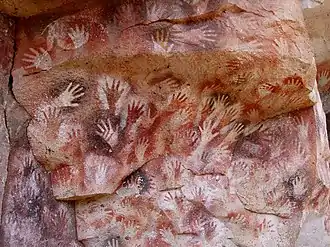 Hands, stenciled at the Cave of the Hands | |
| Official name | Cueva de las Manos, Río Pinturas |
| Location | Santa Cruz, Argentina |
| Criteria | Cultural: (iii) |
| Reference | 936 |
| Inscription | 1999 (23rd Session) |
| Area | 600 ha (1,500 acres) |
| Buffer zone | 2,331 ha (5,760 acres) |
| Coordinates | 47°09′21″S 70°39′26″W |
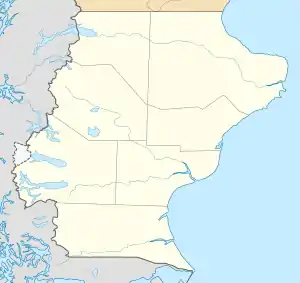  Location of Cueva de las Manos in Santa Cruz Province 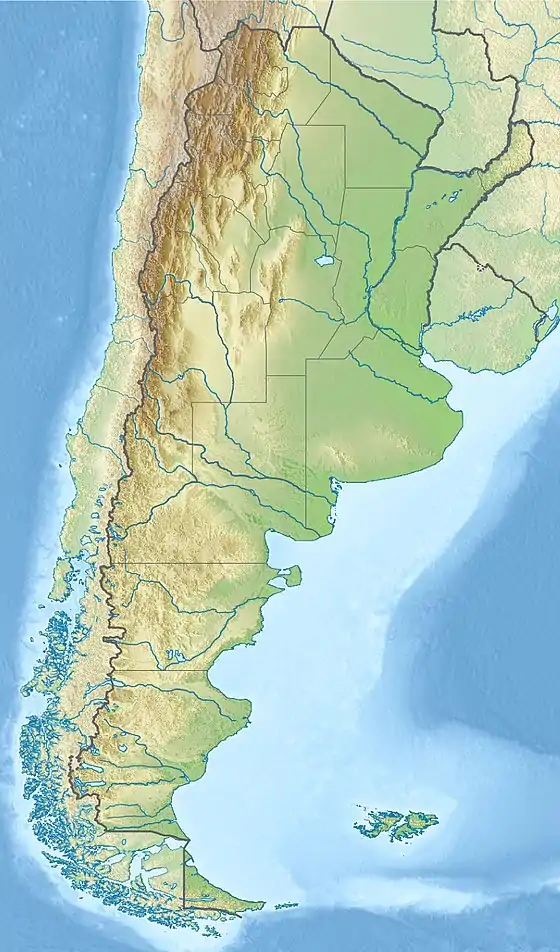 Cueva de las Manos (Argentina) | |
The site was last inhabited around 700 AD, possibly by ancestors of the Tehuelche people. Argentine surveyor and archaeologist Carlos J. Gradin and his team conducted the most important research on the site in 1964, when they began excavating sites during a 30-year study of cave art in and around Cueva de las Manos. The importance of Gradin's discoveries to the country's natural and cultural heritage resulted in the site being named a UNESCO World Heritage Site in 1999. The site is a National Historic Monument in Argentina.
Location
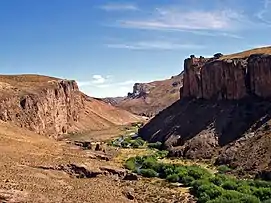
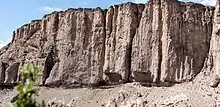
Cueva de las Manos refers to both the main site of the cave and the surrounding complex of rock art sites which includes it.[3] The cave lies at the base of a stepped cliff in the Pinturas River Canyon, in the upper part of the Deseado River basin,[4][5][6] in an isolated part of the Patagonian landscape.[7] It is about 165 km (103 mi) south of Perito Moreno, a town in northwest Santa Cruz Province, Argentina.[8][9] The site is part of both Perito Moreno National Park[10] and Cueva de las Manos Provincial Park.[11]
Climate
During the time of the Paleoindians, around the late Pleistocene to early Holocene geological periods, the areas between 400 and 500 metres (1,300 and 1,600 ft) above sea level formed a microclimate in which the canyon was home to grasslands hospitable to the animals that lived in it.[12] This microclimate included the Schinus molle plant, which was useful to native inhabitants for its ability to form resins and adhesives, as well as its use as a source of firewood.[12] The climate was also home to edible vegetables and plants that could be used for medicine; tubers, such as the rush root; and numerous fruits, such as that of the Berberis plant.[12]
The current climate of the cave area can best be described as precordilleran steppe (or "grassy foothills").[13][14] The climate is cold and dry,[15] with very low humidity;[2] Ian N. M. Wainwright, Senior Conservation Scientist at the Canadian Conservation Institute, and colleagues state that the area receives a total annual precipitation of less than 20 mm (0.79 in) per year,[16] whilst scholars Gladys I. Galende and Rocío Vega state that it averages 200 mm (7.9 in) per year.[17] The topography of the canyon prevents the strong westward winds that are natural to the region, making winters in the area less severe.[18] The average temperature of the area is 8 °C (46 °F),[19] with extreme highs of around 38 °C (100 °F) and extreme lows of around −10 °C (14 °F).[17] The coldest month of the year is July, and the warmest month of the year is February, which experience averages of −3 °C (27 °F) and 21 °C (70 °F), respectively.[17]
Access
In ancient times, people accessed the Pinturas Canyon, and by extension the cave area, through ravines and gorges in the east and west, typically from higher elevations around 600 to 700 metres (2,000 to 2,300 ft) above sea level.[20] Currently, there are three gravel roads that lead to the site: a 46 km (29 mi) route from the south, starting near Bajo Caracoles, and two more further north; a 28 km (17 mi) route from Ruta 40 (Route 40);[9] and a 22 km (14 mi) route that ends with a 4 km (2.5 mi) foot trail.[21]
History
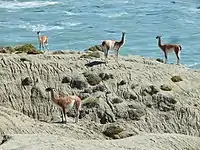
When the site was occupied, the Pinturas and Deseado Rivers drained into the Atlantic Ocean, and provided water for herds of guanacos, making the area attractive to Paleoindians. As the glacial ice fields melted, the Baker River captured the drainage of the eastward flowing rivers. The resulting reduction in water levels of the Pinturas and Deseado rivers led to a progressive abandonment of the Las Manos site.[23]
Projectile points, a bola stone fragment, side-scrapers, and fire pits[24] have been found alongside the remains of guanaco, puma, fox, bird and other small animals.[5][25] Guanacos were the natives' primary food source; hunting tactics included bolas and ambushes,[lower-alpha 2][26][27] and game drives, in which they would drive guanacos into gorges, ravines, and other dangerous areas in order to better collectively hunt them.[28] The use of these natural features in order to trap and hunt guanacos is recorded in the art of the cave, and is an example of how the surrounding topography of the area bore direct influence on the art and how it was created.[29] Dart/spear throwers are also depicted in the artwork of the cave area, although there is little archaeological evidence of this type of weapon being used in Patagonia.[30]
The Pre-Columbian economy of Patagonia as a whole depended on hunting-gathering. Archaeologist Francisco Mena states: "...[in the] Middle to Late Holocene Adaptations in Patagonia ... neither agriculture nor fully fledged pastoralism ever emerged."[31] Argentine surveyor and archaeologist Carlos J. Gradin remarks in his writings that all the rock art in the area shows the hunter-gatherer lifestyle of the artists who made it.[32] The existence of obsidian in the area of the cave—which is not natural to the region—also implies a broad-ranging network of trade between peoples of the cave area and distant tribal groups.[33][34][20]
Beginning around 7,500 BC, the site, along with the Cerro Casa de Piedra-7 site near lake Burmeister, became important landmarks in a nomadic circuit[35] between the Pinturas Canyon and its surrounding areas, the western part of the Central High Plateau, and the steppes and forests of the ecotone bordering the steppes and forests of the mountainous-lake environment of the Andes.[35] These regions existed at various elevations.[lower-alpha 3][35] The migratory patterns of this circuit were seasonal, following the abundance of vegetables in each region, and the births of guanacos, which varied based on the altitude of their habitat.[28] The furs of newborn guanacos were highly sought after by the native peoples, increasing the importance of guanaco birth patterns to the timing of the seasonal migrations.[28] The prime time for newborn guanacos near Cueva de las Manos was around November.[28] The groups who inhabited the area included the long-vanished Toldense people, who lived in the caves until the third or second millennium BC.[36] When occupying the area, temporary camp sites would be made around the cave, where extended families or even large bands of people would gather.[28] The groups that gathered at these camp sites would have enabled the inhabitants to organize group hunting of guanacos.[28]
The earliest rock art at the site began to be created around 7,300 BC.[lower-alpha 1][6] At first, Cueva de las Manos was the only site in this region to contain rock art, consisting of the A1 and A2 styles of the cave, but after 6,800 BC the art of Las Manos, particularly hunting scenes of what would later become known as styles A3, A4, and A5, was created at other sites in the region.[28] The site was last inhabited around 700 AD, with the final cave dwellers possibly being ancestors of the Tehuelche tribes.[37][38][39]
Modern study and protection
Father Alberto Maria de Agostini, an Italian missionary and explorer, first wrote about the site in 1941.[40][41] It was then investigated by an expedition of the La Plata Museum in 1949.[3] Argentine surveyor and archaeologist Carlos Gradin and his team began the most substantial research on the site in 1964, initiating a 30-year-long study of the caves and their art.[42][26] Gradin's work has helped to identify the different stylistic sequences of the cave.[6]
Cueva de las Manos is a National Historic Monument in Argentina,[43] and has been since 1993.[44] In 1995, the site became a major subject in a study of Argentina's rock art initiated by the National Institute of Anthropology and Latin American Thought (INAPL).[45] This study led to Cueva de las Manos becoming listed as a UNESCO World Heritage Site in 1999.[45] In 2015, the land was bought from a private ranch by Rewilding Argentina, an environmentalist organization.[46] In 2018, the site received its own provincial park,[11] and as of 2020 the land is controlled directly by the state, after being donated by Rewilding Argentina.[46]
Geology
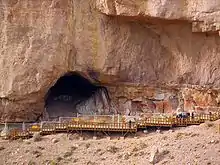
The cave is formed out of the walls of the canyon, which are composed of ignimbrite[47] and other volcanic rocks in the Bahía Laura Group.[45] The rocks were formed about 150 million years ago during the Jurassic period as part of the larger Deseado Massif.[45][19] The cave and surrounding overhangs were carved out of the rock face through differential erosion, a process by which weaker rocks were eroded away, leaving formations composed of the stronger rocks.[45] This erosion was caused by the Pinturas River, fed by glacial runoff, which cut into the Chon Aike Formation in order to form the Pinturas Canyon.[45] The cave itself is located at a fissure in the rock face, which caused the river to erode it more than the surrounding canyon wall.[19]
The site is composed of the cave itself, which is about 20 m (66 ft) deep, and two outcroppings, and the walls at either side of the entrance.[48] The entrance faces approximately northeast and is about 15 m (50 ft) in height by 15 m (50 ft) wide.[48] The paintings on the cave's wall span about 60 m × 200 m (200 ft × 650 ft).[48] The initial height of the cave is 10 m (33 ft).[49] The ground inside has an upward slope; as a result, the height is eventually reduced to no more than 2 m (6 ft 7 in).[49]
Artwork

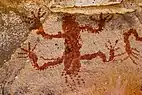
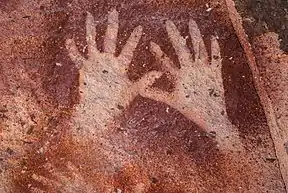
Cueva de las Manos is named for the hundreds of hand paintings stenciled into multiple collages on the rock walls.[50] The art in the Cueva de las Manos is some of the most important art in the New World, and by far the most famous among rock art in the Patagonian region.[26][38][51][52] The art dates to between around 7,300 BC to 700 AD,[lower-alpha 1] during the Archaic period of Pre-Columbian South America,[53][54] or the late Pleistocene to early Holocene geological periods.[38][55] Scholars Ralph Crane and Lisa Fletcher assert that the rock art at Cueva de las Manos includes the oldest-known cave paintings in South America.[56]
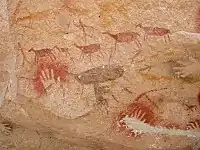
The artwork decorates the interior of the cave and the surrounding cliff faces.[57] The art can be divided by subject into three basic categories: people, the animals they ate, and the human hand.[26] Inhabitants of the Las Manos site hunted guanacos for survival, a dependency reflected in their artwork by totemic-like depictions of the creatures.[26]
Several waves of people occupied the cave over time.[37] The age of the paintings was calculated from the remains of bone-made pipes used for spraying the paint on the wall of the cave to create the stenciled artwork of the hand collages,[58] radiocarbon dating of the artwork itself,[59] and stratigraphic dating, including from a piece of the rock wall that had fallen with art on it.[60] Chemical analysis of the pigments used to create the painting, and analysis of the stylistic aspects and superimpositioning (overlap) of the different parts of the art has verified that it is unquestionably authentic.[6][1] According to scholar Irene Fanning and colleagues in 2020, it is "...the best material evidence of early hunter gatherer groups in South America."[39]
Forms
The works in the cave can at first be described as naturalistic—they are close to how the subjects of the art would have looked in real life.[1] Over time, they gradually become more stylized, meaning that the images become increasingly abstract and different in form from how the subject would normally look.[26][6]
There are over 2,000 handprints in and around the cave.[49] Most of the images are painted as negatives or stencilled, alongside some positive handprints.[61] A survey in the 1970s counted 829 left hands to 31 right.[41][62][61] This suggests that painters held a bone spray pipe (possibly made from a bird) with their right hand.[61][63][64][59] Some hands are missing fingers, which could be due to necrosis, amputation, or deformity, but might also indicate the use of sign language or bending fingers to convey meaning.[65][66]
The varying depth of the rock face alters the "canvas" of the artwork, and the different depths from the viewer alters the way the images are seen, based on where the viewer is standing.[67] There is a large amount of superimpositioning of the hands in different areas as well,[26][6] with some areas of the art containing so much that the hands form a palimpsest background of layered color.[68][69] Along with the superimposed masses of images, there are many purposefully placed single hands.[69]
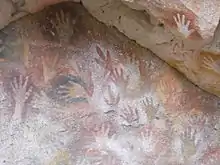
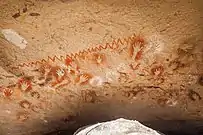
There are also depictions of human beings, guanacos,[37] rheas, felines, south Andean deer,[70] and other animals, as well as geometric shapes, zigzag patterns, representations of the sun, and hunting scenes.[49][64] The hunting scenes are naturalistic portrayals of a variety of hunting techniques, including the use of game drives and bolas.[lower-alpha 2][37][27] Similar paintings, though in smaller numbers, can be found in nearby caves. There are also red dots on the ceilings, probably made by submerging hunting bolas in ink, and then throwing them up.[6][64]
The wildlife depicted in the artwork is still found in the area today.[57][10] Most prominent among the animals are the guanacos, upon which the natives depended for survival.[26] There are repeated scenes of guanacos being surrounded as they are hunted,[49] suggesting that this was the preferred tactic for killing the creatures.[26]
Cultural context
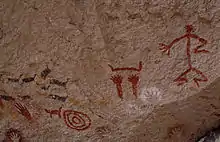
Little is known about the culture of those who made these works aside from the tools they used and what they hunted. Modern research is left to speculate about their culture and what life was like in the societies that created it.[26] However, that so many people contributed to the artwork for thousands of years suggests the cave held great significance for the artists who painted on its walls.[6] The art shows the people of this area were not merely restricted to stone tools and subsistence, but had a symbolic element to their culture.[55]
Regardless of its purpose, the artwork played a key role in the collective social memories of the peoples who inhabited the area, with earlier groups influencing later ones through a continuous narrative, playing out over multiple millennia.[73] Important aspects of the culture of the hunter-gatherers are shown in the themes of the art, such as the reproductive cycles of guanacos, and collective hunting.[73] The site also bore a deep social and personal connection to the artists, as the same groups returned to the location seasonally and created artwork at the cave, which was a kind of ritual.[73]
Purpose
The exact function or purpose of this art is unknown, although some research has suggested that it may have had a religious or ceremonial purpose[26][74] as well as a decorative one.[65] Some scholars, such as American world historian Merry Wiesner-Hanks, have suggested that hands are indicative of the human desire to be remembered,[63] or to record that they were there.[64][75] However, Jean Clottes, a prominent French prehistorian and archaeologist, has challenged this perspective, stating that that "the likelihood of such behavior is virtually zero."[74] Instead, Clottes asserts that prehistoric shamanism is the most plausible explanation for the purpose of the artwork, as part of "ceremonies about which we will never know anything", although he acknowledges that this hypothesis does not explain everything, and that much work still needs to be done.[74] Another hypothesis posits that perhaps the art served as boundary markers between peoples, showing territoriality as well as ensuring the cooperation of others by functioning as aggregation sites.[76][77] There are also hypotheses that the works were part of hunting magic,[78] with Australian archaeologist and anthropologist Alan Thorne suggesting that they might have been created as part of efforts to influence the number of animals available to be hunted.[79] Regardless of the specific reasons for the creation of the art, the fact that many people gathered in one place to contribute to the rock art for such a long period shows a large cultural significance, or at least usefulness, to those who participated.[6]
Materials
The binder used in the artwork is unknown but the mineral pigments include iron oxides, producing reds and purples; kaolin, producing white; natrojarosite, producing yellow; manganese oxide (pyrolusite),[16] which makes black; and copper oxide,[lower-alpha 4] making green.[80][37][10] Haematite, goethite, green earth, quartz, and calcium oxalate have also been detected.[16][81] Gypsum was used,[16] which allowed the pigments to better adhere to the surface of the rock faces that they were created on.[59]
Stylistic groups
Research and archaeology on the rock art of the cave has led specialists to categorize the art into four stylistic groups, proposed by Carlos Gradin and adapted and modified by others:[82] A, B, B1, and C,[83] also known as Río Pinturas I, II, III, and IV, respectively.[6] These stylistic groups, separated into three phases of production, cover a time period of around eight millennia.[38] The first two groups were partly conceived to differentiate group A's dynamic depiction of guanacos from group B's static depiction of them.[83]
Stylistic group A
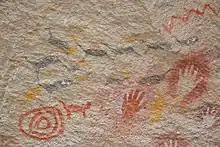
Stylistic group A (also known as Río Pinturas I) is the art of the first hunter-gatherers who lived in the area.[6] It is the oldest style in the cave, and can be traced back to around 7,300 BC.[39][38][26] The style is naturalistic and dynamic, and encompasses polychrome, dynamic hunting scenes along with negative human hand motifs.[38][6] The imagery takes advantage of the grooves and irregularities in the rock face itself to form part of the art.[6][29] This is especially true in the use of these irregularities to represent the topography of the settings of the images, such as in the depiction of gorges or ravines.[29] The hunters depicted in the scenes were likely long distance hunters, and the hunting scenes often depicted ambush or surround tactics being used when hunting guanacos.[6]
Since 2010, this stylistic group has been further subdivided into 5 different sub-styles, or series, categorized by color/material.[70] These series are classified as A1 (Ochre series), which is primarily made up of ochre and some red; A2 (Black series), which is predominantly black but also contains some dark purple; A3 (Red series) which primarily incorporates red; A4 (Purplish/Dark Red series), which uses purplish red and dark red; and A5 (White/Yellow series), which predominately uses the color white but also incorporates yellow-ochre.[70] In terms of layering, A2 generally covers A1; A3 goes over A1 and A2; A4 goes over A3 and A2; and A5 is positioned on top of all other layers.[70] The sub-styles of stylistic group A are numbered chronologically; that is, A1 is the oldest and A5 is the youngest.[84]
Black series in particular introduced several artistic innovations that would be carried forward into subsequent artistic styles.[24] Among these include the introduction of both aerial and hierarchical perspectives, which would be incorporated into later artwork.[24] It also introduced contrasting colors, in the form of black and dark purple, which were used in order to differentiate between separate representations, a method that would also be used over time throughout the history of the art of the cave.[24] Many of these influences would carry on in the styles of hunting scenes as late as 5,400 BC.[85]
Stylistic group A ended during the H1 eruption of the Hudson volcano, which took place around 4,770/4,675 BC[86] and led to the abandonment of the Rio Pinturas Area.[87] It is very likely that this eruption is what caused the end of this stylistic group.[86]
Stylistic groups B and B1
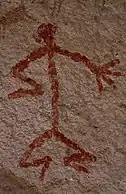
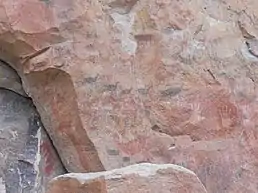
A new cultural group, entering the scene before 5,000 BC, and lasting until around 1,300 BC, created the art of what is now considered stylistic groups B (Río Pinturas II) and B1 (Río Pinturas III).[6]
Around 5,000 BC, group B emerged.[38] Static, isolated groups of guanacos with large bellies, possibly pregnant, replace the lively hunting scenes that marked the previous group.[38][6][88] These pregnant guanacos and their style and construction were first introduced as part of the Black series of Stylistic group A.[24] Large groups of superimposed handprints, numbering around 2,000, in many colors, are associated with group B,[6] as are some rarer motifs of human and animal footprints.[26]
In group B1, a subgroup of B, the forms become more and more schematic, and figures, human and animal, become more stylized;[89] the group includes hand stencils, bola marks, and dotted line patterns.[6][38]
Stylistic group C
Stylistic group C, Río Pinturas IV, begins around 700 AD and marks the last of the stylistic sequences in the cave.[6][38] The group focuses around abstract geometric figures[38] including highly schematic silhouettes of both animal and human figures, alongside circles, zigzag patterns, dots, and more hands superimposed onto larger groups of hands.[6][38] The primary color is red.[6][38]
Cultural significance and conservation
Every February the nearby town of Moreno hosts a celebration in honor of the caves[6][90] called Festival Folklórico Cueva de las Manos.[91] Significant numbers of tourists visit the cave,[32] which is known worldwide.[5][4][92] The site's designation as a World Heritage Site has contributed to this effect, acting as a type of "quality seal" for potential tourists and the global cultural tourism industry.[93] As of 2020, Cueva de las Manos is visited by around 8,000 people per year.[46] As a tourist site, it is run by the state.[46] The cave and its paintings have served as the inspiration and setting for the children's book Ghost Hands, written by American writer Thomas A. Barron and illustrated by William Low and published in 2011.[94]
The number of tourists visiting the site has increased by a factor of four since its inclusion on the UNESCO World Heritage list in 1999.[95] This large influx of tourists has brought new challenges for those seeking to preserve the site.[6] Currently, the most significant threat is graffiti.[16][43] Other forms of vandalism, such as visitors taking pieces of painted rock from the walls and touching the paintings with their hands, have damaged the site and contributed to the overall negative impact of tourism.[2]
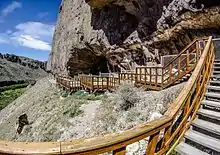
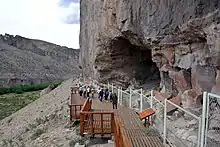
In response to these issues, the site has been closed off with chain-link fencing[43][96] with a boardwalk to secure the site from the demands of increased ecotourism.[97][95] The boardwalk helps to control the movements of visitors and serves as a convenient walkway.[95] The site has also been equipped with sanctioned walking trails, a guide lodge, railings and a parking lot.[32] A team of professionals from the INAPL and the National Scientific and Technical Research Council (CONICET) supervised the construction of these facilities.[32][98] An awareness program has also been undertaken to educate tourists and visitors to the site, including local guides,[97][99] and to facilitate greater involvement by local communities.[32] The rock art of the site is also being recorded and documented in 360º video, in preparation for the eventual creation of a virtual reality experience involving the site.[100] To access the site, visitors must be accompanied by a tour guide.[101][96]
Despite these measures taken to protect the site, the local provincial government,[97] the Argentinian government, and the UNESCO have been criticized for not doing enough to protect it.[102] The provincial government in particular has been criticized for falling short of the recommendations of the INAPL, including the need for additional staffing and a permanent on-site archaeologist.[97]
See also
- Argentine painting
- List of Stone Age art
- Los Toldos (Santa Cruz) — nearby archaeological site and namesake of the Toldense culture group
- Piedra Museo — another archaeological site of the Toldense culture group
- Pre-Columbian art
- Prehistoric art
Notes
- The UNESCO dates the art to 11,000 to 7,500 BC.[1][2]
- Bolas were weapons designed with cords, having weights on each end that were thrown at the legs of animals to trap them allowing them to be killed by hunters.[71][72]
- These regions were occupied between 500 and 700, 800 to 900, and 800 to 900 meters (2,300 and 1,600, 2,600 to 3,000, and 2,600 to 3,000 ft) above sea level, respectively.[35]
- This pigment is used more rarely. It was drawn from a source 150 km (93 mi) away.[80]
References
- World Heritage Sites: a Complete Guide to 1007 UNESCO World Heritage Sites (6th ed.). UNESCO Publishing. 2014. p. 607. ISBN 978-1-77085-640-0. OCLC 910986576.
- UNESCO World Heritage Centre. "Cueva de las Manos, Río Pinturas". UNESCO World Heritage Centre. Archived from the original on 14 April 2021. Retrieved 7 April 2021.
- Schneier, Patricia; Ponce, Agustina; Aschero, Carlos A. (2021). Gorski, Sonnia Romero (ed.). "Arte rupestre, etnografía y memoria colectiva: el caso de Cueva de las Manos, Patagonia Argentina" [Rock art (cave painting), Ethnography and collective memory. Case of study: Cueva de las manos, Patagonia, Argentina]. Revista Uruguaya de Antropología y Etnografía (in Spanish). Instituto de Antropología Facultad de Humanidades y Ciencias de la Educación. 6 (1): 71–85. doi:10.29112/RUAE.v6.n1.4 (inactive 6 November 2021). eISSN 2393-6886. Archived from the original on 2 November 2021. Retrieved 2 November 2021.CS1 maint: DOI inactive as of November 2021 (link)
- Mena, McEwan & Borrero (1997), p. 38.
- Borrero, Luis Alberto (1 September 1999). "The Prehistoric Exploration and Colonization of Fuego-Patagonia". Journal of World Prehistory. 13 (3): 321–355. doi:10.1023/A:1022341730119. S2CID 161836687.
- Onetto, María; Podestá, María Mercedes (2011). "Cueva de las Manos: An Outstanding Example of a Rock Art Site in South America" (PDF). Adoranten. Scandinavian Society for Prehistoric Art: 67–78. ISSN 0349-8808. ProQuest 1521033595. Archived (PDF) from the original on 15 April 2021. Retrieved 22 March 2021.
- Finlay, Victoria (2014). The brilliant history of color in art. J. Paul Getty Museum. p. 10. ISBN 978-1-60606-429-0. OCLC 879583340.
- Moss, Chris (13 December 2014). "Guide to Patagonia: What to Do, How to Do It, and Where to Stay". The Guardian. Archived from the original on 17 April 2021. Retrieved 9 April 2021.
- Tang, Jin Bo (April 2015). "The Hand in Art: 'Hands' in the Artwork of Patagonia". The Journal of Hand Surgery. 40 (4): 806–808. doi:10.1016/j.jhsa.2015.01.022. S2CID 71792792. PII S0363-5023(15)00081-7.
- Lundborg, Göran (2014). "Handprints from the Past". The Hand and the Brain. Springer. pp. 41–48. doi:10.1007/978-1-4471-5334-4_5. ISBN 978-1-4471-5333-7. Archived from the original on 9 October 2021. Retrieved 9 October 2021.
- "Se concretó la donación de tierras para el Parque Provincial Cueva de las Manos". Argentina.gob.ar (in Spanish). 13 July 2020. Archived from the original on 24 June 2021. Retrieved 19 June 2021.
- Aschero & Schneier (2021), p. 311.
- Orquera (1987), p. 378.
- Aschero (2018), p. 213.
- Srur, Ana M.; Villalba, Ricardo; Baldi, Germán (2011). "Variations in Anarthrophyllum rigidum radial growth, NDVI and ecosystem productivity in the Patagonian shrubby steppes". Plant Ecology. 212 (11): 1841–1854. doi:10.1007/s11258-011-9955-6. JSTOR 41508649. S2CID 1008572.
- Wainwright, Ian N. M.; Helwig, Kate; Rolandi, Diana S.; Gradin, Carlos; Podestá, María Mercedes; Onetto, María; Aschero, Carlos A. (2002). Rock paintings conservation and pigment analysis at Cueva de las Manos and Cerro de los Indios, Santa Cruz (Patagonia), Argentina. 13th Triennial Meeting Rio de Janeiro Preprints. 2. ICOM Preprints. pp. 583 & 585. OCLC 938407252. Archived from the original on 29 October 2021. Retrieved 9 May 2021.
- Galende, Gladys I.; Vega, Rocío (4 May 2021). "Summer diet selection of a rock specialist: the Wolffsohn's viscacha (Lagidium wolffsohni) in protected natural area of Pinturas River, Cueva de las Manos, Patagonia, Argentina". Studies on Neotropical Fauna and Environment. 56 (2): 135–145. doi:10.1080/01650521.2020.1763763. ISSN 0165-0521.
- World Heritage Papers 13 (PDF). Linking Universal and Local Values: Managing a Sustainable Future for World Heritage. 24 May 2003. p. 159. Archived (PDF) from the original on 14 October 2020. Retrieved 22 April 2021.
- "Cueva de las Manos. Ubicación del sitio arqueológico". cuevadelasmanos.org (in Spanish). INAPL. Retrieved 16 November 2021.
- Aschero & Schneier (2021), p. 312.
- Albiston, Isabel; Brown, Cathy, Clark, Gregor, Egerton, Alex; Grosberg, Michael; Kaminski, Anna; McCarthy, Carolyn, Mutić, Anja; Skolnick, Adam (2018). Argentina. Lonely Planet. p. 443. ISBN 978-1-78657-066-6. OCLC 1038423144.
- Aschero & Schneier (2021), p. 320.
- Isla, Federico Ignacio; Espinosa, Marcela; Iantanos, Nerina (1 March 2015). "Evolution of the Eastern flank of the North Patagonian Ice Field: The deactivation of the Deseado River (Argentina) and the activation of the Baker River (Chile)". Zeitschrift für Geomorphologie. 59 (1): 119–131. Bibcode:2015ZGm....59..119I. doi:10.1127/0372-8854/2014/0149. In "New Findings from Department of Geology in Geomorphology Provides New Insights [Evolution of the Eastern flank of the North Patagonian Ice Field: The Deactivation of the Deseado River (Argentina) and the Activation of the Baker River (Chile)]". Science Letter. NewsRX LLC. 1 May 2015. p. 936. Gale A415804207.
- Aschero & Schneier (2021), p. 323.
- Mena, McEwan & Borrero (1997), pp. 38–39, 48–49 & 50–51.
- Schobinger (2016), pp. 39–44, 57–61, 67 & 70.
- Mena, McEwan & Borrero (1997), pp. 38–39, 46–47, 48–49 & 50–51.
- Aschero & Schneier (2021), p. 313.
- Aschero & Schneier (2021), pp. 313, 315, 320–321, & 323.
- Aschero & Schneier (2021), p. 316.
- Mena, McEwan & Borrero (1997), pp. 46–47.
- Fiore (2008), p. 315.
- Magnin, L.; Lynch, V.; García Añino, E. (2 July 2020). "Intra-Site Use Patterns during the Early Holocene in the Cueva Maripe Site (Santa Cruz, Argentina)". PaleoAmerica. 6 (3): 268–282. doi:10.1080/20555563.2019.1709032. S2CID 213889275.
- Méndez M., César A.; Stern, Charles R.; Reyes B., Omar R.; Mena L., Francisco (2012). "Early Holocene Long-Distance Obsidian Transport in Central-South Patagonia". Chungara: Revista de Antropología Chilena. University of Tarapacá. 44 (3): 363–375. ISSN 0716-1182. JSTOR 23266116.
- Aschero & Schneier (2021), pp. 312–313.
- Orquera (1987), p. 370.
- "Cueva de las Manos, Río Pinturas." Archived 2020-04-08 at the Wayback Machine UNESCO World Heritage List. Retrieved 7 March 2012.
- Art & Place: Site-Specific Art of the Americas. Editorial Director: Amanda Renshaw; Text & Expertise provided by Daniel Arsenault et al. Phaidon Press. 2013. pp. 354–355. ISBN 978-0-7148-6551-5. OCLC 865298990. Archived from the original on 29 October 2021. Retrieved 27 March 2021.CS1 maint: others (link)
- Fanning, Irene; Glusberg, Jorge; Frei, Cheryl Jiménez; Perazzo, Nelly; Hartop, Christopher; Pérez, Jorge F. Rivas; Corcuera, Ruth; Reyes, Marta Arciprete de; Vaquero, Julieta Zunilda (9 March 2020). "Argentina, Republic of". Oxford Art Online. Oxford University Press (published 2003). doi:10.1093/gao/9781884446054.article.t003988. ISBN 978-1-884446-05-4. Retrieved 4 April 2021.
- Gutiérrez De Angelis, Marina; Winckler, Greta; Bruno, Paula; Guarini, Carmen (2019). "Rethinking Paleolithic Visual Culture throughout immersive technology: The site 'Cueva de las Manos' as a virtual 'Denkraum' (Patagonia, Argentina)". Widok (25): 411–435. doi:10.36854/widok/2019.25.2081. S2CID 229288678. CEEOL 895443.
- Podestá, María Mercedes; Raffino, Rodolfo A.; Paunero, Rafael Sebastián; Rolandi, Diana S. (2005). El arte rupestre de Argentina indígena: Patagonia. Grupo Abierto Communicaciones. ISBN 978-987-1121-16-8. Archived from the original on 29 October 2021. Retrieved 1 March 2021.
- Delegación Buenos Aires-MINPRO. "Cueva de las Manos". Cueva de las Manos (in Spanish). Archived from the original on 26 April 2012. Retrieved 21 March 2021.
- Wainwright, Ian N. M. (1995). "Conservation and recording of rock art in Argentina". CCI Newsletter. No. 16. Canadian Conservation Institute. pp. 4–5. Archived from the original on 29 October 2021. Retrieved 9 April 2021.
- Levrand, Norma Elizabeth; Endere, María Luz (2020). "Nuevas categorías patrimoniales. La incidencia del soft law en la reciente reforma a la ley de patrimonio histórico y artístico de Argentina" [New heritage categories: The incidence of soft law in the recent reform of the historical and artistic heritage law of Argentina]. Revista Direito GV (in Portuguese). 16 (2): e1960. doi:10.1590/2317-6172201960.
- Geuna, Silvana Evangelina; Escosteguy, Leonardo Darío (April 2008). "El Valle del Río Pinturas. La Cueva de las Manos". Anales – Dirección Nacional del Servicio Geológico Minero Argentino (in Spanish). 46: 771–780. hdl:11336/76841. ISSN 0328-2325.
- Temes, Joaquin (18 July 2020). "'Cueva de las Manos' to become a protected area after donation". Buenos Aires Times. Retrieved 15 November 2021.
- Aschero (2018), p. 209.
- Schobinger (2016), p. 40.
- Menon (2010), p. 243.
- Shally-Jensen, Michael (2015). Countries, Peoples & Cultures: Central & South America. 1 (First ed.). Salem Press. p. 147. ISBN 978-1-61925-788-7. OCLC 915353454.
- Menon (2010), p. 30: "Cave paintings from much earlier epochs have been discovered in several provinces, the most famous being Cueva de las Manos in Patagonia (see p243)."
- Funari, Pedro Paulo A.; Zarankin, A.; Stovel, E. (2009). "South American Archaeology". In Gosden, Chris; Cunliffe, Barry; Joyce, Rosemary A. (eds.). The Oxford Handbook of Archaeology. Oxford University Press. pp. 958–1000. doi:10.1093/oxfordhb/9780199271016.013.0031. ISBN 978-0-19-927101-6. OCLC 277205272.
This is perhaps the best-known site in the country, because of its evocative zoomorphic, anthromorphic, and geometric rock-art panels.
- National Geographic Society (9 October 2013). "Cuevas de las Manos". National Geographic Society. Archived from the original on 6 March 2021. Retrieved 4 March 2021.
- Trofimova, E.; Trofimov, A. (1 September 2019). "World Subterranean Heritage". Geoheritage. 11 (3): 1113–1131. doi:10.1007/s12371-019-00351-8. S2CID 150080128.
- Neves, Walter A.; Araujo, Astolfo G. M.; Bernardo, Danilo V.; Kipnis, Renato; Feathers, James K. (22 February 2012). "Rock Art at the Pleistocene/Holocene Boundary in Eastern South America". PLOS ONE. 7 (2): e32228. Bibcode:2012PLoSO...732228N. doi:10.1371/journal.pone.0032228. PMC 3284556. PMID 22384187.
- Crane, Ralph J.; Fletcher, Lisa (2015). Allen, Daniel (ed.). Cave. Earth Series. Reaktion Books. pp. 111–112. ISBN 978-1-78023-460-1. OCLC 915154364.
- Onetto, Maria (2014). "Cueva de las Manos, Río Pinturas Cave Art". In Smith, Claire (ed.). Encyclopedia of Global Archaeology. 3. Springer. pp. 1841–1846. doi:10.1007/978-1-4419-0465-2_1624. ISBN 978-1-4419-0426-3. LCCN 2013953915.
- Wood, Barry (1 October 2019). "Beachcombing and Coastal Settlement: The Long Migration from South Africa to Patagonia—The Greatest Journey Ever Made". Journal of Big History. 3 (4): 38. doi:10.22339/jbh.v3i4.3422. Archived from the original on 9 February 2020. Retrieved 5 May 2021.
- "Cueva de las Manos. Historia de las Investigaciones en el sitio arquelógico". cuevadelasmanos.org (in Spanish). INAPL. Retrieved 16 November 2021.
- Schobinger (2016), p. 67.
- Moore (2017), p. 100.
- Steele, James; Uomini, Natalie (2005). "Humans, tools and handedness" (PDF). In Roux, Valentine; Bril, Blandine (eds.). Stone Knapping: the Necessary Conditions for a Uniquely Hominin Behaviour. McDonald Institute for Archaeological Research, University of Cambridge. p. 234. ISBN 1-902937-34-1. OCLC 64118071. Archived (PDF) from the original on 16 October 2021. Retrieved 23 April 2021.
- Parfit, Michael (December 2000). "Hunt for the First Americans". National Geographic. Vol. 198 no. 6. National Geographic Society. p. 40. ISSN 0027-9358.
- Wiesner-Hanks, Merry E. (23 September 2015). A Concise History of the World. Cambridge University Press. pp. 11–13. ISBN 978-1-107-02837-1. OCLC 908262350.
- Sraj, Shafic (January 2015). "The Hand in Art: The Hand Was First in Art". The Journal of Hand Surgery. 40 (1): 140. doi:10.1016/j.jhsa.2014.10.045. PII S0363-5023(14)01496-8.
- Achrati, Ahmed. "Hand Prints, Footprints and the Imprints of Evolution". Rock Art Research. 25 (1): 23–33. doi:10.3316/ielapa.484264644023649 (inactive 31 October 2021). OCLC 663872753. Archived from the original on 29 October 2021. Retrieved 26 July 2021.CS1 maint: DOI inactive as of October 2021 (link)
- Aschero & Schneier (2021), p. 315.
- Dobrez, Patricia (11 December 2014). "Hand Traces: Technical Aspects of Positive and Negative Hand-Marking in Rock Art". Arts. 3 (4): 367–393. doi:10.3390/arts3040367.
- Dobrez, Patricia (December 2013). "The Case for Hand Stencils and Prints as Proprio-Performative". Arts. 2 (4): 273–327. doi:10.3390/arts2040273.
- Aschero & Schneier (2021), p. 314.
- "bolas". Oxford English Dictionary (Online ed.). Oxford University Press. Retrieved 29 October 2021. (Subscription or participating institution membership required.)
- Aschero & Schneier (2021), pp. 316 & 319.
- Aschero & Schneier (2021), pp. 324–325.
- Clottes, Jean (2016). What is Paleolithic Art?. Translated by Martin, Oliver Y.; Martin, Robert D. University of Chicago Press. pp. 55–56. doi:10.7208/chicago/9780226188065.001.0001. ISBN 978-0-226-26663-3. LCCN 2015029149.
- Moore (2017), p. 102.
- Podestá, María Mercedes (2002). "Cueva de las Manos as an example of cultural-natural heritage hybrids" (PDF). In Gauer-Lietz, Sieglinde (ed.). Nature and Culture: Ambivalent Dimensions of our Heritage Change of Perspective. Deutsche Unesco-Kommission. pp. 128–129. ISBN 3-927907-84-7. Archived (PDF) from the original on 24 June 2021. Retrieved 22 June 2021.
- Aschero (2018).
- Beresford, Matthew (2013). The white devil: the werewolf in European culture. Reaktion Books. p. 35. ISBN 978-1-78023-205-8. OCLC 861693363.
- Raymond, Robert; Thorne, Alan; Buckley, Anthony (1989). Roads Without Wheels (DVD). Man on the Rim: The Peopling of the Pacific. Landmark Media. 14 minutes in. OCLC 664751633.
There are some animals here too. Paintings probably intended to increase the numbers of animals that could be hunted.
- Moore (2017), p. 98.
- Siddall, Ruth (8 May 2018). "Mineral Pigments in Archaeology: Their Analysis and the Range of Available Materials". Minerals. 8 (5): 201. doi:10.3390/min8050201. ISSN 2075-163X.
- Fiore (2008), pp. 313 & 315.
- Dobrez, Livio; Dobrez, Patricia (2014). "Canonical Figures and the Recognition of Animals in Life and Art". Boletín del Museo Chileno de Arte Precolombino. 19 (1): 9–22. doi:10.4067/s0718-68942014000100002.
- Aschero & Schneier (2021), pp. 313–314.
- Aschero & Schneier (2021), p. 310.
- Aschero (2018), p. 234: "It is very likely that the great eruption of the Hudson volcano around 6720/6625 BP . . . effectively marked the ending of SGA [stylistic group A] in the Alto Rio Pinturas and the high Andean lands."
- Aschero & Schneier (2021), pp. 313 & 323.
- Aschero (2018), p. 220.
- Brook, George A.; Franco, Nora V.; Cherkinsky, Alexander; Acevedo, Agustín; Fiore, Dánae; Pope, Timothy R.; Weimar, Richard D.; Neher, Gregory; Evans, Hayden A.; Salguero, Tina T. (October 2018). "Pigments, binders, and ages of rock art at Viuda Quenzana, Santa Cruz, Patagonia (Argentina)". Journal of Archaeological Science: Reports. 21: 47–63. doi:10.1016/j.jasrep.2018.01.004. S2CID 134053614. PII S2352409X17306193.
- Menon (2010), p. 242.
- Bernhardson, Wayne (2014). McLain, Kevin (ed.). Patagonia (4th ed.). Moon Publications. p. 385. ISBN 978-1-61238-912-7. OCLC 897447154.
- Cohen, Jeffrey Jerome (2018). "Feeling Stone". SubStance. Johns Hopkins University Press. 47 (2): 23–35. ISSN 1527-2095. Project MUSE 701284.
- Troncoso, Andrés; Armstrong, Felipe; Basile, Mara (2017). "Rock Art in Central and South America: Social Settings and Regional Diversity". In David, Bruno; McNiven, Ian J (eds.). The Oxford Handbook of the Archaeology and Anthropology of Rock Art. Oxford University Press. p. 300. doi:10.1093/oxfordhb/9780190607357.013.53. ISBN 978-0-19-060735-7.
- Loomis, Jenna (November 2018). "'People did great things with their hands': Telling Stories to Engage with Culture". WOW Stories. hdl:10150/651275. ISSN 2577-0551.
- Podestá, María Mercedes; Strecker, Matthias (2014). "South American Rock Art". Encyclopedia of Global Archaeology. Springer. pp. 6828–6841. doi:10.1007/978-1-4419-0465-2_1623. ISBN 978-1-4419-0426-3.
- Keeling, Stephen; Meghji, Shafik; Moseley-Williams, Sorrel; Triebe, Madelaine (2019). The Rough Guide to Argentina (7th ed.). Rough Guides. p. 494. ISBN 978-1-789-19461-6. LCCN 2005209439. OCLC 1112379178.
- Strecker, Matthias; Pilles, Peter J. (January 2005). "Administration of parks with rack art: A symposium and workshop in Jujuy Argentina, December 2003". Conservation and Management of Archaeological Sites. 7 (1): 52–55. doi:10.1179/135050305793137585. S2CID 109586686.
- Elías, Alejandra; Onetto, María; Salerno, Virginia; Cassiodoro, Gisela; Castro, Analía; Colombo, Mariano Jorge (2010). "Imaginátelo en vivo: patrimonio en acción y arqueología "todo terreno" en Cueva de las Manos, Santa Cruz" [Imagine It Live: Heritage in Action and "Off-Road" Archeology in Cueva De Las Manos, Santa Cruz]. Cuadernos del Instituto Nacional de Antropología y Pensamiento Latinoamericano (in Spanish). Instituto Nacional de Antropología y Pensamiento Americano. 22: 145–154. ISSN 1852-1002.
- Strecker, Matthias; Podestá, María Mercedes (January 2006). Saiz-Jimenez, C. (ed.). "Rock Art Preservation in Bolivia and Argentina" (PDF). COALITION: CSIC Thematic Network on Cultural Heritage. Electronic Newsletter. No. 11. pp. 5–10. OCLC 972288456. S2CID 201825304. Archived (PDF) from the original on 18 June 2013. Retrieved 6 April 2021.
- Gutiérrez De Angelis, Marina (20 April 2021). "Expanded Visual Anthropology: Cave Art and Mixed Reality in the archaeological site Cueva de las Manos (Argentina)". Revista de Antropologia Visual (in Spanish). 2 (29): 1–20. doi:10.47725/rav.029.01. ISSN 2452-5189.
- Gustafsson, Anders; Karlsson, Håkan (2014). "Authenticity and the construction of existential identity: Examples from World Heritage classified rock art sites". In Alexandersson, Henrik; Andreef, Alexander; Bünz, Annika (eds.). Med hjärta och hjärna: en vänbok till professor Elisabeth Arwill-Nordbladh. GOTARC Series A, Gothenburg Archaeological Studies. 5. Goteborgs Universitet, Institutionen for historiska studier. p. 641. OCLC 904568027. Archived from the original on 29 October 2021. Retrieved 9 May 2021.
- Endere, María Luz (January–December 2001). "Patrimonio arqueológico en Argentina. Panorama actual y perspectivas futuras" [Archaeological Heritage in Argentina. Current Situation and Perspectives for the Future]. Revista de Arqueología Americana (in Spanish). Instituto Panamericano de Geografica e Historia (20): 143–158. JSTOR 27768449. Gale A87703543.
Bibliography
- Aschero, Carlos A. (2018). "Hunting scenes in Cueva de las Manos: Styles, content and chronology (Río Pinturas, Santa Cruz – Argentinian Patagonia)". In Troncoso, Andrés; Armstrong, Felipe; Nash, George (eds.). Archaeologies of rock art: South American Perspectives. Routledge. pp. 209–237. doi:10.4324/9781315232782-9. ISBN 9781138292673. OCLC 975369942. S2CID 189442969.
- Aschero, Carlos A.; Schneier, Patricia (13 April 2021). "The Black Series in the Hunting Scenes of Cueva De Las Manos, Río Pinturas, Patagonia, Argentina". In Davidson, Iain; Nowell, April (eds.). Making Scenes: Global Perspectives on Scenes in Rock Art. Berghahn Books. pp. 310–326. ISBN 978-1-78920-921-1. Archived from the original on 6 November 2021. Retrieved 3 November 2021.
- Fiore, Dánae (2008). "Art on the rocks: Argentina, 2000–2004". In Bahn, Paul G.; Franklin, Natalie R.; Strecker, Matthias (eds.). Rock art studies: news of the world. 3. Paul G. Bahn, Natalie R. Franklin, Matthias Strecker. Oxford Books. pp. 309–318. ISBN 978-1-78297-590-8. JSTOR j.ctt1cd0p65. OCLC 908040896. Archived from the original on 29 October 2021. Retrieved 8 April 2021.
- Mena, Francisco; McEwan, Colin; Borrero, Luis Alberto (1997). McEwan, Colin; Borrero, Luis Alberto; Prieto, Alfredo (eds.). Patagonia: natural history, prehistory, and ethnography at the uttermost end of the earth. Princeton University Press. doi:10.1515/9781400864768. ISBN 978-1-4008-6476-8. JSTOR j.ctt7ztms2. OCLC 889252383.
- Menon, Jayashree, ed. (2010). Argentina. Eyewitness Travel Guides. Contributors: Wayne Bernhardson, Declan McGarvey, Chris Moss (Rev. ed.). DK Publishing. ISBN 978-0-75666-193-9. OCLC 741938981.
- Moore, Jerry D. (2017). Incidence of travel: recent journeys in ancient South America. University Press of Colorado. doi:10.5876/9781607326007. ISBN 978-1-60732-600-7. JSTOR j.ctt1m3210q. LCCN 2016053403. OCLC 973325343.
- Orquera, Luis Abel (December 1987). "Advances in the archaeology of the Pampa and Patagonia". Journal of World Prehistory. 1 (4): 333–413. doi:10.1007/BF00974880. JSTOR 25800531. S2CID 161730330.
- Schobinger, Juan (5 December 2016). The Ancient Americans: a reference guide to the art, culture, and history of pre-Columbian North and South America. 1. Translated by Evans-Corrales, Carys (1st ed.). Routledge. doi:10.4324/978131570375. ISBN 978-0-7656-8034-1. OCLC 967392115.
Further reading
- Gradin, Carlos J (1983). "El arte rupestre de la cuenca del Río Pinturas, Provincia de Santa Cruz, República Argentina". Acta Praehistorica. 2.
- Gradin, Carlos J.; Aguerre, Ana M. (1994). Contribución a la Arqueología del Río Pinturas (in Spanish). Búsqueda de Ayllu.
- Gradin, Carlos J.; Aschero, Carlos A.; Aguerre, Ana M. (1977). "Investigaciones arqueológicas en la Cueva de las Manos (Alto Río Pinturas, Santa Cruz)". Relaciones de la Sociedad Argentina de Antropología (in Spanish). 10: 201–270. hdl:10915/25285. OCLC 696124191.
External links
 |
Wikimedia Commons has media related to Cueva de las Manos, Río Pinturas. |
 |
Wikivoyage has a travel guide for Cueva de las Manos. |
- Cueva de las Manos Website (in Spanish)
- Cueva de las Manos, cave 3D model (Skechfab)
- Cueva de las Manos, Perito Moreno, images (in Spanish)
- Cave of Hands, Perito Moreno, images
- Cueva de los Manos, images
- Nomination file 936
| Northwest |  | |
|---|---|---|
| Mesopotamia |
| |
| Cuyo | ||
| Pampas | ||
| Patagonia | ||
Authority control  | |
|---|---|
| General | |
| National libraries | |
| Other | |