Curious George Learns the Alphabet
Curious George Learns the Alphabet is a children's book written and illustrated by Margret Rey and H. A. Rey and published by Houghton Mifflin in 1963. It is the sixth book in the original Curious George series.
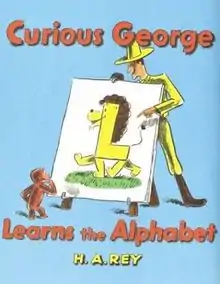 First edition | |
| Author | H. A. Rey Margret Rey |
|---|---|
| Country | United States |
| Language | English |
| Series | Curious George |
| Genre | Children's literature |
| Publisher | Houghton Mifflin |
Publication date | 1963 |
| Media type | |
| Preceded by | Curious George Flies a Kite |
| Followed by | Curious George Goes to the Hospital |
Plot
George is so curious as he looks at the little black marks, dots, and lines in the man with the yellow hat's books, he starts tearing some pages. Suddenly, the man with the yellow hat comes just in time and scolds George for tearing his books apart to find out what's in them. Books are for reading because they are full of stories, which are made of words, which are made of letters. If George wants to read a story, he first has to know the letters of the alphabet. The man then sets up a pad and begins to write each of the letters from the alphabet as well as drawing a picture for each letter (capital and lowercase letter) of the alphabet, correlating to the letter each individual picture starts with.
- The man shows George that A is first letter of the alphabet. The big A represents an Alligator, and the small a represents a piece of an apple (an apple slice).
- The big B looks like a blue Bird with feet on it, a tail, and a Bill. The small b represents a bee buzzing around a blossom.
- The big C represents a big Crab with a shell, feet, and two claws. The small c is like the big C, but smaller, so it becomes a small crab.
The man tells George he now has three letters: A, B, and C. With three letters, George can make a word, the first word he can read himself. The word is a cab. George knows what a cab is since the man once took him for a ride in a cab (a reference to a previous story). The man and George then draw the next few letters.
- The big D represents a Dinosaur and the small d looks like a dromedary, which is a camel (also known as the Arabian camel) with one hump.
- The big E represents an Elephant eating his evening meal: Eggplants. The small e resembles the ear of a man, or the ear of a monkey.
- The big F represents a Fireman Fightinng a Fire and the small f represents a flower. (George's friend was fond of flowers, but George preferred food.)
- The big G represents a Goose, and the small g represents a goldfish. George's name also starts with G.
The man tells George he now has seven letters: A, B, C, D, E, F, and G. With seven letters, they can already make quite a few words. The man tells George he have written some of them down: Dad, Ed, bad, bag, cage, bed, and feed. The man then tells George to read them while he gets him his lunch. However, when the man comes back with George's lunch, he catches George wearing the alphabet chart around his neck. He is impressed about George's real words (Dad, Ed, bag, cage, bed, and feed), but scolds him for his mischief. He says that even though George knows how to spell and read those words, it seems the only word he also can read is "bad". The man then decides they've had enough for one morning. He will feed George now and take his nap. Then, George and the man will go on with the letters.
- The big H represents a house and the small h represents a horse eating heaps of hay.
- The big I (which is a long line going straight down) resembles an icicle. The small i (which has a line with a dot on top) represents an iguana.
- The big J represents a Jaguar living in the Jungle, where George used to live. The small j represents a jack-in-the-box in which George used to make it jump.
- The big K represents a big Kangaroo named Katy and the small k represents a small kangaroo who is Katy's kid.
- The big L represents a Lion (with a Leg of Lamb for Lunch) and the small l represents a lean lady strolling along a lake licking a lollipop.
- The big M represents a Mailman named Mister Miller bringing a letter. The small m represents a mouse is munching mints.
The man tells George that M is the thirteenth letter of the alphabet, which means they are halfway through. George can make lots of words with 13 letters from A through M. The man gives him a pad of paper and a pencil. George started to think of words, and then he wrote them down and shows them to the man. He is quite impressed with the real words (ball, milk, cake, ham, jam, egg, lime, feed, and kid). However, the man gets confused at the made-up words (dalg, glidj, and blimlimlim), and he again scolds George for his mischief. He tells George that there are no such words and any letters do not make just any kind of words. George and the man then continue to look at some new letters (the other half of the alphabet).
- The big N represents a Napkin standing on a dinner plate that looks neat. The small n represents a nose in the face of a man. He has a new blue necktie on and is nibbling noodles.
- The big O represents a big Ostrich, and the small o represents a small ostrich. (Ostriches eat odd objects, especially eat a bugle that belonged to George (a reference to a previous story).
- The big P represents a big Penguin, and the small p represents a small penguin.
- The big Q represents a Quail. The small q represents a quarterback. A quarterback has to be quick, so is George.
The man tells George to get his football. He then says that it will do George good to play a little before they go on with the letters. George knew how to play the game. He knew how to carry the ball, how to take a three-point stance, and how to get ready for the kick-off. He was a fine halfback, too, and he could make a short pass, or recover a fumble. The man tells George that it was a good game, but when time is over, they go back to the alphabet.
- The big R represents a Rabbit with a radish. The small r represents a rooster.
- The big S represents a big Snail, and the small s represents a small snail.
- The big T represents a Table set for a Tea for Two. George did not care for Tea, but liked Toast. The small t represents a tomahawk.
The man tells George that it is snack time. He gives George a note to run over to the baker and hand him the note and to come right back with one dozen doughnuts without any tricks. George (curious) looked at the note the man had written and he wants more than one dozen doughnuts (perhaps 10, 100, or 1,000 dozen), so he changes the word "one" to "ten" by writing a T, an E and an N over the word "one" which is crossed out. Then, he goes over to the bakery to request ten dozen doughnuts to the baker. The baker says that an extra-large bag is needed for ten dozen doughnuts, since it is quite a lot (but that is what the note says). George brings the bag of ten dozen (120) doughnuts home, opens the extra-large bag of doughnuts and dumps them out of the bag onto the floor. When the man (finding all different kinds of doughnuts being dumped out onto the floor) catches George for changing up the note, he scolds him and says that it must be what he (himself) gets for teaching the alphabet to a little monkey. The man tells George he cannot eat any doughnuts right now and to put them back in the bag, so that they will go on with the rest of the alphabet. As a result, snack time is postponed until the alphabet is finished.
- The big U represents a big Umbrella standing Upright and the small u represents a small umbrella. The umbrella handle is also like a U.
- The big V is a big Valentine, and the small v is a small valentine. George loved valentines. He got several valentine cards every year. One card came from Nevada.
- The big W and the small w are whiskers, big ones and small ones, found on walruses, cats, and some men. George does not have whiskers but he was curious how would look if he did.
- The big X and the small x look alike, only one is big and one is small, just some of the other letters (such as W, V, U and S, along with others). Since there are only a few words that start with an X, they don't look like an X. The only exception is X-mas. Santa stands for X-mas. There is only one Santa so George and the man need only one picture. George thought X-mas was exciting. As a result, the big X and the small x are both for X-mas.
- The big Y is a big Yak, and the small y is a small, young yak.
- The big Z is a big Zebra, and the small z is a small zebra. The zebras are zipping along with zest.
Since Z is the last letter of the alphabet, the man tells George that he now knows all 26 letters of the alphabet, and now he may have the doughnuts. At the last page, the story ends when George (before eating some of the doughnuts) takes most of the doughnuts and spells out the word "THE END" (in sense it's the end of the story).