Cycling in the United States
Cycling in the United States is a minor sport in the country. It is also a mode of transport, particularly in urban areas.
| Cycling in the United States | |
|---|---|
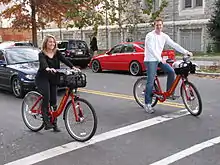 Capital Bikeshare users in Washington, D.C. | |
| Country | United States |
| Governing body | USA Cycling |
| National team(s) | United States Olympics team |
International competitions | |
As a mode of transport
History
Bicycling has been used as a mode of transport in the U.S. since the country's inception.
It experienced a rise in popularity in the 21st century, as people sought to escape congestion and reduce their environmental impact. Activists and organizations such as the League of American Bicyclists campaigned for safer bicycle infrastructure.
Law
Bicycle law in the United States regulates the use of bicycles. Although bicycle law is a relatively new specialty within the law, first appearing in the late 1980s, its roots date back to the 1880s and 1890s, when cyclists were using the courts to assert a legal right to use the roads. In 1895, George B. Clementson, an American attorney, wrote The Road Rights and Liabilities of Wheelmen, the first book on bicycle law, in which he discussed the seminal cases of the 1880s and 1890s, which were financed by Albert Pope of Columbia Bicycles, and through which cyclists gained the right to the road.[1]
By the mid-1980s, a substantial body of law pertaining to bicycles had developed, and a few attorneys had begun specializing in bicycle law. Today, attorneys specializing in bicycle law represent professional athletes, as well as average cyclists, on issues ranging from professional contracts, to traffic accidents, to traffic tickets. In addition, attorneys specializing in bicycle law may advise cyclists on other legal issues, such as bicycle theft, insurance, harassment of cyclists, defective products law, and non-professional contractual issues.
Many U.S. states require by law that children wear helmets while bicycling.Culture
The reason speculated for the lack of use of bicycles usage in the United States is because of the dominance of cars and lack of safe spaces to use bikes.[2][3][4][5]
As a sport
Ayesha McGowan became the first African American female professional road cyclist.[6] Major Taylor was the first African American world champion in cycling.[7][8][9][10]
See Also
References
- Mionske, Bob, Bicycling & the Law 345 (VeloPress 2007)
- "Rise in cycling is changing US cities". 14 July 2016. Retrieved 11 March 2019 – via www.bbc.co.uk.
- Buehler, Ralph; Pucher, John (2012). "Walking and Cycling in Western Europe and the United States: Trends, Policies, and Lessons". TR News: 34–42.
- Davies, Alex. "Here's What Americans Don't Get About Cycling — And Why It's A Problem". Business Insider. Retrieved 11 March 2019.
- Pucher, John; Buehler, Ralph; Merom, Dafna; Bauman, Adrian (December 2011). "Walking and Cycling in the United States, 2001–2009: Evidence From the National Household Travel Surveys". American Journal of Public Health. 101 (S1): S310-7. doi:10.2105/AJPH.2010.300067. PMC 3222478. PMID 21551387.
- Cohen, Josh (11 June 2015). "Can Ayesha McGowan Become America's First Black Woman Pro Cyclist?". Retrieved 11 March 2019.
- "Honoring Major Taylor, America's first black world champion". SI.com. Retrieved 11 March 2019.
- "Marshall 'Major' Taylor: world champion cyclist He was the second black world champion". 22 February 2018. Retrieved 11 March 2019.
- King, Gilbert. "The Unknown Story of "The Black Cyclone," the Cycling Champion Who Broke the Color Barrier". Smithsonian. Retrieved 11 March 2019.
- "Guy On A Bike: African-American Cycling Pioneers". 16 February 2017. Retrieved 11 March 2019.
 Cycling by country and city Cycling by country and city | |||||||||
|---|---|---|---|---|---|---|---|---|---|
| Africa | |||||||||
| Asia | |||||||||
| Europe |
| ||||||||
| North America | |||||||||
| Oceania | |||||||||