Theories about Cyrus the Great in the Quran
Cyrus the Great in the Quran is a theory that identifies Dhul-Qarnayn, a figure mentioned in verses 18:83-98 of the Qurān, with Cyrus the Great.[1] (He is most commonly identified with Alexander the Great).[2] Proposed by the German philologist G. M. Redslob in 1855, it failed to gain followers among Western scholars,[3] but was taken up by several traditional Indian, Pakistani and Iranian scholars and commentators, including Maulana Abul Kalam Azad, Israr Ahmed, Maududi, Javed Ahmed Ghamidi, Allameh Tabatabaei (in Tafsir al-Mizan),[4] Naser Makarem Shirazi (et al., in Tafsir Nemooneh)[5] and Muhammad Ali.[6]
Dhul-Qarnayn: Surat al-Kahf (surah 18), verses 83–101
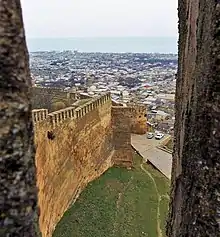
The story of Dhūl-Qarnāyn is related in Quran chapter 18 (al-Kāhf, "The Cave"). This chapter was revealed to Muḥammad when his tribe, Quraysh, sent two men to discover whether the Jews, with their superior knowledge of the scriptures, could advise them on whether Muhammad was a true prophet of God. The rabbis told them to ask Muhammad about three things, one of them "about a man who traveled and reached the east and the west of the earth, what was his story". "If he tells you about these things, then he is a prophet, so follow him, but if he does not tell you, then he is a man who is making things up, so deal with him as you see fit."
The verses of the chapter reproduced below show Dhul-Qarnayn traveling first to the Western edge of the world where he sees the sun set in a muddy spring, then to the furthest East where he sees it rise from the ocean, and finally northward to a place in the mountains where he finds a people oppressed by Gog and Magog:
| Verse | Abdullah Yusuf Ali | Pickthall |
|---|---|---|
| 18:83. | They ask thee concerning Zul-qarnain Say, "I will rehearse to you something of his story." | They will ask thee of Dhu'l-Qarneyn. Say: "I shall recite unto you a remembrance of him." |
| 18:84 | Verily We established his power on earth, and We gave him the ways and the means to all ends. | Lo! We made him strong in the land and gave him unto every thing a road. |
| 18:85 | One (such) way he followed, | And he followed a road |
| 18:86 | Until, when he reached the setting of the sun, he found it set in a spring of murky water: near it he found a people: We said: "O Zul-qarnain! (thou hast authority), either to punish them, or to treat them with kindness." | Till, when he reached the setting-place of the sun, he found it setting in a muddy spring, and found a people thereabout. We said: "O Dhu'l-Qarneyn! Either punish or show them kindness." |
| 18:87 | He said: "Whoever doth wrong, him shall we punish; then shall he be sent back to his Lord; and He will punish him with a punishment unheard-of (before). | He said: "As for him who doeth wrong, we shall punish him, and then he will be brought back unto his Lord, Who will punish him with awful punishment!" |
| 18:88 | "But whoever believes, and works righteousness, he shall have a goodly reward, and easy will be his task as we order it by our command." | "But as for him who believeth and doeth right, good will be his reward, and We shall speak unto him a mild command." |
| 18:89 | Then followed he (another) way. | Then he followed a road |
| 18:90 | Until, when he came to the rising of the sun, he found it rising on a people for whom We had provided no covering protection against the sun. | Till, when he reached the rising-place of the sun, he found it rising on a people for whom We had appointed no shelter therefrom. |
| 18:91 | (He left them) as they were: We completely understood what was before him. | So (it was). And We knew all concerning him. |
| 18:92 | Then followed he (another) way. | Then he followed a road |
| 18:93 | Until, when he reached (a tract) between two mountains, he found, beneath them, a people who scarcely understood a word. | Till, when he came between the two mountains, he found upon their hither side a folk that scarce could understand a saying. |
| 18:94 | They said: "O Zul-qarnain! the Gog and Magog (people) do great mischief on earth: shall we then render thee tribute in order that thou mightest erect a barrier between us and them?" | They said: "O Dhu'l-Qarneyn! Lo! Gog and Magog are spoiling the land. So may we pay thee tribute on condition that thou set a barrier between us and them?" |
| 18:95 | He said: "(The power) in which my Lord has established me is better (than tribute): help me therefore with strength (and labour): I will erect a strong barrier between you and them: | He said: "That wherein my Lord hath established me is better (than your tribute). Do but help me with strength (of men), I will set between you and them a bank." |
| 18:96 | "Bring me blocks of iron." At length, when he had filled up the space between the two steep mountain sides, he said, "Blow (with your bellows)" then, when he had made it (red) as fire, he said: "Bring me, that I may pour over it, molten lead." | "Give me pieces of iron" – till, when he had leveled up (the gap) between the cliffs, he said: "Blow!" – till, when he had made it a fire, he said: "Bring me molten copper to pour thereon." |
| 18:97 | Thus were they made powerless to scale it or to dig through it. | And (Gog and Magog) were not able to surmount, nor could they pierce (it). |
| 18:98 | He said: "This is a mercy from my Lord: but when the promise of my Lord comes to pass, He will make it into dust; and the promise of my Lord is true." | He said: "This is a mercy from my Lord; but when the promise of my Lord cometh to pass, He will lay it low, for the promise of my Lord is true." |
| 18:99 | On that day We shall leave them to surge like waves on one another: the trumpet will be blown, and We shall collect them all together. | And on that day we shall let some of them surge against others, and the Trumpet will be blown. Then We shall gather them together in one gathering. |
| 18:100 | And We shall present Hell that day for Unbelievers to see, all spread out,- | On that day we shall present hell to the disbelievers, plain to view, |
| 18:101 | (Unbelievers) whose eyes had been under a veil from remembrance of Me, and who had been unable even to hear. | Those whose eyes were hoodwinked from My reminder, and who could not bear to hear. |
Parallels between Dhul-Qarnayn and Cyrus
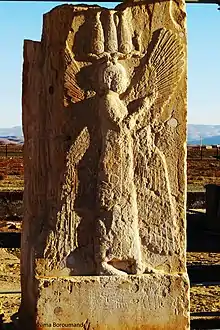
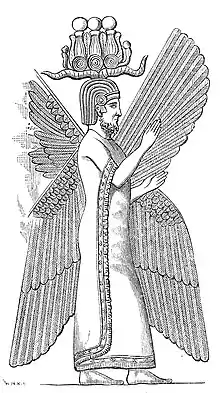
Dhul-Qarnain ("The Two-Horned") must have been familiar to the Jews, for it was at their instigation that the disbelievers of Mecca put their question to Muhammad.
The Book of Daniel, Chapter 8, says:
- In the vision I was looking and saw myself in Susa the capital, in the province of Elam, and I was by the river Ulai. 3 I looked up and saw a ram standing beside the river. It had two horns. Both horns were long, but one was longer than the other, and the longer one came up second. 4 I saw the ram charging westward and northward and southward. All beasts were powerless to withstand it, and no one could rescue from its power; it did as it pleased and became strong. 5 As I was watching, a male goat appeared from the west, coming across the face of the whole earth without touching the ground. The goat had a horn between its eyes. 6 It came toward the ram with the two horns that I had seen standing beside the river, and it ran at it with savage force."
Gabriel then gives the interpretation: "As for the ram that you saw with the two horns, these are the kings of Media and Persia." The Jews had a high opinion of Cyrus the Great, because it was his invasion which brought about the downfall of the kingdom of Babylon and the liberation of the Israelites, and horns were a familiar symbol of power in the kingdoms of Mesopotamia.
Dhul-Qarnayn must have been a great ruler whose conquests spread from the East to the West and to the North.
The conquests of Cyrus spread to Syria and Asia Minor in the West and to the Indus in the East, and his kingdom extended to the Caucasus in the North.
Dhul-Qarnayn must be a ruler who constructed a strong wall across a mountain pass to protect his kingdom from the incursions of tribes of Gog and Magog.
Gog and Magog were the wild tribes of Central Asia who were known by different names, Scythians, Parthians, Tartars, Mongols, and Huns, who had been making incursions on various kingdoms and empires from very ancient times. Strong bulwarks had been built in southern regions of Caucasia, though it has yet to be determined historically whether these were built by Cyrus.
Dhul-Qarnayn should be a monotheist and a just ruler.
Even his enemies praised Cyrus for his justice, and Ezra asserts that he was a God-worshiper and a God-fearing king who set free the Israelites because of his God-worship, and ordered that the Temple of Solomon be rebuilt for the worship of God.
The three journeys
Journey towards the West
According to Ibn Kathir, it means that he followed a route to the West of the earth until he reached the last boundary of the land, beyond which there was ocean. Verse 18:86 says: "He found it setting in a muddy spring" (Pickthall). If Dhul-Qarnain was Cyrus, then that place would be the western limit of Asia Minor and the "muddy spring" (or "warm spring" according to some hadiths[10]) would be the Aegean Sea. The word "ain" in Qurān verse 18:86 means spring or source of water from the ground, as in other verses according to Lane's Lexicon:
- The place [or aperture] whence the water of a قَنَاة [i.e. pipe or the like,] pours forth : (K, TA:) as being likened to the organ [of sight] because of the water that is in it. (TA.) And, (K, TA,) for the same reason, (TA,) ‡ The place whence issues the water of a well. (TA.) And, (S, Msb, K, &c.,) for the same reason, as is said by Er-Rāghib, (TA,) ‡ The عَيْن (S, Msb,) or source, or spring, (K, TA,) of water, (S, Wsb, K, TA,) that wells forth from the earth, or ground, and runs : (TA: [and accord. To the Msb, it app. Signifies a running spring:] of the fem. gender[11]
The word "bahr" (not used in this verse) means sea or large body of water[12] and appears in many other verses in the Qurān to mean a sea.
Journey towards the East
That is, when he advanced towards the East in Babylon, the people, who had no shelter were the captured tribes of Israel. The reason the Qurān mentions no more on the topic is because the whole epic is written in the Book of Kings, of the Tanakh (Hebrew Bible). The Qurān simply says at 18:90, "To the extent that when he reached the rising-place of the sun, he found it rising upon a nation for which We had not kept any shelter from it."[13]
Journey towards the North/Gog and Magog
The "two mountains" must have been parts of that mountain range which runs between the Caspian Sea and the Black Sea. This must be, for beyond them was the territory of Gog and Magog. "It was difficult to communicate with them: their language was almost foreign to Dhul-Qarnain and his companions, and, as they were quite barbaric, none could understand their language, nor were they acquainted with any foreign language."
As has already been pointed out, Gog and Magog were the wild tribes of North Eastern Asia which, from the very early times had been making inroads on settled kingdoms and empires in Asia and Europe and ravaging them. According to Genesis (Chapter 10), they were the descendants of Japheth, the son of Noah, and the Muslim historians have also accepted this. And according to the Book of Ezekiel (Chapters 38, 39), they inhabited the territories of Meshech (Moscow) and Tubal (Tubalsek). According to the 1st century CE Israelite historian Josephus, Magog were called Scythians by the Greeks,[14] and their territory spread to the north and the east of the Black Sea. However, Josephus also says that the Scythians had been shut up behind an iron gate built across a passage by Alexander [the Great].[15] According to Jerome, Magog inhabited the territory to the north of Caucasia near the Caspian Sea:
- The hordes of the Huns had poured forth all the way from Maeotis (they had their haunts between the icy Tanais and the rude Massagetae, where the gates of Alexander keep back the wild peoples behind the Caucasus)[16]
Wall of Cyrus to protect from Gog & Mogog
He said: "Though I have built a very strong iron-wall, as far as it was possible for me, it is not ever-lasting, for it will last only as long as Allah wills, and will fall down to pieces when the time of my Lord's promise shall come. Then no power in the world shall be able to keep it safe and secure."
Some people have entertained the misunderstanding that the wall attributed here to Dhul-Qarnain refers to the famous Great Wall of China, whereas this wall was built between the river basins of Derbent and Dar'yal, two cities of Daghestan in the Caucasus, the land that lies between the Black Sea and the Caspian. There are high mountains between the Black Sea and Dar'yal having deep gorges which cannot allow large armies to pass through them. Between Derbent and Dar'yal, however, there are no such mountains and the passes also are wide and passable. In ancient times savage hordes from the north invaded and ravaged southern lands through these passes and the Persian rulers who were fearful of them had to build a strong wall, 50 miles long, 29 feet high and 10 feet wide, for fortification purposes, ruins of which can still be seen (e.g. Great Wall of Gorgan).[17] Though it has not yet been established historically who built this wall in the beginning, Muslim historians and geographers assign it to Dhul-Qarnain because its remains correspond with the description of it given in the Quran, despite the fact that the wall is in fact Sassanid in origins, and thus is about 1000 years too late to have been built by Cyrus. "The OSL and radiocarbon samples demonstrated conclusively that both walls had been built in the 5th or, possibly, 6th century AD".[18]
Ibn Jarir Tabari and Ibn Kathir have recorded the event, and Yaqut al-Hamawi has mentioned it in his Mujam-ul-Buldan that: when after the conquest of Azerbaijan, Umar sent Suraqah bin `Amr, in 22 A.H. (643CE) on an expedition to Derbent, the latter appointed `Abdur Rahman bin Rabi`ah as the chief of his vanguard. When 'Abdur Rehman entered Armenia, the ruler Shehrbaz surrendered without fighting. Then when `Abdur Rehman wanted to advance towards Derbent, Shehrbaz informed him that he had already gathered full information about the wall built by Dhul-Qarnain, through a man, who could supply all the necessary details and then the man was actually presented before `Abdur Rehman. (Tabari, Vol. III, pp. 235–239; Al-Bidayah wan-Nihayah, Vol. VII, pp. 122–125, and Mu'jam-ul-Buldan, under Bab-ul-Abwab: Derbent).
Two hundred years later, the Abbasid Caliph Al-Wathiq dispatched a party of 50 men under Sallam-ul-Tarjuman to study the wall of Dhul-Qarnain, whose observations have been recorded in great detail by Yaqut al-Hamawi in Mu jam-ul-Buldan and by Ibn Kathir in Al-Bidayah. They write:
this expedition reached Samarrāh from where they reached Tbilisi and then through As-Sarir and Al-Lan, they reached Filanshah, from where they entered the Caspian territory. From there they arrived at Derbent and saw the wall. (Al-Bidāyah Vol. II, p. 111, Vol. VII, pp. 122–125; Mujam-ul-Buldān: under Bab-ul-Abwāb). This clearly shows that even up until the tenth century, Muslim scholars regarded this wall of the Caucasus as the wall of Dhul-Qarnain.
Yaqut in his Mu jam-ul-Buldan has further confirmed the same view at a number of places. For instance, under Khazar (Caspian) he writes:
- "This territory adjoins the Wall of Dhul-Qarnain just behind Bab-ul-Abwab, which is also called Derbent." In the same connection, he records a report by Ahmad bin Fadhlan, the ambassador of Caliph Al-Muqtadir, who has given a full description of the Caspian land, saying that Caspian is the name of a country whose capital is Itil (near the present Astrakhan) right through which flows River Itil, which joins the Caspian front Russia and Bulghar.
Regarding Bab-ul-Abwab he says that this city is called both Al-Bab and Derbent, which is a highly difficult passage for the people coming from the northern lands towards the south. Once this territory was a part of the kingdom of Nausherwan, and the Persian rulers paid particular attention to strengthening their frontiers on that side.
About Dhul-Qarnain, Muhammad Ali says (p586): The word qarn means a horn, as also a generation or a century and dhul qarnain literally means the two-horned one, or one belonging to the two generations or two centuries. The reference here seems to be to the two horned ram of Daniel's vision (Dan. 8:3), which he interpreted as the Kingdoms of Media and Persia, which were combined into a single kingdom under one ruler, Cyrus, who is erroneously called Darius in the Bible. The reference in Daniel's vision is, however, not to Cyrus but to Darius I Hystaspes (521-485 B.C.), "who allowed the Jews to rebuild their temple, and is referred to in Ezra 4:5,24;5:5;6:1;Hag1:1;2:10;Zech. 1;7, and probably in Neh. 12:22. His liberality towards the Jews is in complete accord with what we know otherwise of his general policy in religious matter towards the subject nations"
Maududi says: {Early commentators on the Quran were generally inclined to believe that it referred to Alexander. The characteristics attribute to Dhul-Qarnayn, however, hardly apply to Alexander. In the light of the latest historical evidence, contemporary commentators on the Quran are inclined to believe that Dhul-Qarnayn signifies the Persian Emperor, Cyrus. This, in any case, seems more plausible. Nevertheless, the info available to date does not enable one to form a definitive opinion concerning Dhul-Qarnayn's identity.
- Key points:
- The title "The Two-Horned' was at least familiar to the Jews. This is evident from the fact they had instigated the Meccan unbelievers to ask the Prophet about him. One must, therefore, inevitably turn to Jewish literature or oral traditions from the time of Muhammad to find out who this person was or to establish what was the kingdom known as 'The Two-Horned.'
- (in summary of Maududi) there are only a few people who fit this description
- The title of Dhul-Qarnayn may be used for a ruler who, being concerned with the defense of his kingdom from the assaults of Gog and Magog, had a strong protective wall constructed across a mountain pass.
- He is a God conscious person.
Problems with the theory
While the tolerance and relief Cyrus gave to the Jews of the Babylonian captivity is well known and preserved in the Biblical book of Ezra, evidence does not indicate that Cyrus himself was a devout monotheist. In contrast, cuniform inscriptions including on the Cyrus Cylinder used for propaganda in the places he conquered show him to have promoted and requested the intercession of a wide range of gods, and he was respected for his tolerance in a range of conquered lands. The Encyclopedia Iranica in its online article on Cyrus notes the following regarding his religious policies:[19]
- Babylonian texts record that Cyrus "restored the statues of the Babylonian gods to their sanctuaries"
- In a temple in Uruk he called himself "caretaker of the temples of Esagila and Ezida," respectively the sanctuaries of Marduk in Babylon and Nabû in Borsippa
- In another inscription, from Ur, he boasted that "the great gods have delivered all the lands into my hands"
- On the Cyrus cylinder he claimed that the god Marduk had ordered him to become ruler of the whole world and to treat the Babylonians with justice
- According to the same text, the idols that Nabonidus had brought to Babylon from various other Babylonian cities were reinstalled in their former sanctuaries, as were the statues of alien gods from Susa and the cities of northern Mesopotamia. The ruined temples of Babylonia, Elam, and what had been Assyria were reconstructed.
A translation of the Cyrus Cylinder by Irvin Finkel of the British Museum includes the following lines:
"Marduk, the great lord, rejoiced at [my good] deeds [...] From [Shuanna] I sent back to their places to the city of Ashur and Susa, Akkad, the land of Eshnunna, the city of Zamban, the city of Meturnu, Der, as far as the border of the land of Guti - the sanctuaries across the river Tigris - whose shrines had earlier become dilapidated, the gods who lived therein, and made permanent sanctuaries for them. [...] I collected together all of their people and returned them to their settlements, and the gods of the land of Sumer and Akkad which Nabonidus – to the fury of the lord of the gods – had brought into Shuanna, at the command of Marduk, the great lord, I returned them unharmed to their cells, in the sanctuaries that make them happy. May all the gods that I returned to their sanctuaries, every day before Bel and Nabu, ask for a long life for me, and mention my good deeds, and say to Marduk, my lord, this: 'Cyrus, the king who fears you [...] May Marduk, the great lord, present to me as a gift a long life and the fullness of age"[20]
See also
References
Citations
- Azad 1990, p. 205.
- Wheeler 2006, p. 182.
- Tatum, James (1994). The Search for the ancient novel. Johns Hopkins University Press. p. 342. ISBN 978-0-8018-4619-9.
- In his Vol 26 of his Opus Magnum, Tafsir al-Mizan
- In his Bargozideh Tafseer-i Nemuneh (برگزیده تفسیر نمونه), Vol 3, p69
- Raheem, M. R. M. Abdur (1988). Muhammad the Prophet. Pustaka Nasional Pte Ltd. p. 231. ISBN 978-9971772239.
- Mallowan, Max (1972). "Cyrus the Great (558-529 B.C.)". Iran. 10 (10): 1–17. doi:10.2307/4300460. JSTOR 4300460. Retrieved 8 March 2021.
- Stronach, David (2009). "PASARGADAE". Encyclopædia Iranica, online edition. Encyclopædia Iranica. Retrieved 8 March 2021.
- Stronach, David (2003). "HERZFELD, ERNST ii. HERZFELD AND PASARGADAE". Encyclopædia Iranica, online edition. Encyclopædia Iranica. Retrieved 8 March 2021.
- Some hadiths have warm instead of muddy - the words are very similar - or even black mud, and al-Tabari also discusses the variant readings See here for discussion and endnote 76 for Arabic citation, and here for another hadith that comes in both versions
- Lane's Lexicon book 1, page 2215
- Lane's Lexicon book 1, page 156
- "Surah Kahf". Surah Kahf Translation.
- Flavius Josephus, Antiquities of the Jews Book 1, Chapter 6, verse 1 Project Gutenberg
- Flavius Josephus, The Wars of the Jews, Book VII, Chapter VII, Verse 4 Project Gutenberg
- Letter 77 "To Oceanus", 8, Jerome
- UC Berkeley's page on archaeologist David Stronach: "Archived copy". Archived from the original on 2005-11-08. Retrieved 2005-11-08.CS1 maint: archived copy as title (link)
- Omrani Rekavandi, H., Sauer, E., Wilkinson, T. & Nokandeh, J. (2008), The enigma of the red snake: revealing one of the world’s greatest frontier walls, Current World Archaeology, No. 27, February/March 2008, pp. 12-22
- "CYRUS iii. Cyrus II The Great". iranicaonline.org. Encyclopedia Iranica. Retrieved April 17, 2021.
- Simonin, Antoine (2012). "The Cyrus Cylinder". worldhistory.org. worldhistory.org. Retrieved April 17, 2021.
Bibliography
- Azad, Abul Kalam (1990). India's Maulana Abul Kalam Azad. Indian Council for Cultural Relations. ISBN 9788185434001.
- Ball, Warwick (2002). Rome in the East: The Transformation of an Empire. Routledge. ISBN 9781134823871.
- Berberian, Manuel (2014). Earthquakes and Coseismic Surface Faulting on the Iranian Plateau. Elsevier. ISBN 978-0444632975.
- Bietenholz, Peter G. (1994). Historia and fabula: myths and legends in historical thought from antiquity to the modern age. Brill. ISBN 978-9004100633.
- Cook, David (2005). Contemporary Muslim Apocalyptic Literature. Syracuse University Press. ISBN 9780815630586.
- Ernst, Carl W. (2011). How to Read the Qur'an: A New Guide, with Select Translations. University of North Carolina Press. ISBN 9781134823871.
- Glassé, Cyril; Smith, Huston (2003). The New Encyclopedia of Islam. Rowman Altamira. ISBN 9780759101906.
- Netton, Ian Richard (2006). A Popular Dictionary of Islam. Routledge. ISBN 9781135797737.
- Pinault, David (1992). Story-Telling Techniques in the Arabian Nights. BRILL. ISBN 978-9004095304.
- van Bladel, Kevin (2008). "The Alexander Legend in the Qur'an 18:83-102". In Reynolds, Gabriel Said (ed.). The Qurʼān in Its Historical Context. Routledge.
- Van Donzel, Emeri J.; Schmidt, Andrea Barbara (2010). Gog and Magog in Early Eastern Christian and Islamic Sources. Brill. ISBN 978-9004174160.
- Wasserstrom, Steven M. (2014). Between Muslim and Jew: The Problem of Symbiosis Under Early Islam. Princeton University Press. ISBN 9781400864133.
- Wheeler, Brannon (2006). "Dhu Al-Qarnayn". In Leaman, Oliver (ed.). The Qur'an: An Encyclopedia. Taylor & Francis. ISBN 9780415326391.
- Wheeler, Brannon M. (2013). Moses in the Qur'an and Islamic Exegesis. Routledge. ISBN 9781136128905.
- Yamanaka, Yuriko; Nishio, Tetsuo (2006). The Arabian Nights and Orientalism: Perspectives from East and West. I.B.Tauris. ISBN 9781850437680.
External links
| Family |
|  | ||||
|---|---|---|---|---|---|---|
| Battles | ||||||
| Related | ||||||
| ||||||