DCI-P3
DCI-P3, or DCI/P3, is a common RGB color space for digital movie projection from the American film industry.[1]
| |
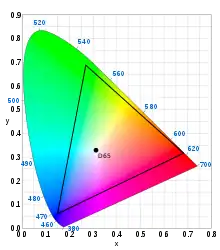 The CIE 1931 chromaticity diagram for DCI-P3-D65 with the spectral colors and purple line along the rim. The corners of the triangle are the primary colors of the DCI-P3 color space. The white point shown here is Illuminant D65. However DCI-P3 uses a slightly warmer and greener whitepoint with a correlated color temperature of approximately 6300K (not shown). | |
| Status | Published |
|---|---|
| Organization | |
| Authors | DCI |
| Base standards | RGB |
| Related standards | sRGB |
| Domain | Color space, color model |
| Website | |
History
Early history
In the CIE 1931 xy chromaticity diagram the DCI-P3 color space covers 45.5% of all chromaticities and 86.9% of Pointer’s gamut. In the CIE 1976 u’v’ chromaticity diagram the coverage is 41.7% and 85.5% respectively.[2] The blue primary color is the same as sRGB and Adobe RGB;[1] the red primary color is a monochromatic light source and has a wavelength of 615 nm. DCI-P3 was defined by the Digital Cinema Initiatives (DCI) organization and published by the Society of Motion Picture and Television Engineers (SMPTE) in SMPTE EG 432-1 and SMPTE RP 431-2.[3] As a step towards the implementation of the significantly wider Rec. 2020 it is expected to see adoption in television systems and in the home cinema domain.[4]
On November 10, 2010, SMPTE published SMPTE EG 432-1:2010.[5]
On April 6, 2011, SMPTE published SMPTE RP 431-2:2011.[6]
Early producing
Officially supported DCI-P3 color space can be reproduced on a released in 2008[7] HP LP2480zx monitor, known as first "HP DreamColor".[8][9] The P3 gamut also can be reproduced on a released in 2010 EliteBook mobile workstation.[10]
2014–2016
In September 2014, Eizo introduced during a fair trade Photokina in Germany the CG-318 - the first professional 4K monitor with supporting of P3 color space.
In April 2014, was released two HP Z "Dreamcolor" displays[11] with P3 support.
In September 2015, Apple's iMac desktop became the first consumer computer with a built-in wide-gamut display, supporting the P3 color space.
On January 4, 2016, the UHD Alliance announced their specifications for Ultra HD Premium which requires devices to display at least 90% of the DCI P3 color space (in area, not volume).[12][13]
In March and September 2016, Apple's 9.7-inch iPad Pro,[14] iPhone 7[15] and 7 Plus[16][17] released with a display supporting P3 color; released in October 2016, new MacBook Pro also featuring support for P3.[18][19]
In August 2016, the Samsung Galaxy Note 7 shipped with an HDR display[20] with 100% DCI-P3 color gamut.[21]
In October 2016, Microsoft's Surface Studio desktop computer was unveiled, featuring P3 wide color.
2017
In April 2017, Samsung released the Galaxy S8, which supports P3 wide color.[22]
In June 2017, OnePlus 5 was released with support for P3.[23]
In October, 2017, Google released the Pixel 2, which covers 95% of the P3 color standard, and the Pixel 2 XL, which covers 100%. [24]
In November 2017, HTC announced HTC U11+ phone with P3 color support.[25]
In December 2017, Apple released iMac Pro, featuring P3 color.[26]
2018
In May, 2018, OnePlus launched the OnePlus 6 which also like its predecessor covers completely the DCI-P3 color space. Also Xiaomi Mi8 covers completely the DCI-P3 color space.
In October, 2018, Google released Pixel 3 and Pixel 3 XL which both cover 100% of the P3 color standard.[27]
2019
In January 2019, Asus launched the PQ22UC, a portable 21.6-inch 4K OLED screen with 99% DCI-P3 colour gamut that can run over USB-C.[28]
In June 2019, Apple introduced the Pro Display XDR, a 32-inch 6K (6016 x 3384) screen with DCI-P3 10-bit color, and 1,000,000:1 contrast ratio.[29]
In November 2019, Acer released their new studio laptop series called "ConceptD"; one of its laptop ConceptD 3 and ConceptD 3 Pro has 15.6-inch DCI-P3 Full HD display.[30]
2020
In November 2020, Apple released a new MacBook Air with a new display capable of P3 wide color.
2021
In October 2021, Apple released new 14" and 16" MacBook Pros with a new display capable of P3 wide color.
System colorimetry
| Color space | White point | CCT | Primary colors | ||||||
|---|---|---|---|---|---|---|---|---|---|
| xW | yW | K | xR | yR | xG | yG | xB | yB | |
| P3-D65 (Display) | 0.3127 | 0.3290 | 6504 | 0.680 | 0.320 | 0.265 | 0.690 | 0.150 | 0.060 |
| P3-DCI (Theater) | 0.314 | 0.351 | 6300 | 0.680 | 0.320 | 0.265 | 0.690 | 0.150 | 0.060 |
| P3-D60 (ACES Cinema) | 0.32168 | 0.33767 | 6000 | 0.680 | 0.320 | 0.265 | 0.690 | 0.150 | 0.060 |
DCI-P3 uses a simple 2.6 gamma curve, a white luminance of 48 cd/m2, and a whitepoint with a correlated daylight temperature of ~6300K, though it is not on the Planckian locus and is slightly greener, the result of optimizing for best light output with xenon lamp projectors.[5] Blue is the same as in BT.709.
DCI-P3 has a 25% larger color gamut than sRGB.[32]
Display P3 is a color space created by Apple Inc. It uses the DCI-P3 primaries but with a D65 white point which is much more common among computer-display colorspaces (sRGB and AdobeRGB both use D65). Also unlike DCI-P3's 1/2.6 pure gamma curve, Display P3 uses the sRGB transfer curve (EOTF and thus display referred), which, for comparison purposes, could be approximated to a 1/2.2 gamma curve.[33]
Display P3 (termed P3-D65) is also used for some of Netflix deliverables, including HDR and without BT.2020 container.[34][35]
DCI-P3+ and Cinema Gamut
| Color space | White point | CCT | Primary colors | ||||||
|---|---|---|---|---|---|---|---|---|---|
| xW | yW | K | xR | yR | xG | yG | xB | yB | |
| DCI-P3+ | 0.314 | 0.351 | 6300 | 0.740 | 0.270 | 0.220 | 0.780 | 0.090 | -0.090 |
| Cinema Gamut | 0.3127 | 0.329 | 6504 | 0.740 | 0.270 | 0.170 | 1.140 | 0.080 | -0.100 |
An expanded gamut known as the DCI-P3+ color space is also available, which in turn is a smaller version of the Cinema Gamut color space.[36] DCI-P3+ uses a green-tinted white point with a correlated color temperature of 6300K. Cinema Gamut is specified as having a D65 white point.
References
- "Color spaces". Technicolor SA. Archived from the original on 2016-02-03. Retrieved 2016-02-01.
- Kid Jansen (2014-02-19). "The Pointer's Gamut". tftcentral. Retrieved 2018-12-13.
- The Society of Motion Picture and Television Engineers, 2011, New York: RP 431-2, D-Cinema Quality – Reference Projector and Environment for the Display of DCDM in Review Rooms and Theaters
- Geoffrey Morrison (2015-04-12). "Ultra HD 4K TV color, part II: The (near) future". CNET. Retrieved 2016-02-01.
- "EG 432-1:2010 - Digital Source Processing — Color Processing for D-Cinema". Institute of Electrical and Electronics Engineers. 2010-11-10. doi:10.5594/SMPTE.EG432-1.2010.
- "RP 431-2:2011 - D-Cinema Quality — Reference Projector and Environment". Institute of Electrical and Electronics Engineers. 2011-04-06. doi:10.5594/SMPTE.RP431-2.2011.
- "HP DreamColor LP2480zx". Studio Daily. 2008-07-01. Retrieved 2021-07-02.
- "Two days with HP and DreamWorks". JusTech'n. 2008-06-10. Retrieved 2021-07-02.
- "HP, DreamWorks Preview Breakthrough Color Display Technology | CreativePro Network". 2008-04-16. Retrieved 2021-07-02.
- Goldman, Joshua. "HP EliteBook Mobile Workstation 8540w review: HP EliteBook Mobile Workstation 8540w". CNET. Retrieved 2021-07-02.
- April 2014, Kevin Parrish 08. "HP Intros Two New DreamColor Displays: HP Z27x & Z24x". Tom's Hardware. Retrieved 2021-07-02.
- "UHD Alliance Defines Premium Home Entertainment Experience". Business Wire. 2016-01-04. Retrieved 2016-02-01.
- Andy Vandervell (2016-01-06). "What is Ultra HD Premium? New HDR standard explained". TrustedReviews. Time Inc. UK. Retrieved 2016-09-19.
- "iPad Pro 9.7" (Wi-Fi Only) 32, 128, 256 GB Specs (A1673, MLMP2LL/A*, 2976, iPad6,3): EveryiPad.com". everymac.com. Retrieved 2021-08-24.
- Mike Wuerthele (2016-09-09). "Apple's Wide Color screen on the iPhone 7 will lead to more faithful color reproduction". AppleInsider. Retrieved 2016-09-19.
- "iPhone 7 (AT&T/T-Mobile/Global/A1778) 32, 128, 256 GB Specs (A1778, MN9E2LL/A*, 3091*, iPhone9,3): EveryiPhone.com". everymac.com. Retrieved 2021-08-24.
- "iPhone 7 Plus (AT&T/T-Mobile/Global/A1784) 32, 128, 256 GB Specs (A1784, MNQT2LL/A*, 3092*, iPhone9,4): EveryiPhone.com". everymac.com. Retrieved 2021-08-24.
- "MacBook Pro - Technical Specifications". Apple. Retrieved 2017-09-15.
- "MacBook Pro 13-Inch "Core i5" 2.0 Late 2016 Specs (Late 2016 13", MLL42LL/A*, MacBookPro13,1, A1708, 2978): EveryMac.com". everymac.com. Retrieved 2021-08-24.
- "The HDR screen of the Galaxy Note 7 could be the next big thing for phones". CNET. Retrieved 2017-04-09.
- "Galaxy Note7 OLED Display Technology Shoot-Out". www.displaymate.com. Retrieved 2017-04-09.
- Soneira, Raymond. "Galaxy S8 OLED Display Technology Shoot-Out". DisplayMate. Retrieved 4 April 2017.
- Rahman, Mishaal (29 June 2017). "Enable the OnePlus 5's DCI-P3 Wide Color Gamut Mode on the OnePlus 3T". xda-developers. Archived from the original on 29 June 2017. Retrieved 29 June 2017.
- "Forbes: Google Pixel 3 Vs Pixel 3 XL: What's The Difference?". Retrieved 2018-11-18.
- "HTC U11 Plus". HTC. Retrieved 3 November 2017.
- "iMac Pro - Technical Specifications". Apple. Retrieved 2017-08-18.
- Kelly, Gordon. "Google Pixel 3 Vs Pixel 3 XL: What's The Difference?". Forbes. Retrieved 2018-11-18.
- "CES 2018 ASUS Unveils ProArt PQ22UC OLED Monitor: 4K, 99% DCI-P3, 0.1 ms Response Time". ANDANTECH. Retrieved 2019-01-30.
- "Apple unveils powerful, all-new Mac Pro and groundbreaking Pro Display XDR". Apple. Retrieved 2020-11-29.
- "Acer's ConceptD Line Just Got Cheaper and More Powerful".
- Rajan Joshi; Shan Liu; Gary Sullivan; Gerhard Tech; Ye-Kui Wang; Jizheng Xu; Yan Ye (2016-01-31). "HEVC Screen Content Coding Draft Text 5". JCT-VC. Retrieved 2016-01-31.
- Dean Jackson (2016-07-01). "Improving Color on the Web". WebKit. Retrieved 2016-09-19.
- "displayP3 - CGColorSpace". Apple Developer Documentation. Retrieved 2017-08-18.
- "Netflix Full Licensed Technical Specification v9.1". Netflix Partner Help Site. Retrieved 2021-03-25.
- "Netflix Talks Dolby Vision and HDR10". Streaming Media Magazine. 19 June 2017. Retrieved 11 April 2021.
- "PUB DIM-1102-000" (PDF). DCI-P3+ and Cinema Gamut. Retrieved 2021-08-27 – via Document is hosted on Canon's website at https://canoncanada.custhelp.com/app/answers/answer_view/a_id/1027929/~/extended-color-gamut-information.
