RG color space
The RG or red–green color space is a color space that uses only two colors: red and green. It is an additive format similar to the RGB color model but without a blue channel. Thus, blue is said to be out of gamut. The format is not in use today, and was used only on two-color Technicolor and other early color processes for films. By comparison with a full spectrum, its poor color reproduction made it undesirable. The system cannot create white naturally, and many colors are distorted.


No color containing a blue color component can be replicated accurately in the RG color space. A similar color space, called RGK, also has a black channel. Outside of a few low-cost high-volume applications, such as packaging and labelling, RG and RGK are no longer in use because devices providing larger gamuts such as RGB and CMYK are in widespread use. Until recently, its primary use was in low-cost light-emitting diode displays in which red and green tended to be far more common than the still nascent blue LED technology, but full-color LEDs with blue have become more common in recent years.
ColorCode 3-D, a stereoscopic color scheme, uses the RG color space to simulate a broad spectrum of color in one eye. The blue portion of the spectrum transmits a black-and-white (black-and-blue) image to the other eye to give depth perception.


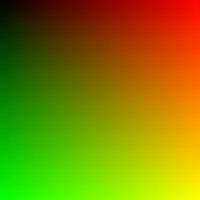
Additive RG Additive RG color palette
See also
References
- Even Proportional Color Triangle
- Cinematographic Multiplex Projection, &c. U.S. Patent No. 1,391,029, filed Feb. 20, 1917.
- "Moving Pictures in Color", The New York Times, February 22, 1917, p. 9.
- The First Successful Color Movie", Popular Science, Feb. 1923, p. 59.
- filmmakeriq.com, The History and Science of Color Film: From Isaac Newton to the Coen Brothers
