DNF (software)
DNF or Dandified YUM[2][3][4] is the next-generation version of the Yellowdog Updater, Modified (yum), a package manager for .rpm-based distributions. DNF was introduced in Fedora 18 in 2013,[5] it has been the default package manager since Fedora 22 in 2015[6] and Red Hat Enterprise Linux 8.[7]
 | |
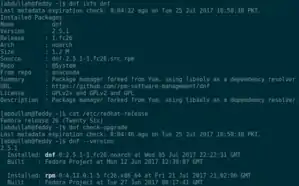 DNF running on Fedora 26 | |
| Developer(s) | Red Hat |
|---|---|
| Stable release | 4.7.0
/ 12 April 2021[1] |
| Repository | |
| Written in | C, C++, Python |
| Operating system | Linux |
| Platform | RPM |
| Available in | English |
| Type | Package management system |
| License | GPLv2 |
| Website | rpm-software-management |

Perceived deficiencies of yum (which DNF is intended to address) include poor performance, high memory usage, and the slowness of its iterative dependency resolution.[8] DNF uses libsolv, an external dependency resolver.[8]
DNF performs package management tasks on top of RPM, and supporting libraries.
DNF was originally written in Python, but as of 2016 efforts are under way to port it to C and move most functionality from Python code into the new libdnf library.[9] libdnf is already used by PackageKit, a Linux distribution-agnostic package system abstraction library, even though the library does not have most of DNF's features.[10]
Adoption
DNF has been the default command-line package manager for Fedora since version 22, which was released in May 2015.[6] The libdnf library is used as a package backend in PackageKit,[10] which offers a graphical user interface (GUI). Later dnfdragora was developed for Fedora 27 as another alternative graphical front-end of DNF.[11][12] DNF has also been available as an alternate package manager for Mageia Linux since version 6 and may become the default sometime in the future.[13]
Dependencies
libsolv
- a free package dependency solver using a satisfiability algorithm
- for solving packages and reading repositories
- C
- New BSD License
librepo
- a library providing C and Python (libcURL like) API for downloading Linux repository metadata and packages
- C
- LGPLv2+
References
- "Releases · rpm-software-management/dnf · GitHub". GitHub DNF Repository. 2021-04-12. Retrieved 2021-05-28.
- "DNF". Fedora Project Wiki. Retrieved 2018-05-21.
- "What does DNF stand for". DNF User's FAQ. Retrieved 2018-05-21.
- "README.rst · rpm-software-management/dnf · GitHub". GitHub DNF Repository, commit 8174427421b995265c6297ebd64024ded099ecf0. Retrieved 2018-05-21.
- Byfield, Bruce. "Will DNF Replace Yum?". Linux Magazine. Retrieved 2015-05-28.
- Andrew (2015-05-26). "Fedora 22 Released, See What's New [Workstation]". WebUpd8. Retrieved 2015-05-28.
- Scott Matteson (2019-03-30). "What's new with Red Hat Enterprise Linux 8 and Red Hat Virtualization". TechRepublic. Retrieved 2019-09-24.
- Edge, Jake (2014-01-15). "DNF and Yum in Fedora". LWN.net. Retrieved 2015-03-29.
- Šilhan, Jan (2016-02-24). "DNF into C initiative started". DNF blog. Archived from the original on 2017-07-02. Retrieved 2017-07-05.
- Aleksandersen, Daniel (2017-07-05). "Use DNF rather than PackageKit on Fedora". Ctrl blog. Retrieved 2017-08-07.
- "Changes/Replace yumex-dnf with dnfdragora - Fedora Project Wiki". fedoraproject.org. Retrieved 2021-09-27.
- "F27 Self Contained Change: Replace Yumex-DNF with dnfdragora - devel - Fedora Mailing-Lists". lists.fedoraproject.org. Retrieved 2021-09-27.
- Larabel, Michael (2016-09-05). "Mageia To Offer DNF, But Will Keep Using URPMI By Default". Phoronix. Retrieved 2017-12-04.
