Thracian religion
The Thracian religion refers to the mythology, ritual practices and beliefs of the Thracians, a collection of closely related ancient Indo-European peoples who inhabited eastern and southeastern Europe and northwestern Anatolia throughout Antiquity and who included the Thracians proper, the Getae, the Dacians, and the Bithynians. Little is known about their mythology and rituals, but some of their gods are depicted in statuary or described in Greek sources.
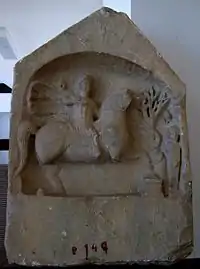
Origins and history
The Thracian religion's creation myth and its pantheon were derived from the Proto-Indo-European religion.[1]
Cosmology and pantheon
The Thracians, like the other ancient peoples of southeast Europe, believed universal forces worked within the world, which was itself made from the four classical elements, namely the Earth, Air, Water and Fire. This conception of the world is attested from the early Bronze Age, in the fouth millennium BCE, and was recorded in poems and hymns originally composed in the late Bronze Age in the 2nd millennium BCE and were transmitted orally.[1]
These four elements were conceived of as forces or energies which were combined in the form of the mountain, which also represented the Great Mother Goddess (see below).[1]
According to Herodotus, the Thracians worshipped only three gods, whom he identified with the Greek deities Artemis, Ares, and Dionysos, who respectively held the positions of the Mother of Gods, the Father deity, and the Son of the previous two. However more Thracian deities are mentioned by Herodotus himself and are also attested archaeologically.[2][3]
This triad recorded by Herodotus might have reflected the tripartite division of Indo-European societies into the priestly, military and economic categories. Thus, "Ares" represented the warrior function, "Dionysos" was connected to the clergy, and "Artemis" in her form as the Great Goddess was the female "transfunctional" deity who was the patron of reproduction in both nature and human society.[3]
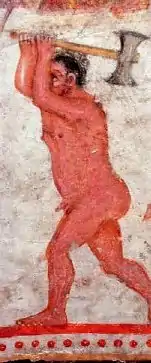
Perke
The Thracian deity equated by Herodotus with the Greek Artemis was the Great Mother Goddess, who was known in Thrace as Perke (meaning "rock" or "mountain top"). Other popular names by which Perke was known included Bendis, Kotyto, and Hipta or Hippa. Perke represented the mountain, which itself personified the four classical elements from which the world was believed to be made of: her womb deep in the caves of the Earth was washed by underground Water springing from it while she rose high in a rocky peak which was hidden by the Air of heaven and lit by the Fire of lightning.[1]
In Thracian mythology, Perke represented the initial state of the world, which was at rest. The goddess self-fertilised herself and gave birth to a first son, Sabazios, who represented the male principle. Through the sacred marriage of Perke and Sabazios, another son, Orpheus, was born. This son personified the energies of the creation and set them free: thus, from the union of Perke and her first son, all the potent elements of the world were fertilised, ensuring the continuation of life in the world.[1]
Sabazios
The god Sabazios was the first son of Perke created by the goddess herself. This deity was the personification of the male principle who had both a celestial and a chthonic aspect, which were respectively identified with the sun and with fire.[1]
While Sabazios was initially the god representing the celestial and solar aspect of Perke's first son, who was identified with the Greek god Apollo, he gradually absorbed his chthonic and fire aspects as well, in which form he was identified with the Greek god Dionysos. Accordingly, in Greek Orphism, which was a derivation of Thracian religion, the first son of Perke was called both Apollo and Dionysos, representing his dual celestial and chthonic nature.[1] The chthonic Sabazios was also known as Zagreus, under which name he was personified as a bull, that is the ritual incarnation of the male principle. As Zagreus, Sabazios was a god of fertility, of the rejuvenation of nature and the flowering of life.[1]
The worship of Sabazios's Thracian solar aspect who was identified with the Greek Apollo is attested in literary, epigraphic and iconographic records. According to Sophocles, the sun was the celestial body which was most worshipped by the Thracians, and the cult of the solar deity was already well-developed in Thrace by the late Bronze Age.[3] The chthonic aspect of Sabazios was the Thracian declension of the same deity known to the Greeks as Dionysos, in which form he was the personification of wine, which in the Thracian religion was the sacred drink which brought secret knowledge and immortality, as well as of the plant from which wine was made, the grape.[3]
Sabazios's "Apollonian" form was seen as standing in opposition to the chthonic deities of death and the underworld in Thrace and in Asia Minor. In both regions he was revered under the Greek epithet of Smintheús (Σμινθεύς), the "god of mice", due to the mouse's role in Thracian religion as the symbol of indigeneity to Thrace. The mouse was, however, also considered to incarnate the antagonist, and therefore the Sabazios was its natural adversary.[3]
Sabazios "Apollonian" aspect was also a deity of the initiation of the young. His epithet Zērúnthios, meaning "bestial" or "rich in game", referred to his lupine character. His epithet Sītálkās, meaning "illustrious wheat", is connected to the name of Apollo in Asia Minor, Erusíbios (Ἐρυσίβιος, meaning "wheat rust", and which was connected to the Germanic concept of the Roggenwolf, meaning "rye wolf", which is the name of a rye-infecting fungus. These functions of Sabazios as a deity of transition are whence arise his role as an initiation "father", a function which is attested in an inscription on a silver jug from the Rogozen Treasure reading Κοτυς Απολλωνος παις ("Kotys the son of Apollo"), as well as in Thracian names containing a theophoric element and ending in -kenthos, meaning "child of", which referred to patrilineal descent from a deity.[3]
This concept of a divine descent was practised by Thracian kings, who attested of their divine descent through their names or their paternal ancestry.[3] Sabazios in his "Apollonian" aspect was thus a god of kingship due to his multiple associations with gold, such as his symbolic animal the griffin, his homeland in Hyperborea, his many epithets derived from the Thracian word for gold, *saldas,[6] and the source of treasures being the inside of the earth. Another epithet of Sabazios reflecting this connection with treasures is Pituaēnós (Πιτυαηνός), derived from the Thracian word for treasure, pitúē.[7][3] Sabazios in his "Dionysian" aspect was also the founder-deity of a royal dynasty and was depicted on royal insignia.[3]
The chthonic, or "Dionysian", Sabazios's personification of the sacred drink represented an ancient Indo-European mythological and ritual theme, and he therefore belonged to a type of deity whose various iterations among a number of cultures were nevertheless very similar, such as being associated with the constellation Orion, the bull, and autumn. The god's myth and cult reflected the making of wine from the grape, and therefore depicted his killing, dismemberment, and crushing to death. The making of the wine itself was seen as transcending the essential opposition between the raw and the cooked: the wine initially belonged to wild nature and was brought into human culture by cutting and cultivating it, and its fruits were collected, crushed and allowed to ferment until refined into wine, the sacred drink. Thus, the "sufferings" of the plant were seen as reflecting those of Sabazios himself. And like the wine itself, this god had a fiery nature according to which he was born and died from lightning, that is celestial fire.[3] The "Dionysian" Sabazios was seen as a "stranger" not only because he turned the world upside down and destroyed established social norms, especially through him making women leave their homes to go into the wild, but also because he was conceptualised as coming from the outside to reach inside man and inspire him with his cult's ecstatic frenzy.[3]
Graeco-Roman authors recorded connections between the Thracian cult of the solar Sabazios and the Greek cult of Apollo, with Herodotus writing of a sacred road leading from Thrace to Delphi, where a family of priests named the Thrakides held an important position. Moreover, the ancient Greeks believed that the mythical Hyperboreans sent offerings to Apollo which passed through Thrace to reach the god's sanctuary at Delos.[3]
Iconography
The earliest depictions of Sabazios in Thrace provided him with attributes showing both his foreign and wild nature, such as his wearing of a nebrís (νεβρίς) fawn skin cloak, and him being accompanied by drunken companions including satyrs and sileni and maenads, who were his frenzied followers, all depicted moving in an ecstatic dance. Many Thracian vessels were decorated with Dionysiac attributes, such as images of the god himself, his characteristic plants, the ivy and grape wine, and other of his symbols.[3]
A Thracian rhyton-jug from Borovo likely depicted themes of the cult of Sabazios opposing "nature" (represented by blood, wild plants, frenzied dancing, erotic play, and intoxication) to "culture" (depicted by wine diluted with water, the careful dancing of Eros accompanied by music, and the marriage ritual).[3]
Earrings from Mesembria in the form of winged figures with solar discs over their heads likely represented the solar Sabazios, and similar and likely connected representations of the solar deity are found among the Thracians' Paeonian neighbours, who worshipped the sun in the form of a disc at the top of a wooden pole.[3]
Orpheus
The Thracian god Orpheus was the second son of Perke, born from her union with her first son, Sabazios. In Thracian religion, the god Orpheus personified the energies of the creation and set them free: thus, from the union of Perke and her first son, all the potent elements of the world were fertilised, ensuring the continuation of life in the world.[1] Orpheus was given the name of Zalmoxis in northern Thrace, under which name he was worshipped by the Thracian Getae tribe.[3]
Orpheus was the first initiate into the mystery cult of the sacred marriage of Perke, and thus was the first priest-king, carrying the teachings of his own origins, was both a prophet and preacher of the mystery cult of Perke, and was therefore predestined to bring order to the world. Only through Orpheus's coming did the Cosmos start to function, and both the creation of the physical world and the beginning of human society were brought into existence.[1] Orpheus himself then, by his gradual self-improvement, gained enlightenment and united with Perke, thus becoming a demigod.[1]
This is reflected in the myth of the Getae recorded by Herodotus, according to which they were enlightened by their priest-king-diviner, Zalmoxis (Orpheus), who then became a demigod because he was born out of Perke's sacred marriage. Zalmoxis then initiated the Getae to his teachings by building an underground home for himself where he hid from his tribe for three years, and then making them gather in this underground dwelling and appearing to them every four years.[3][1] Zalmoxis's underground dwelling was connected to the Indo-European conception of the afterlife as a clay house and to the association of clay with death.[3]
Once he had become a demigod, Orpheus became the deified warrior-king, that is the Thracian deity equated by Herodotus with the Greek Ares.
Iconography
In accordance to the Indo-European conception of the war-god as having a lupine character, the deified warrior form of Orpheus had a wolfish aspect.[3].
The warrior Orpheus's representations fitted the motif of the Indo-European war-god's struggle with a monstrous wolf or dog as his principal deed, and a local epithet of the Thracian "Ares" was Kandaon, meaning "dog-strangler". A Thracian image of a winged centaur on whose shoulders lie a strangled wolf might be an early representation of this god, who is accordingly depicted in the Letnitsa treasure as a mounted hero preparing to fight a bear after having already defeated a wolf, lying dead and upside down beneath the horse's hooves.[3]
The Thracian "Hermes"
The Thracian god equated by Herodotus with the Greek Hermes was an ityphallic god who represented both the male principle and the two sacred marriages uniting Perke with Sabazios and then Orpheus. This god was worshipped only by the Thracian royalty.[1]
Iconography
The Thracian "Hermes" was depicted with an erect phallus, which represented his functions.[1]
Zis
The Thracian declension of the Indo-European sky-god Dyēus was called Zi, Zis, Dis and Tis. In his role of storm- and thunder-god, Zis was given the epithet of Zbelthurdos,[3] which means "lightning thrower" and "lightning bearer".[8][9]
The Thracian Chaos-dragon
Following the motif of the Indo-European serpent-slaying myth, the dragon who is the opponent of Zis is a personification of Chaos and the opponent of the cosmic order and the world of the living.[3]
The Thracian Chaos-dragon was depicted in various ways, though the most common representation of it was a three-headed or three-bodied snake, sometimes possessing wings or rudimentary legs, thus unifying the elements and spatial zones of the cosmos. Other depictions of the Chaos-dragon depicted it as a fish with a boar's head, as a sphinx, a chimaera, or a harpy. The depiction of the Chaos-dragon as a spotted snake with a bird's head combines spatial opposites (the bird representing "above" and the snake representing "below") also has parallels in ancient Indo-Aryan and modern Balkans folklore.[3]
The legendary kenkhrines snake inhabiting the islands of Aegean Thrace mentioned by the Greek poet and physician Nicander of Colophon in his poem Theriaca might have been inspired by the Thracian Chaos-dragon.[3]
The Cabeiri
On the island of Samothrace, Perke and her sons Sabazios and Orpheus, to which was added the ityphallic deity Kasmylos (whose erect phallus represented the male principle as well as the sacred marriages of Perke with Sabazios and then Orpheus), became known as the Cabeiri, or the "great ones".[1] The Cabeiri were seen a group of deities who assured salvation in the afterlife and upheld social order. The Thracian names of the individual Cabeiri are attested from Samothrace as Axiokersos, Axieros, Aziokersa and Kasmylos, with the element Axi- (the colour black) signalling their chthonic nature.[3]
The ancient Greeks, among whom the cult of the Cabeiri had spread, believed Thrace to be one of the multiple possible places from where these deities originated.[3]
The Cabeiri were worshipped in a mystery cult, which was a variation of the "Thracian Orphic" mystery cult, and initiation into it was believed to bring order to society as well as to the lives of the cult's initiates.[3]
Thracian Orphism
The myths and doctrines constituting the Thracian religion are collectively called by modern-day scholars as "Thracian Orphism", to distinguish it from the Greek Orphism, which was a later derivation from the Thracian mythos from the late 6yh century BCE.[1]
In the mythology of "Thracian Orphism", Perke represented the initial state of the world, which was at rest. The goddess self-fertilised herself and gave birth to a first son, Sabazios, who represented the male principle and had a dual nature, being both a sky-god identified with the Sun, and an underworld-god identified with fire.[1] This process constituted the four phases of the goddess's life, in which are present the four elements, and which consist consecutively of:[1]
- rest, representing Earth.
- self-fertilisation, representing Air.
- pregnancy, representing Water.
- giving birth to her first Sabazios, representing Fire.
These four phases were themselves succeeded by four other phases representing the life cycle of Sabazios:[1]
- In the fifth phase, Sabazios illuminated the world with his light.
- In the sixth phase, Sabazios reaches his zenith.
- In the seventh phase, Sabazios enters into a sacred marriage with Perke. Then, as Zagreus and in accordance to the ritual of him being sacrificed, Sabazios is dismembered into seven pieces: a head, a torso, two legs, two arms, and a phallus. The seven ram skins that Zagreus wears are scattered to the four cardinal points in this phase.
- In the eighth cosmic phase, the son of Perke and Sabazios, the priest-king Orpheus, is born. In this phase, Sabazios is also reborn and he protects Orpheus.
Through the sacred marriage of Perke and her son, another son, Orpheus, was born. This son personified the energies of the creation and set them free: thus, from the union of Perke and her first son, all the potent elements of the world were fertilised, ensuring the continuation of life in the world.[1] Orpheus was the first initiate into the mystery cult of the sacred marriage of Perke, and thus was the first priest-king, carrying the teachings of his own origins, was both a prophet and preacher of the mystery cult of Perke, and was therefore predestined to bring order to the world. Only through Orpheus's coming did the Cosmos start to function, and both the creation of the physical world and the beginning of human society were brought into existence.[1]
This cosmic cycle was a tenfold one, with the number ten believed to represent the Cosmos because it contained four phases (in Thracian religion, the tetrad was the basis of the Cosmos) consisting of the numbers four, three, two and one, and expressed in the formula 4 + 3 + 2 + 1 = 10. There were therefore final two phases of the cosmic cycle:[1]
- in the ninth phase, Orpheus attains enlightenment.
- in the tenth phase, Orpheus is allowed to also unite with the goddess in sacred marriage.
The Titan enemies of the infant Sabazios smeared their faces with white clay and offered him a mirror, an essentially visual object. When Sabazios saw his image in the mirror, he followed it, and thus was dismembered. The Titans were then punished by being turned into ashes from which humanity was born.[3]
Orpheus's appearance in the myth is characterised by his reformation of the religion of Sabazios which makes the knowledge of the mysteries of the god available to men only. In revenge for not allowing them to see or participate in the mysteries reserved for men, the Bacchae of the Ciconi tribe, possessed by divine fury, dismember Orpheus and threw his dismembered parts in the Hebrus river. The dismemberment of Orpheus, the first teacher of the mysteries of Perke and Sabazios, replicated that of Sabazios himself. The gods turned his head into a sacred snake and his lyre into a constellation, and from his blood the cithara plant grew on the Mount Pangaion, which was one of the places considered to be the most sacred to Perke. Henceforth, legend claimed that whenever Sabazios's chthonic aspect (Dionysos-Zagreus) was worshipped on this mountain, the cithara plant would resound like a lyre or cithara.[3][1] After killing Orpheus, the Ciconi women are marked with tattoos and their husbands return to them, and they become the mothers of their clans.[3]
The Orphic myth was a myth of sacrificial crisis and of renewal of the cosmos as well as of human creation and procreation and of the social order, characterising Sabazios's appearances to humanity in moments of social disturbance, with the social order being restored through sacrifice.[3]
The attributes of the Titans, the mirror and the mask, provided them with a common mythic space where they can meet the infant Sabazios and kill him. The role of the mirror in this myth is to confuse Sabazios and make him lose the sense of the boundary between the here and the beyond, and therefore to make him fall asleep, that is to be transported to the world beyond. Thus, the mirror reflects the dual nature of Sabazios himself, who, like the mirror, reverses everything. The role of the white clay the Titans masked their faces in the myth is to reveal their inner nature as "other", that is representatives of death; white clay itself was associated with death in Thrace, reflecting an Indo-European conception of the afterlife as a clay house. The identification of the Titans with clay, a primal matter, also reflected their nature as the world's first people. The Titans' clay masks therefore also performed the function as the mirror, that of reversing the world, and marked the mythical and ritual state of death.[3]
Fitting the nature of the Orphic myth as a myth of sacrificial crisis and of crisis and renewal of the cosmos as well as of human creation and procreation and of the social order, the reversion of the social order is represented by the Ciconi women leaving their homes, drinking wine and taking up the weapons of men. The restoring of order through sacrifice happens when the women are marked with tattoos and become their clans' ancestresses.[3]
Dionysos and Lycurgus
Mythologically, the first person Dionysos (Sabazios) met in Thrace was Lycurgus, the king of the Edoni, who attacked the god's retinue and then pursued Dionysos himself with a cattle goad while Dionysos fled into the sea and found was given shelter by Thetis.[3]
Dionysos in this myth has zoomorphic, rather than anthropomorphic, nature, and he is referred to as a bull in Graeco-Roman records of the myth. Therefore, in this myth Lycurgus acts as a "herdsman" just as were initiates of the mystery cult of Dionysos.[3]
This myth is also one of sacrificial crisis, whereby Lycurgus reversed the proper order of things by chasing the god like an animal.[3]
Temples, cult and customs
The Thracian Orphic mysteries
The religious doctrine of the Thracians, that is "Thracian Orphism", was accessible only to the royalty and nobility.[1] Therefore, the mystery cult of "Thracian Orphism", which was most often practised in the Thracian mountains, was one of the main secrets of the royal family. This mysterial knowledge was believed to be transmitted through the consumption of the sacred drink, wine.[3]
According to the Orphic tradition, the king, representing the priest-king Orpheus, through his gradual self-improvement reflecting the ten-fold cosmic cycle of the Orphic myth, would enter a second union with Perke, and thus become a demigod.[1]
The initiates of the Orphic cult, however, were almost complete opposites of the Orphic king, and it was by disciplining their bodies through abstinence and striving for spiritual self-knowledge, that they sought to achieve immortality, which the Thracians believed could be attained only by a select few initiates who would rise in body and spirit to join Orpheus and remain with him eternally.[1] The initiated of the Orphic cult believed they could pass through the phases of self-improvement as well, and accordingly the men of the Thracian nobility, completely unarmed and wearing only white linen and gold pins in their hair, climbed rock-steps of the sacred mountain from the cave-womb of Perke to the summit to praise the rising Sabazios.[1]
The mysteries of the Cabeiri
The mysteries of the Cabeiri, which were a variant of the Orphic mystery cult adopted by the Greeks, took the form of a sacred marriage between the god (Sabazios) and the goddess (Perke), or the priest and the priestess, out of which was born a mysterial child (Orpheus).
This sacred marriage is represented in a jug-rhyton from the Borovo Treasure: on its upper frieze the domination of wild Nature is depicted in the form of sileni drinking wine or swinging on boughs, and satyrs pursuing maenads who are themselves intoxicated by the small of the blood of killed animals and dancing in trance; the lower frieze instead represents civilisation and order in the form of measured dancing to the music of the flute, figures of the child Eros mixing wine with water, and the union of the god and goddess in marriage, thus subsuming their instincts in culturally-appropriate decency.[3]
The mysteries of the Cabeiri on the island of Lemnos were performed in the dialect of the Thracian language of the Sintian tribe. A sanctuary to the Cabeiri was built in palace of the Odrysian king Seuthes III in his capital city of Seuthopolis.[3]
The initiation ritual
The initiation ritual into the mystery of the Cabeiri on Samothrace consisted of the aspiring initiate pouring blood over his naked body, after which he washed himself and dressed.[1]
Then he would enter into a long windowless hall whose walls were lined with benches where the other initiates were already seated and waiting for the new initiate. The initiate would then step on a wooden platform in the centre of the hall. while a priest spoke in the liturgical "sacred Thracian dialect" of the sanctuary to describe the sacred unions of the Mother Goddess. Those present who understood the priest's words responded with an Orphic oath and vowed to keep secret the knowledge of how the gods created the world and set it in motion.[1]
After the oath, each of the new initiates received a red belt and a magnetite bracelet representing the blood and the womb of Perke.[1]
Temple worship
The common people of Thrace, however, were forbidden from participating in the mountain mysteries, and were allowed to worship only in the temples,[1] which were built on mountain tops where the Sun would light them immediately on rising.[10]
The oldest Thracian sanctuaries were the simplest, and were dedicated to Perke. They consisted of a large rock in a sacred grove and near a spring, and worship was carried out by leaving gifts at the stone and burning resins and incenses there.[1] In later Thracian sanctuaries to Perke, beginning in the middle of the first millennium BCE, the stone was used as an altar which was located either in the open, or in a building with an open roof, before which a priest would chant incantations to summon the goddess to appear to her worshippers during the ceremony.[1]
Sanctuaries dedicated to Sabazios were also built on mountains, being round in shape and having no roof so the fire from the altar could reach the sky.[10] Depending on the worshippers' capabilities, the sanctuaries of Sabazios were built as a circle of stones or slabs, with the circular shape representing both the sun and fire.[1] In the 5th century BCE Herodotus recorded a famous oracle of Dionysos in the country of the Satrae was located on the highest mountain (likely on the Rila range in the southwestern Rhodope Mountains) of that tribe's territory. In the 5th century CE, Macrobius described a Thracian temple of Dionysos located on the hill of Zilmisos as being round, with a roof open at the centre so that the light of the sun at noon would fall exactly on the altar at the centre of the sanctuary; the shape and placement of this temple clearly connected it with the solar cult.[10][1]
According to Macrobius's description, Sabazios was worshipped in this temple with "magnificent faith and reverence", and the god was called "Apollo" at noon and "Dionysos" at night; the Thracian priests who performed the cult of Sabazios chanted hymns in a Thracian "sacred dialect" which were addressed to the various different personifications of the god, who was given many names reflecting his solar and chthonic aspects, and described his deeds in the celestial, earthly, and chthonic realms.[1]
During the night, fire was lit on the altar [1] and wine libations were poured on the fire. The resulting flaring up or dying down of the fire were believed to be prophetic signs which had to be interpreted.[3][1]
Orgiastic rites
In addition to the formal worship at the altar, the common people also carried out worship of Perke and Sabazios through orgiastic rites in their mountaintop sanctuaries.[1]
The participants invoked Sabazios to inspire them, and once possessed, the ran through the mountain meadows and forests, while carrying torches and shouting the names of the god.[1] Sabazios himself himself was represented in these rites in the form of a god-mask, which could have animal and floral imagery, and was the ritual equivalent of mythical metamorphosis.[3]
These rites were carried out noisily, under the sound of Thracian and Asian music played by cymbals, drums, and flutes, and with nocturnal dances. During these rites, women who had dedicated themselves to Sabazios, known as Maenads or Bacchae, would run barefoot, with snakes hissing in their hair, carrying a thyrsus in one hand and an axe in the other, and they would tear to pieces a sacrificial animal representing Zagreus and eat its flesh and drink its blood.[1]
The sacrifice of Zagreus
Sabazios, in his form of Zagreus, was believed to have to suffer since he represented fertility, the rejuvenation of nature and the flowering of life. Therefore, in an annual ritual held every February, a bull representing Zagreus was sacrificed and torn to pieces, and its bloody flesh, standing for Zagreus's own flesh, was consumed by the participants. After rituals of sacred ploughing and sowing were enacted, Perke was summoned through a prayer, and she was believed to bring her son back to life in the form of a ram, a he-goat, or a male black lamb, as the incarnation of the male principle renewed, and the reborn Zagreus was represented as a male youth wearing seven ram skins.[1]
The sacrificed messenger
The Getae believed that Zalmoxis allowed himself to be contacted only through a messenger who had been ritually sacrificed by being impaled on three spears.[1]
If the messenger died from being impaled, he was believed to have passed on to the afterlife, where he would live forever with Zalmoxis. However, if the messenger survived, he was believed to be unworthy of addressing Zalmoxis, and consequently was condemned to live the rest of his life in disgrace.[1]
Judgement
The Bithynians, who were a Thracian tribe settled in Asia Minor, would hold their tribunals in the open air due to their belief that the sun would control the rightfulness of their decisions.[3]
The Afterlife
The Thracians believed immortality could be attained only by a select few initiates of the mystery cult of Orpheus, who would rise in body and spirit to join Orpheus and remain with him eternally.[1]
The warrior and the wolf
Due to the association of the wolf with the warrior-god, wolves and dogs were symbols of war in ancient Thrace, and accordingly distinctive hairstyles and beards were attributes of warriors in Thrace, with Homer recording that the Thracian Abantes wore their hair piled high on their heads, and Plutarch ascribing this custom to the Thracians' warlike nature. This hairstyle is attested in Thracian art in the form of the topknot of the hero depicted in the Letnitsa Treasure.[3]
Furthermore, the association of the wolves with initiation in Thracian culture meant that they were the symbol of the warrior-hero, characterised by asymmetry (this heroic asymmetry represented a direct opposition to the symmetry of social order), being one-armed, one-legged, and one-eyed, but sometimes simply represented as left-handed, with this heroic asymmetry in turn representing the transition from adolescence to adulthood, when a young man was initiated into the warrior class but his status had not been solidified yet. Accordingly some depictions of heroes in Thrace show them holding the spear in their left hand; this iconography might have been derived from older symbolisms which used spatial symbolism to represent the "right" and "wrong" social roles. Like the wolf, the hero-warrior was conceptualised as a lone hunter who also acted as a member of a group, attacked at night and in winter, lived outside human society, and sometimes disguised himself as an actual wolf; thus the Thracian hero was linked to a notion of wolf and antagonist. This half-outsider status of the young Thracian warriors was represented in animal as well as in sexual transformations, and was therefore treated as a woman by the adult warriors.[3]
Connected to this sexual transformation is the punishment the Dacian king Oroles imposed on his warriors who had shown cowardice in battle, whereby he ordered them to reverse their sleeping position in bed and to serve their wives, thus showing them that they had behaved "like women" in battle by subordinating them to the lower status of their women.[3]
Due to this connection with the wolf, the Thracians' Greek neighbours ascribed to their country a number of heroes whose names were derived from the word lúkos (λύκος), meaning "wolf", such as Lukoûrgos (Λυκοῦργος, Latin: Lycurgus)) and Harpalúkē (Ἁρπαλύκη, Latin: Harpalyce). Lycurgus, in accordance to the asymmetrical nature of the hero, was represented as one-legged in Thrace.[3]
Legacy
According to Balkans folklore, dragons with legs are believed to be the most dangerous type of dragons, and some dragons are depicted as spotted snakes with bird heads, which might be motifs originating in depictions of the ancient Thracian Chaos-dragon.[3]
Elements of the cult of the solar Sabazios have survived in the folklore of the populations living on both sides of the Bosporus, and some of the cult's components are still present in some customs from Bulgaria and northern Greece.[1]
Bulgarian folklore's legend of the most dangerous of all wolves, the lame wolf Kutsulan, might have its origins in the lupine, asymmetrical, and outcast warrior-hero of the ancient Thracian religion.[3]
See also
 |
Wikimedia Commons has media related to Dacian and Dacians. |
Notes
- Fol 1998, p. 86-91.
- Fol & Marazov 1977, p. 24.
- Marazov 1998, p. 32-71.
- Wagner, Hans (5 August 2004). "Die Thraker". Eurasisches Magazin (in German). Retrieved 19 January 2020.
- Dimitrov, Kalin (12 September 2008). "Thracian tomb of Aleksandrovo". Chain. Retrieved 19 January 2020.
- Duridanov 1985, p. 83.
- Duridanov 1985, p. 13.
- Duridanov 1985, p. 69, 85, 87.
- Georgiev, Vladimir (1977). Траките И Техният Език [The Thracians and their Language] (in Bulgarian). Изд-во на Българската академия на науките. pp. 78, 102–103.
- Fol & Marazov 1977, p. 31.
References
- Duridanov, Ivan (1985). Die Sprache der Thraker [The Language of the Thracians] (in German). Hieronymus Verlag. ISBN 978-3-888-93031-7.
- Fol, Alexander (1998). Marazov, Ivan (ed.). The Thracian Cosmos. New York City: Harry N. Abrams, Inc. pp. 32–71. ISBN 978-1-882-50706-1.
- Fol, Alexander; Marazov, Ivan (1977). Thrace & the Thracians. New York City: St. Martin's Press. ISBN 978-0-304-29880-8.
- Marazov, Ivan (1998). "Between Ares and Orpheus: Myth, Kingship and Art in Ancient Thrace". In Marazov, Ivan (ed.). Ancient Gold: The Wealth of the Thracians: Treasures from the Republic of Bulgaria. New York City: Harry N. Abrams, Inc. pp. 32–71. ISBN 978-1-882-50706-1.
Lists of mythological figures | |
|---|---|
| By geography |
|
| By association |
|
| |

