Dark Side of the Moon Tour
The Dark Side of the Moon Tour was a concert tour by British rock band Pink Floyd in 1972 and 1973 in support of their album The Dark Side of the Moon, covering the UK, US, Europe and Japan. There were two separate legs promoting the album, one in 1972 before the album's release and another in 1973 afterwards.
| Tour by Pink Floyd | |
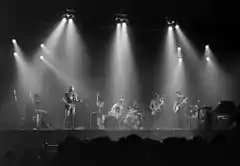 Performing Dark Side of the Moon at Earl's Court Arena in May 1973 | |
| Associated album | The Dark Side of the Moon |
|---|---|
| Start date | 20 January 1972 |
| End date | 4 November 1973 |
| No. of shows | 128 (135 scheduled) |
| Pink Floyd concert chronology | |
Pink Floyd had worked out a basic structure of Dark Side of the Moon in late 1971, and played it at almost every gig the following year, alongside a set of earlier live favourites. Various changes to the structure were made throughout this time, as songs were tightened up and arrangements changed. By 1973, the album was finished and the live performance resembled the completed work. To re-create it in concert, the group added saxophonist Dick Parry and female backing singers to the show. The stage performance was enhanced with extra visual effects and an improved quadrophonic sound system. The success of Dark Side of the Moon and the US top 20 hit "Money" greatly increased Pink Floyd's profile and they began to play sell-out stadium shows, though the audience changed from being one that would quietly listen to one that just wanted to dance and hear hit songs.
1972
.jpg.webp)
Pink Floyd planned their first UK wide tour since 1969 for the start of 1972.[1] They were worried that their stage show was becoming stale, and decided they needed a new piece of music for the upcoming tour.[2] Shortly after the release of the album Meddle, the group booked Decca Studios, Hampstead from 29 November – 10 December 1971 to write new material that would form part of a stage show.[3] The group booked a warehouse owned by the Rolling Stones in Bermondsey to rehearse the new suite of music, followed by a dress rehearsal at the Rainbow Theatre, London, where they tested a new Watkins Electric Music PA system designed by Bill Kelsey, which had a complete quadrophonic sound system, and a lighting rig designed by Arthur Max.[4]
Playing 89 shows in 1972, the most until 1994, Pink Floyd debuted the new suite live on 20 January at the Brighton Dome. Partway through, when playing "Money", there were problems with the backing tape, and the group decided to stop. After a break, they came back and played "Atom Heart Mother" instead.[5] The first complete performance was the following day at the Portsmouth Guildhall.[6] At the Free Trade Hall, Manchester, the power failed 25 minutes into the show, and the rest of the concert was abandoned.[6] Two extra shows were booked on 29 and 30 March to make up for this.[7]
The title of the suite was changed to Eclipse after it was discovered that Medicine Head had released an album with the same name,[1] then Dark Side of the Moon – A Piece for Assorted Lunatics, the name under which it made its press debut in February 1972.[8] The title changed for the first part of the US tour to Eclipse (A Piece for Assorted Lunatics) during April and May before reverting to Dark Side of the Moon – A Piece for Assorted Lunatics at the end of September for the second part of the US tour, and finally released in 1973 as The Dark Side of the Moon.[9]
Dark Side of the Moon was performed differently to the finished album, and evolved over the year. Although Pink Floyd had previously rehearsed material before recording it, taking it on tour first allowed the piece to be improved and strengthened.[10] They also knew that their audience were happy to sit patiently and listen to the group, which gave them the confidence to play over 40 minutes of new material they had not heard.[11] "On the Run", whose working title was "The Travel Sequence", was at first a guitar and keyboard jam and would remain so for the rest of the year's performances.[10][12] "Time" was played at a slower speed, and the line "Lying supine in the sunshine" was sung instead of "Tired of lying in the sunshine".[13][14] "The Great Gig in the Sky", whose working title was "Religion" or "The Mortality Sequence", consisted at the debut in January of an organ solo and various tapes of "preachers" either preaching or reading from such passages as from Chapter 5, Verse 13 of Ephesians, a book of the Bible, or reciting The Lord's Prayer, including soundbites from broadcaster Malcolm Muggeridge.[10] Initially, the suite ended with "Brain Damage". Roger Waters felt there needed to be a suitable ending, and wrote "Eclipse" as a suitable finale.[10] It made its debut at a gig at De Montfort Hall, Leicester on 10 February.[10]
The first London performance, and the first to the press was on 17 February 1972 at the Rainbow Theatre,[15] where the band played for four consecutive nights, following which the group took a break from touring to work on the soundtrack album Obscured By Clouds.[16] A bootleg recording of the concerts was released and sold 100,000 copies, annoying the band as it was still a work in progress.[11] The tour then moved to Japan for five shows,[7] and then to the US and Europe. The group headlined the British Rock Meeting festival at Germersheim, West Germany on 21 May and the Amsterdam Rock Circus at the Olympic Stadium, playing "Atom Heart Mother" instead of Dark Side of the Moon.[17]
As a replacement for the first Brighton Dome show which was abandoned during Dark Side of the Moon, Pink Floyd gave two concerts at the venue on 28 and 29 June. The latter show was filmed by Peter Clifton for inclusion on his film Sounds of the City. Clips of these were occasionally aired on television and the performance of "Careful with That Axe, Eugene" was on the various artists video Superstars in Concert.[18]
The tour moved to the US in September. Engineer Alan Parsons was asked to run the front of house sound, setting a trend for Pink Floyd inviting studio personnel out on tour.[19] Richard Wright had now written the piano music to "The Great Gig in the Sky", replacing the earlier "Mortality Suite" piece, and it was performed in the arrangement per the finished album, without vocals.[18][20] On 22 September, the group played the Hollywood Bowl, which featured eight powered searchlights beaming rays from behind the Bowl's amphitheatre.[10] They then played two dates at the Winterland Ballroom, San Francisco on 23 and 24 September.[21] The group returned to the UK to play a sell-out charity show at the Empire Pool, Wembley on 21 October, supporting War on Want and Save the Children.[22] This was followed by shows in Europe to the end of the year, with the final date at the Palais de Sports, Lyon on 10 December.[23] By then, Dark Side of the Moon sounded close to the final album, except without any female vocals or saxophone, which would follow the next year.[15]
Set list
Set One:
The Dark Side of the Moon (except 21–22 May)[24]
- "Speak to Me"
- "Breathe"
- "The Travel Sequence" (replaced by "On The Run" the following year)[25]
- "Time"
- "The Mortality Sequence" (Early version of "The Great Gig in the Sky" without female vocals)[26]
- "Money"
- "Us and Them"
- "Scat" (Early version of "Any Colour You Like")
- "Brain Damage"
- "Eclipse" (after 10 February)[10]
Set Two:[27]
- "One of These Days"
- "Careful with That Axe, Eugene" (sometimes not performed)[6]
- "Set the Controls for the Heart of the Sun" (sometimes as an encore)[28]
- "Atom Heart Mother" (20 January, 6 March, 16 April, 21–22 May)[29][30]
- "Echoes" (occasionally as an encore)[7]
Encores (when played):
- "A Saucerful of Secrets" (occasional, until 22 September)[31]
- "Blues" (occasional)[32]
- "Childhood's End" (1 and 9 December)[33]
Roland Petit Ballet shows
In November 1972, during the middle of the tour's European leg, and again in January 1973, Pink Floyd performed with the Roland Petit Ballet. The set list for which their portion of the ballet was choreographed to was "One of These Days", "Careful with That Axe, Eugene", "Obscured by Clouds", "When You're In" and "Echoes".[34] Some of the 1973 shows only featured the ballet playing to pre-recorded tracks, as the group were trying to finish recording The Dark Side of the Moon at this time.[33]
1973
_-_NARA_-_553890.jpg.webp)
Following the Roland Petit shows, Pink Floyd booked further rehearsal time at the Rainbow Theatre from 19–21 February 1973 for an enhanced stage show. Dark Side of the Moon was moved from the start of the show to the end of the main set. For the first time, the group took additional musicians with them; saxophonist Dick Parry (an old childhood friend of David Gilmour) and three female backing vocalists who had been touring with Leon Russell. The tour began in Madison, Wisconsin on 4 March.[35][36] On 17 March, they performed at Radio City Music Hall, New York City at 1am, being transported onto stage from one the elevators surrounded by dry ice, which drew strong press reviews. The show made use of a 20-speaker quadrophonic sound system.[37][38]
Following the US tour, the band played two nights at Earl's Court on 18 and 19 May. In "Set the Controls for the Heart of the Sun", a gong played by Waters was lit up with flames. During Dark Side of the Moon, a 7-foot (2.1 m) plane crashed into the stage at the end of "On the Run".[39]
The group returned to the US in June, playing stadiums for the first time.[40] By this time, Dark Side of the Moon had been released and topped the Billboard charts, and the single "Money" had become a top 20 hit. Although all the shows sold out, the audience now included people who wanted to hear the hit singles and "boogie", in sharp contrast to earlier audiences who were happy to listen to whatever music Pink Floyd were playing.[41] The tour closed with two European shows in October.[42]
On 4 November 1973, Pink Floyd played two charity shows at London's Rainbow Theatre as a benefit for Robert Wyatt, formerly the drummer of UFO Club contemporaries Soft Machine, who had become paralysed after falling out of a window. The concerts raised a reported £10,000 for Wyatt.[43][42] Clare Torry sung her vocal to "The Great Gig in the Sky" as it had appeared on the album.[42] Pink Floyd then took a lengthy break from touring and did not play any further shows until June 1974.[44]
Set list
Set One:[45]
- "Obscured By Clouds"
- "When You're In"
- "Childhood's End" (6–10 March)[46][47]
- "Set the Controls for the Heart of the Sun" (11 March onwards)[48]
- "Careful with That Axe, Eugene"
- "Echoes" (served as the opening number from 4 – 12 March)[35]
Set Two:
- "Speak to Me"
- "Breathe"
- "On the Run"
- "Time"/"Breathe (Reprise)"
- "The Great Gig in the Sky"
- "Money"
- "Us and Them"
- "Any Colour You Like"
- "Brain Damage"
- "Eclipse"
Encore:
- "One of These Days"
Tour dates
1972
| Date | City | Country | Venue |
|---|---|---|---|
| Europe | |||
| 17 January | London | England | Rainbow Theatre, Finsbury Park – Rehearsals |
| 18 January | |||
| 19 January | |||
| 20 January | Brighton | Brighton Dome (first "Dark Side of the Moon" live performance interrupted at 'Money' due to technical problems) | |
| 21 January | Portsmouth | Portsmouth Guildhall (first complete live performance of "Dark Side Of The Moon") | |
| 22 January | Bournemouth | Bournemouth Winter Gardens | |
| 23 January | Southampton | Southampton Guildhall | |
| 27 January | Newcastle upon Tyne | Newcastle City Hall | |
| 28 January | Leeds | Leeds Town Hall | |
| 3 February | Coventry | Lanchester Polytechnic College Arts Festival – Locarno Ballroom | |
| 5 February | Bristol | Colston Hall | |
| 10 February | Leicester | De Montfort Hall | |
| 11 February | Manchester | Free Trade Hall (abandoned due to power failure) | |
| 12 February | Sheffield | Sheffield City Hall | |
| 13 February | Liverpool | Liverpool Empire Theatre | |
| 17 February | London | Rainbow Theatre | |
| 18 February | |||
| 19 February | |||
| 20 February | |||
| Asia | |||
| 6 March | Tokyo | Japan | Tokyo Metropolitan Gymnasium |
| 7 March | |||
| 8 March | Osaka | Festival Hall | |
| 9 March | |||
| 10 March | Kyoto | Dai-Sho-Gun Furitsu Taiikukan | |
| 13 March | Sapporo | Nakajima Sports Center | |
| Europe | |||
| 29 March | Manchester | England | Free Trade Hall (replacement shows for 11 February) |
| 30 March | |||
| North America | |||
| 14 April | Tampa | United States | Fort Homer W. Hesterly Armory |
| 15 April | Pembroke Pines | Hollywood Sportatorium | |
| 16 April | Columbia | Columbia Township Auditorium | |
| 18 April | Atlanta | Atlanta Symphony Hall | |
| 20 April | Pittsburgh | Syria Mosque | |
| 21 April | Baltimore | Lyric Opera House | |
| 22 April | Akron | Akron Civic Theatre | |
| 23 April | Cincinnati | Music Hall | |
| 24 April | Cleveland | Allen Theatre | |
| 26 April | Detroit | Ford Auditorium | |
| 27 April | |||
| 28 April | Chicago | Auditorium Theatre | |
| 29 April | Philadelphia | Spectrum | |
| 1 May | New York City | Carnegie Hall | |
| 2 May | |||
| 3 May | Washington, D.C. | John F. Kennedy Center for the Performing Arts | |
| 4 May | Boston | Music Hall | |
| Europe | |||
| 18 May | West Berlin | West Germany | Deutschlandhalle |
| 21 May | Germersheim | Second British Rock Meeting | |
| 22 May | Amsterdam | Netherlands | Olympic Stadium |
| 28 June | Brighton | England | Brighton Dome (replacement for 20 January) |
| 29 June | |||
| North America | |||
| 8 September | Austin | United States | Austin Municipal Auditorium |
| 9 September | Houston | Houston Music Hall | |
| 10 September | Dallas | McFarlin Memorial Auditorium | |
| 11 September | Kansas City | Memorial Hall | |
| 12 September | Oklahoma City | Civic Center Music Hall | |
| 13 September | Wichita | Levitt Arena | |
| 15 September | Tucson | Tucson Community Center | |
| 16 September | San Diego | Golden Hall | |
| 17 September | Tempe | Big Surf | |
| 19 September | Denver | University of Denver Arena | |
| 22 September | Los Angeles | Hollywood Bowl | |
| 23 September | San Francisco | Winterland Ballroom | |
| 24 September | |||
| 27 September | Vancouver | Canada | Vancouver Gardens |
| 28 September | Portland | United States | Memorial Coliseum |
| 29 September | Seattle | Hec Edmundson Pavilion | |
| 30 September | Vancouver | Canada | Vancouver Gardens |
| Europe | |||
| 21 October | London | England | Empire Pool |
| 10 November | Copenhagen | Denmark | K.B. Hallen |
| 11 November | |||
| 12 November | Hamburg | West Germany | Ernst-Merck-Halle |
| 14 November | Düsseldorf | Philips Halle | |
| 15 November | Böblingen | Sporthalle | |
| 16 November | Frankfurt | Festhalle Frankfurt | |
| 17 November | |||
| 22 November | Marseille | France | Salle Valliers, Roland Petit Ballet |
| 23 November | |||
| 24 November | |||
| 25 November | |||
| 26 November | |||
| 28 November | Toulouse | Palais des Sports | |
| 29 November | Poitiers | Parc des Expositions Les Arènes | |
| 1 December | Saint-Ouen | Centre sportif de l'Île de Vannes | |
| 2 December | |||
| 3 December | Caen | Parc des Expositions | |
| 5 December | Brussels | Belgium | Forest National |
| 7 December | Lille | France | Palais des Sports |
| 8 December | Nancy | Parc de Expositions | |
| 9 December | Zürich | Switzerland | Hallenstadion |
| 10 December | Lyon | France | Palais des Sports de Gerland |
1973
Cancelled shows
| Date | City | Country | Venue |
|---|---|---|---|
| 6 February 1972 | Plymouth | England | ABC Theatre |
| 11 March 1972 | Yokohama | Japan | Kemin Hall |
| 23 June 1972 | Bièvres | France | Bièvres Festival |
| 26 August 1972 | Verona | Italy | Arena di Verona |
| 25 March 1973 | St Petersburg, Florida | United States | Bayfront Center |
| 16 June 1973 | Saratoga Springs, New York | United States | Saratoga Performing Arts Centre |
| 23 September 1973 | Frankfurt | West Germany | Sandrennbahn Altrip |
Source : Povey 2006 pp. 164–179
Personnel
Pink Floyd
- David Gilmour – guitar, vocals
- Roger Waters – bass, vocals
- Richard Wright – keyboards, vocals
- Nick Mason – drums
Additional musicians
- Dick Parry – saxophone (1973)[48][49]
- Nawasa Crowder, Mary Ann Lindsey, Phyllis Lindsey – backing vocals (March – June 1973)[48]
- Blackberries (Billy Barnum, Venetta Fields, Clydie King) – backing vocals (October 1973)[50]
- Vicki Brown, Liza Strike, Clare Torry – backing vocals ("A Benefit for Robert Wyatt", 4 November 1973)[42]
Additional personnel
1972[28]
- Chris Adamson, Seth Goldman, Bobby Richardson, Brian Scott – technician / stage crew
- Mick "The Pole" Kluczynski – tour manager
- Arthur Max – lighting technician
- Chris Mickie – front of house sound
- Peter Watts – head of PA
1973[33]
- Chris Adamson, Robbie Williams – PA and stage technician
- Mick "The Pole" Kluczynski – tour manager
- Arthur Max – Production manager and lighting technician
- Robin Murray – Lighting technician
- Alan Parsons – front of house sound (1973)
- Peter Watts – head of PA
References
- Povey 2006, p. 154.
- Povey 2006, p. 125.
- Povey 2006, p. 151.
- Povey 2006, pp. 142, 154.
- Blake 2011, p. 175.
- Povey 2006, p. 165.
- Povey 2006, p. 166.
- Mason 2004, p. 161.
- Povey 2006, p. 164.
- Povey 2006, p. 155.
- Blake 2011, p. 179.
- Blake 2011, p. 177.
- Blake 2011, p. 184.
- Guesdon & Margotin 2017, p. 350-351.
- Shea 2009, p. 152.
- Povey 2006, pp. 165–166.
- Povey 2006, pp. 167–168.
- Povey 2006, p. 169.
- Blake 2011, p. 178.
- Blake 2011, pp. 184, 187.
- Povey 2006, p. 170.
- Blake 2011, p. 188.
- Povey 2006, pp. 171–172.
- Povey 2006, p. 168.
- Blake 2011, p. 189.
- Blake 2011, p. 187.
- Povey 2006, pp. 164–172.
- Povey 2006, p. 167.
- Povey 2006, pp. 164, 166, 167, 168.
- Rosenberg 1990, p. 39.
- Rosenberg 1990, p. 41.
- Povey 2006, pp. 165–168.
- Povey 2006, p. 172.
- Povey 2006, p. 171.
- Povey 2006, pp. 173–174.
- Blake 2011, pp. 189, 207.
- Povey 2006, p. 174.
- Blake 2011, p. 207.
- Povey 2006, pp. 177–178.
- Povey 2006, p. 178.
- Blake 2011, p. 209.
- Povey 2006, p. 179.
- Blake 2011, p. 211.
- Povey 2006, p. 192.
- Povey 2006, pp. 173–179.
- Povey 2006, pp. 172–173.
- Rosenberg 1990, pp. 42–45.
- Povey 2006, p. 173.
- Rosenberg 1990, p. 45.
- Shea 2009, p. 75.
Sources
- Blake, Mark (2011) [2007]. Pigs Might Fly : The Inside Story of Pink Floyd. Arum Press. ISBN 978-1-781-31519-4.
- Guesdon, Jean-Michel; Margotin, Philippe (2017). Pink Floyd All the Songs - The Story Behind Every Track. Running Press. ISBN 978-0-316-43923-7.
- Mason, Nick (2004). Inside Out: A Personal History of Pink Floyd (New ed.). Widenfeld & Nicolson. ISBN 0-297-84387-7.
- Povey, Glenn (2006). Echoes : The Complete History of Pink Floyd (New ed.). Mind Head Publishing. ISBN 978-0-9554624-0-5.
- Rosenberg, Jon (July 1990) [1988]. A Journey Through Time and Space with Pink Floyd (book) (2nd ed.). T.D.
- Shea, Stuart (2009). Pink Floyd FAQ - Everything Left to Know ... and More. Backbeat Books. ISBN 978-1-617-13395-4.
External links
- 1972 and 1973 dates - brain-damage.co.uk
- Pink Floyd Archives
| Studio albums | |||||||||||
|---|---|---|---|---|---|---|---|---|---|---|---|
| Live albums | |||||||||||
| Compilations | |||||||||||
| Box sets | |||||||||||
| Soundtracks | |||||||||||
| Singles |
| ||||||||||
| Films |
| ||||||||||
| Tours | |||||||||||
| Related media and tributes |
| ||||||||||
| Related articles |
| ||||||||||
| |||||||||||
