Dart 18
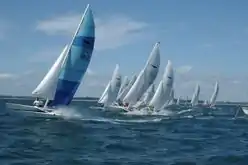
The Dart 18 is a one-design 18-foot (5.5 m) long glassfibre sailing catamaran. It is designed to be sailed by two people and can achieve speeds of up to 20 knots. This is reflected in its Portsmouth Yardstick of 805[1] and D-PN of 76.3[2]
 Class symbol | |
| Crew | 2 |
|---|---|
| Boat | |
| Crew | 2 |
| Hull | |
| Hull weight | 130 kg |
| LOA | 5480 mm |
| Beam | 2280 mm |
| Rig | |
| Mast length | 8 m |
| Sails | |
| Mainsail area | 12.92 m2 |
| Jib/genoa area | 3.16 m2 |
| Spinnaker area | 15.5 m2, not legal for racing |
| Racing | |
| D-PN | 76.3 |
| RYA PN | 805 |
History
The Dart 18 was designed and built by Panthercraft, a company formed in 1969 by two friends Ian Fraser and Kim Stephens.
Kim sailed the International Canoe and Ian the Shearwater Cat and both had some success at National level.
When the Tornado catamaran was chosen for prospective Olympic status in 1966 Ian obtained one of the original Tornadoes from the designer, Rodney March, as a ‘demonstrator’ at Restronguet in late 1968 and persuaded 6 friends to join him in building 6 boats . John Pitt, David Stonehouse, Brian Bishop, John Cooke, Graham Parkin and Ian Fraser. They pooled their resources and in the summer of 1969 established Tornado racing on Carrick Roads .
Kim and Ian both had the desire to ‘build boats’, Kim gave up his surveyor’s job with Ronnie Prior and he, with Ian, applied for a licence from the IYRU to build Tornado catamarans – not in wood, which was the method to date, but in GRP to Rodney’s specification . By using high tech laminates and materials only used so far in the aircraft industries Panthercraft built the world’s first all ‘glass’ Tornado which Ian sailed to 3rd place in the 1970 European championships in Copenhagen . By proving the design and construction was capable of winning, orders for the boats started coming in from all over the world. With the advent of containers it was possible to build boats in the old ‘clothing factory’ at Ponsanooth (which Kim and Ian had earlier purchased), load them in the field opposite Ian’s house and ship them to Hawaii, Los Angeles and Hong Kong and establish a thriving export business .
Panthercraft boats won all the major international events and Ian won the World Championship in 1971 and the Europeans in 1972. At the peak of production the firm was building some 100 Tornados a year .
With the adoption of the Tornado for the 1976 Olympics both of the partners realised that the prospect of making a living out of just one product was numbered . There were approximately 30 licensed builders around the world chasing a very select market and to survive Panthercraft needed a more universally popular design .
Terry Pearce who had, along with Rodney March, engineered the building of the original Tornado for its ‘trials’ in 1966 joined Ian and Kim to share their experiences and produce an outline of the boat that they would wish to sail .
The very first Dart 18, designed and built in Falmouth, Cornwall, is now owned by the National Maritime Museum Cornwall. Up to the present, a number of improvements have been made, but the original concept was preserved though strict class rules. More than 8350 boats have been built up to 2016, which are sailed in more than 16 nations on 4 continents. Since 2012, Windsport International holds the worldwide licence to build the Dart 18. The boats are manufactured since 2005 at Collins Fibreglass Plastics in South Africa and in Europe. The World Championship results can be found here.
Design
The hulls of the Dart 18 are similar to most sailing catamarans, but without centreboards. Instead, the lower part of the hulls have skegs typical for a beach catamaran. The hull material is glassfibre. Both hulls are filled with flotation inserts to preserve buoyancy in case of damage. The inside of each hull can be reached through a hatch cover located at the rear of each hull. The boat is assembled by attaching the main and rear beams to the hulls with spring-loaded retaining clips, and lacing the trampoline to the beams and hulls. The two rudders are removable without tools, retract on impact with the beach, and can be locked in the up position.
The rigging consists of a rotating mast held by a forestay and two shroud wires. The shrouds can be adjusted by simply moving the bolts in the chainplates. The Dart 18 mast does not have spreaders. There is a trapeze for the crew.
The mainsail does not have a boom, has nine full battens, and is controlled by a main sheet with a 7:1 mechanical advantage. The jib sail has two short battens, and is controlled by a jib sheet with a 2:1 mechanical advantage. The main sheet block and both jib sheet blocks have a ratchet and a cleat.
A gennaker sail can be added, but is not legal for racing. This is usually combined with a jib furling system. The boat can also be sailed by one person, without a foresail, with a D-PN of 78.7.[2]
Events
World Championships
| Gold | Silver | Bronze | |
|---|---|---|---|
1991 -  Great Britain Great BritainAbersoch |
Great Britain Kim Furniss Sarah Powell |
Great Britain Gareth Owen Steve Cottrell |
 France FranceDaniel Peponnet Christian Carabeau |
1995 -  Germany GermanyTravemunde |
 Netherlands NetherlandsSven Karsenberg Annemarie Kingma |
Great Britain Gareth Owen Will Thompson |
France Erik Matheron Pamela Matheron |
| 1998 Nouméa New Caledonia | Great Britain Gareth Owen Christopher Delves |
.svg.png.webp) New Caledonia New CaledoniaThierry Lebiez Franck Caromel |
Great Britain David Lloyd Katie Jennings |
1999 -  South Africa South AfricaPort Elizabeth |
Great Britain Jon Hutchings Vicki Jennings |
France Hervé le Maux (FRA) Toya Al (NED) |
Great Britain Robert Garcka Marc Howell |
| 2002 - France Marseille |
France Christophe Gazharian Catherine Gazharian |
France Hervé le Maux (FRA) Joanna Jones-Pierce (GBR) |
France Thierry Wibaux Christine Wibaux |
| 2003 - Great Britain Stokes Bay |
France Vincent Bouvier Fanny Merelle |
France Hervé le Maux (FRA) Joanna Jones-Pierce (GBR) |
Great Britain Matt Pullen Deborah Rickard |
2004 -  Portugal PortugalLagos |
France Thierry Wibaux Christine Wibaux |
France Vincent Bouvier Fanny Merelle |
Great Britain Dave Roberts Louise Roberts |
| 2006 - South Africa East London |
Great Britain Matt Pullen Deborah Rickard |
Great Britain Gareth Owen Angus Armstrong |
Great Britain David Lloyd Polly Bishop |
2007 -  Italy ItalyTorbole Lake Garda |
Great Britain Dan Norman Melanie Rogers |
Great Britain David Lloyd Cathrin Farthing |
Great Britain Paul Wakelin Emma Curtis |
| 2008 - Netherlands Workum |
France Emmanuel Dode Billy Besson |
Great Britain Dan Norman Melanie Rogers |
Great Britain David Lloyd Cathrin Farthing |
| 2009 Palm Beach Aruba | France Emmanuel Dode Fred Moreau |
Great Britain David Lloyd Joanna Jones-Pierce |
Germany Mathias Huber Dominik Volke |
| 2010 - Great Britain Weymouth |
Great Britain Tom Phipps Richard Glover |
France Emmanuel Dode Fred Moreau |
Great Britain Dan Norman Melanie Rogers |
2011 - .svg.png.webp) Belgium BelgiumKnokke |
Great Britain Alan Kernick Fiona Kernick |
Great Britain Dan Norman Mel Rogers |
France Thierry Wibaux Christine Wibaux |
| 2012 - Italy Punta Ala |
Great Britain Tom Phipps Nikki Boniface |
Great Britain Dave Roberts Louise Roberts |
France Thierry Wibaux Christine Wibaux |
| 2013 - France Carnac |
Dan Norman (GBR) Jessica Day (GBR) |
Jonathan Pierce (GBR) Ginny Trafford (GBR) |
Brian Phipps (GBR) Katy Phipps (GBR) |
| 2014/5 - South Africa Stillbaai Vaal Dam |
South Africa Alan Kernick Fiona Kernick |
South Africa Ben Mienie Lloyd Beyers |
South Africa Chris Clarke Morgan Rusch |
| 2016 - Netherlands Medemblik |
Dan Norman (GBR) Alysha Monkman (GBR) |
Dave Roberts (GBR) Louise Roberts (GBR) |
 Michiel Fehr (SUI) Andri Fried (SUI) Michiel Fehr (SUI) Andri Fried (SUI) |
| 2017 - Germany Scharbeutz [3] |
Dave Roberts (GBR) Louise Roberts (GBR) |
Jorg Gosche (GER) Arne Gosche (GER) |
Herve LeMaux (FRA) Joanna Trafford (GBR) |
| 2018 - Italy Dervio Lake Como |
Alessandro Siviero (ITA) Marco Tramutola (ITA) |
Michiel Fehr (SUI) Andri Fried (SUI) |
David Lloyd (GBR) Anne Chaumet - LaGrange (FRA) |
| 2019 - Thailand Pattaya 52 Boats[4] |
GBR 7835 Dave Roberts (GBR) Louise Roberts (GBR) |
GBR 7930 Gareth Owen (GBR) Hebe Hemming (GBR) |
GBR 7945 Daniel Norman (GBR) Alyesha Monkman (GBR) |
| 2020 - France La Rochelle |
COVID 19 |
See also
References
- "Portsmouth Number List 2013". Royal Yachting Association. Retrieved 16 August 2013.
- "Multihull Classes". US Sailing. Archived from the original on 16 August 2012. Retrieved 30 July 2012.
- http://manage2sail.com/de-DE/event/e9efae25-2028-48c1-8451-f3183ddce75b#!/results?classId=8b6af7e7-905a-4d5e-bfbb-5a33fbdad013
- http://www.dart18.com/new/wp-content/uploads/2019/02/Final-Results.pdf
External links
- UK Dart 18 Catamaran History
- UK Dart 18 Catamaran Association
- SA Dart 18 Catamaran Association
- ISAF 2020 class report for the Dart 18
- National Maritime Museum Cornwall
- Windsport, supplier of Dart18 boats and parts