Dictyosphaeria
Dictyosphaeria is a genus of green algae (Class Ulvophyceae) in the family Siphonocladaceae.[1]
| Dictyosphaeria | |
|---|---|
 | |
Scientific classification  | |
| (unranked): | Viridiplantae |
| Phylum: | Chlorophyta |
| Class: | Ulvophyceae |
| Order: | Cladophorales |
| Family: | Siphonocladaceae |
| Genus: | Dictyosphaeria Decaisne |
Taxonomy and Nomenclature
The genus Dictyosphaeria belongs to the Order of Cladophorales; Family Siphonocladaceae. It comprises a total of 13 taxonomically recognized species that were based from available literatures. [2]
Taxonomically Accepted Species of Dictyosphaeria
- Dictyosphaeria australis Setchell
- Dictyosphaeria cavernosa (Forsskål) Børgesen
- Dictyosphaeria enteromorpha Montagne & Millardet
- Dictyosphaeria intermedia Weber Bosse
- Dictyosphaeria mutica Yamada
- Dictyosphaeria ocellata (M.Howe) Olsen-Stojkovich
- Dictyosphaeria sericea Harvey
- Dictyosphaeria spinifera C.K.Tseng & C.F.Chang
- Dictyosphaeria ulvacea Kützing
- Dictyosphaeria valonioides Zanardini
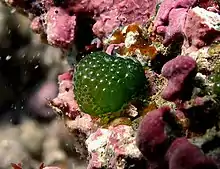
- Dictyosphaeria versluysii Weber Bosse (Figure 1)
General Morphological Description
Thalli
The Thalli is composed of visibly hollow hexagional or polygonal cells; and are monostromatic or polystromatic depending on species. They can be solid or button-shaped at around 1-5 cm; and spherical and club-shaped at 1 cm or more. The size of each cells are around 300 - 500 µm in diameter. Complex rhizoidal system is absent, however, basal cells are firmly attached to the substratum. [3]
The coloration of the macroalgae varies from grass green to bluish. [4]
Cells
Cells are visible to the naked eye. They are minutely determinate, simple or furcate, and tenacular that are structurally cushioned together. Occasionally, tenacular cells may also function as adventitious rhizoids.
Cells are multinucleated and have numerous discoid chloroplasts. Chloroplasts bear single pyrenoid surrounded by starch sheath and divided to two or more portions by traversing thylakoids.
Life History
The life history of Dictyosphaeria is both biphasic and isomporphic alternation of generation. This involves zoospores that are quadriflagellate, as well as isogamous and biflagellate gametes. Asexual reproduction through thalli fragmentation and possible parthenogenesis of gametes which result in smooth surface thalli textures.
Distribution and Habit
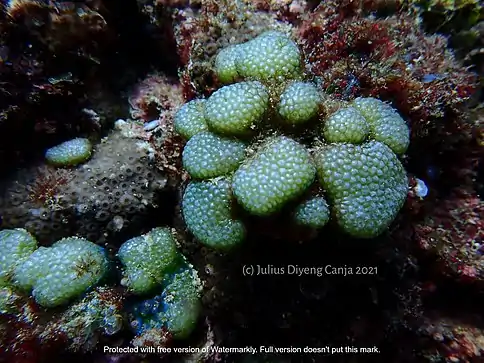
The genus Dictyosphaeria is widely found in the tropical region. Its habitat varies from shallow intertidal habitats, such as coral rubbles, to reef flats where they can be the dominant macroalgae. They are commonly found attached to rocky substrate or coral rubble (Figure 2).
Economic Use
The genus Dictyosphaeria, particularly, D. cavernosa is used for fish bait and animal feed; as well as antimicrobial medicine for human application. [5]
.jpg.webp)
References
- See the NCBI webpage on Dictyosphaeria. Data extracted from the "NCBI taxonomy resources". National Center for Biotechnology Information. Retrieved 2007-03-19.
- "Algaebase :: Listing the World's Algae". www.algaebase.org. Retrieved 2021-12-03.
- "Algaebase :: Listing the World's Algae". www.algaebase.org. Retrieved 2021-12-01.
- "Dictyosphaeria cavernosa". www.hawaii.edu. Retrieved 2021-12-03.
- Trono, Jr., Gavino C. (1997). Field Guide & Atlas of the Seaweed Resources of the Philippines. Makati City, Philippines: Bookmark Inc. ISBN 971-569-252-4.
External links
- https://www.algaebase.org/search/genus/detail/?genus_id=35942
- https://www.hawaii.edu/reefalgae/invasive_algae/chloro/dictyosphaeria_cavernosa.htm