Dig a Pony
"Dig a Pony" is a song by the English rock band the Beatles from their 1970 album Let It Be. It was written by John Lennon and credited to Lennon–McCartney. The band recorded the song on 30 January 1969, during their rooftop concert at the Apple Corps building on Savile Row in central London.
| "Dig a Pony" | |
|---|---|
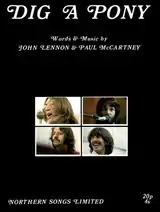 Northern Songs sheet music cover | |
| Song by the Beatles | |
| from the album Let It Be | |
| Released | 8 May 1970 |
| Recorded | 30 January 1969 |
| Genre | Hard rock[1] |
| Length | 3:52 |
| Label | Apple |
| Songwriter(s) | Lennon–McCartney |
| Producer(s) | Phil Spector |
| Audio sample | |
"Dig a Pony"
| |
Composition
"Dig a Pony" is in the key of A major and partly in 3/4 time.[2] It was originally called "All I Want Is You".[3] John Lennon said the song was "a piece of garbage",[4] though he expressed similar scorn for many of his songs. It was written for his soon-to-be wife Yoko Ono,[5] and features a multitude of strange, seemingly nonsensical phrases strung together in what Lennon referred to as a Bob Dylan style of lyric.
In author Ian MacDonald's description, the lyrics "celebrat[e] countercultural claims that society's old values and taboos were dead, that life was a game and art a free-for-all, and (especially) that words meant whatever the hell one wished them to".[6]
"Dig a Pony" was among the first songs the Beatles worked on during day one of their filmed rehearsals for a planned return to live performance, in January 1969.[7] Lennon introduced it to George Harrison soon after arriving at Twickenham Film Studios on 2 January, as the pair ran through their latest songs.[8]
Early American pressings of Let It Be mistitled the song as "I Dig a Pony".
Recording
"Dig a Pony" was one of the songs on Let It Be recorded at the rooftop concert on 30 January 1969.[9][10] Kevin Harrington, the band's roadie, held up Lennon's lyrics for him while he sang.[11][12] It begins with a false start, with Ringo Starr yelling "Hold it!" because he was putting out his cigarette and had both of his drum sticks in his right hand.[13] On the recording, the sound of someone blowing his nose right after Starr's interjection can be heard, which Mark Lewisohn attributes to Lennon.[14]
A studio take of the song from 22 January appears on the 1996 Anthology 3 outtakes compilation.[15] On this version, the first verse and the end of the song start off with Paul McCartney singing "All I want is ..." This phrase appeared in every performance of the song but was cut from the final version by Phil Spector, and subsequently cut from the Let It Be... Naked version, which also omits the false start.[16]
Personnel
According to Walter Everett:[17]
The Beatles
- John Lennon – lead vocal, rhythm guitar
- Paul McCartney – harmony vocal, bass guitar
- George Harrison – lead guitar
- Ringo Starr – drums
Additional musician
References
- Unterberger, Richie. "The Beatles Let It Be". AllMusic. Retrieved 11 December 2021.
- MacDonald 1998, pp. 289, 449.
- Miles 2001, p. 331.
- Sheff 2000, p. 205.
- Hertsgaard 1996, p. 271.
- MacDonald 1998, p. 290.
- Everett 1999, pp. 216, 218.
- Sulpy & Schweighardt 1999, pp. 5–7.
- Hertsgaard 1996, pp. 263, 269.
- Everett 1999, p. 219.
- Archived at Ghostarchive and the Wayback Machine: "The Beatles: I Was On The Roof (Get Back)". YouTube.
- "92 – 'Dig a Pony'". 100 Greatest Beatles Songs. Rolling Stone.
- Fontenot, Robert. "Dig A Pony on About.com". About.com. Retrieved 3 July 2014.
- Lewisohn 1992, p. 312.
- Winn 2009, pp. 250–51.
- Hurwitz, Matt (1 January 2004). "The Naked Truth About the Beatles' Let It Be Naked". Mix Online. Archived from the original on 31 January 2010. Retrieved 20 August 2011.
- Everett 1999, p. 226.
Sources
- Everett, Walter (1999). The Beatles as Musicians: Revolver Through the Anthology. New York, NY: Oxford University Press. ISBN 978-0-19-512941-0.
- Hertsgaard, Mark (1996). A Day in the Life: The Music and Artistry of the Beatles. London: Pan Books. ISBN 0-330-33891-9.
- Ingham, Chris (2006). The Rough Guide to the Beatles. London: Rough Guides/Penguin. ISBN 978-1-84836-525-4.
- Lewisohn, Mark (1992). The Complete Beatles Chronicle: The Definitive Day-by-Day Guide to the Beatles' Entire Career. New York, NY: Harmony Books. ISBN 0-517-58100-0.
- MacDonald, Ian (1998). Revolution in the Head: The Beatles' Records and the Sixties. London: Pimlico. ISBN 978-0-7126-6697-8.
- Miles, Barry (2001). The Beatles Diary Volume 1: The Beatles Years. London: Omnibus Press. ISBN 0-7119-8308-9.
- Sheff, David (2000) [1981]. All We Are Saying: The Last Major Interview with John Lennon and Yoko Ono. New York, NY: St. Martin's Press. ISBN 0-312-25464-4.
- Sulpy, Doug; Schweighardt, Ray (1999). Get Back: The Unauthorized Chronicle of the Beatles' Let It Be Disaster. New York, NY: St. Martin's Griffin. ISBN 0-312-19981-3.
- Winn, John C. (2009). That Magic Feeling: The Beatles' Recorded Legacy, Volume Two, 1966–1970. New York, NY: Three Rivers Press. ISBN 978-0-307-45239-9.
