Djajadiningrat family
The Djajadiningrat family was a high-ranking priyayi family in colonial Indonesia, whose members often served as Bupati or Regents (district heads) of Serang in Banten, Dutch East Indies.[1][2] Noted for their western outlook and loyalty to the Dutch authorities during the colonial period, the family nonetheless fought on both sides of the Indonesian National Revolution (1945–1949).[3]
History

The family is of Baduy and Bantenese extraction. According to Nina Consuelo Epton, the family's oral history recounts that in the middle of the seventeenth century, their ancestor, the renegade son of a Baduy chieftain, sought shelter at the court of the Sultan of Banten.[2] He was subsequently admitted into the inner circle of the Sultan's court and was allowed to marry one of the Sultan's daughters, thereby becoming the founder of the Djajadiningrat family.[2]
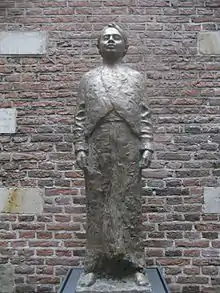
Later marriages into the Javanese reigning dynasties further cemented the Djajadiningrat family's hold on power, as was shown by the career of R.T.A. Natadiningrat and his eldest son, R.T. Sutadiningrat, who both ruled in succession as Regents of Serang, in Banten.[4] After an alleged involvement in a peasants' revolt, he latter was succeeded by his younger brother, the progressive Raden Bagoes Djajawinata.[4]
In the late nineteenth century, the family benefited from the patronage of the Dutch scholar and educator Snouck Hurgronje.[5][6][7] Hurgronje, who believed in coopting the Indonesian elite by giving their children a Dutch education, ensured the admission to the prestigious Koning Willem III School of the brothers Achmad (1877–1943) and Hoessein Djajadiningrat (1886–1960), sons of Raden Bagus Djajawinata.[4][7][8] Achmad, the elder son, went on to succeed his father as Regent of Serang (1901–1924), then of Batavia (1924–1929), and served as a member of both the Volksraad (Indonesia's colonial quasi-parliament) and the Raad van Indië (Council of the Indies). Hoessein, the younger son, completed his doctoral studies at Leiden University in 1913, and became a distinguished scholar of Sundanese, Bantenese, Malay and Islamic studies.[9]
The family, like most other native Sundanese and Bantenese families, originally had no surname; the Dutch-educated Achmad Djajadiningrat adopted the surname 'Djajadiningrat' in the late nineteenth century.[10] Other prominent members of the family include Achmad Djajadiningrat's son, Idrus Nasir Djajadiningrat (1920–1980), and the latter's cousin Maria Ulfah Santoso (1911–1988), both of whom were important figures in the Indonesian Revolution. The media tycoons Pia Alisjahbana and Svida Alisjahbana are the daughter and granddaughter respectively of Hisnat Djajadiningrat, Achmad's daughter from his first wife.[11]
Notable Family Members
Raden Bagoes Djajawinata, Regent of Serang (1854-1899) had 9 children:
- Achmad Djajadiningrat (1877-1943), succeeded his father as Regent of Serang (1901-1924), then Regent of Batavia (1924-1929). He also served as a member of the Volksraad since 1918, stepped down from his regency a few years later when a new law forbade regents to hold multiple offices. In 1929 he served as member of the Raad van Nederlandsch Indie until 1932, when illness prevented him to serve any longer.[12] He was the first to use the surname 'Djajadiningrat', prompting his siblings to adopt the surname.[11] He had several children from multiple wives, some of whom:
- Erna Djajadiningrat (1911-1984), first Indonesian woman to receive the Guerilla Star in 1949, in recognition for her wartime service.[13]
- Idrus Nasir Djajadiningrat (1920-1980), nicknamed "Didi", served as navy officer during the Indonesian war for independence, ending his service with the rank of rear admiral. Served as Indonesian ambassador to Belgium in 1968-1970, later ambassador to Soviet Union in 1976-1980.[11]
- Hisnat Djajadiningrat. Her daughter Pia would marry Sofyan Alisjahbana, son of famed author Sutan Takdir Alisjahbana. Together they managed the Femina Group, an Indonesian media and publishing group.[14]
- Mochammad Djajadiningrat (?-?)
- Hasan Djajadiningrat (?-1920), led the Sarekat Islam organization in Banten until his early death.[15]
- Chadijah Djajadiningrat (?-?), had 3 children, one of whom:
- Maria Ulfah Santoso (1911-1988), member for the Committee for Preparatory Work for Indonesian Independence, women's right activist, and minister of social affairs in 1946-1947 under prime minister Sjahrir. She was the first Indonesian woman to earn a Masters' degree in Law in 1933 from Leiden University.[16]
- Hoesein Djajadiningrat (1886-1960), distinguished himself as the first Indonesian to achieve a doctoral degree (via dissertation) from Leiden University in 1913. In 1924 he was appointed as a lecturer at Rechtshogeschool te Batavia, giving lectures on Islamic law and Indonesian native languages. During the Japanese occupation of the East Indies, he was appointed as head of Office of Religious Affairs. After Indonesian independence, he taught in Faculty of Letters, University of Indonesia since its foundation in 1950, becoming professor of Islamic and Arabic Studies in 1952.[17] His wife Partini is the eldest daughter of Mangkunegara VII and sister to Mangkunegara VIII of the royal house of Mangkunegara. Together they had 6 children, one of whom:[11]
- Husein Hidayat Djajadiningrat (1928-?), later served in the Indonesian Army in RPKAD, ending his service with the rank of colonel.
- Loekman Djajadiningrat (1894-1944), managed to flee Japanese invasion along with Lieutenant Governor-General van Mook and remnants of the colonial government to Australia. After some times serving as a commissioner for Australia and New Zealand, he later appointed to head the education department of the Dutch East Indies Government-in-Exile. He died in Sydney in 1944.[18]
- Soelasmi Djajadiningrat (?-?)
- Hilman Djajadiningrat (1896-1963), served as Regent of Serang from 1935-1945. In 1942 during Japanese occupation, he was appointed the Resident of Banten until 1945, when he returned as Regent of Serang. Later, he would lead pro-Dutch, federalist faction in the State of Pasundan, opposing the pro-Republican faction led by Wiranatakusumah. In 1948 he would serve as the governor of Djakarta Federal District until 1950.[19]
- Rifqi Djajadiningrat (?-?)
Gallery
 Achmad Djajadiningrat
 Hoessein Djajadiningrat
%252C_p16.jpg.webp) Hilman Djajadiningrat
Hilman Djajadiningrat Erna Djajadiningrat
 Partini Djajadiningrat, wife of Hoesein and daughter of Mangkunegara VII
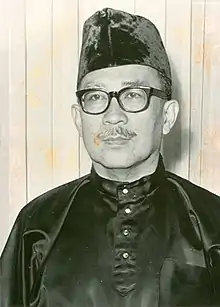 Idrus Nasir Djajadiningrat
 Maria Ulfah Santoso
References
- Netherlands News Digest. Netherlands Information Bureau. 1944. pp. 120, 430. Retrieved 15 July 2018.
- Epton, Nina Consuelo (1974). Magic and mystics of Java. London: Octagon Press. pp. 53–55. Retrieved 8 August 2018.
- Soekarno's Mentjapai Indonesia Merdika. Southeast Asian Studies Committee, James Cook University. 1978. p. 34.
- Kartodirdjo, Sartono (2014). The Peasants' Revolt of Banten in 1888: Its Conditions, Course and Sequel: A Case Study of Social Movements in Indonesia. Springer. pp. 85–86. ISBN 9789401575430. Retrieved 8 August 2018.
- "Bijdragen tot de taal-, land- en volkenkunde van Nederlandsch-Indië". M. Nijhoff. 1989: 297–301. Retrieved 15 July 2018. Cite journal requires
|journal=(help) - "Bijdragen tot de taal-, land- en volkenkunde". M. Nijhoff. 1999: 519–541. Retrieved 15 July 2018. Cite journal requires
|journal=(help) - Laffan, Michael Francis (2003). Islamic Nationhood and Colonial Indonesia: The Umma Below the Winds. Routledge. pp. 91–94, 181–187. ISBN 9781134430819. Retrieved 15 July 2018.
- Djajadiningrat, Achmad Pangeran Aria (1936). Herinneringen van Pangeran Aria Achmad Djajadiningrat (in Dutch). G. Kolff. Retrieved 15 July 2018.
- Salam, Solichin (1990). Wajah-wajah nasional (in Indonesian). Pusat Studi Dan Penelitian Islam. pp. 430–435. Retrieved 15 July 2018.
- Heesterman, J. C. (1989). India and Indonesia: General Perspectives. BRILL. p. 77. ISBN 9004083650. Retrieved 15 July 2018.
- Suryani, Ade Jaya (January–April 2013). "Bantenese Authors and Their Works: A General Overview" (PDF). Alqalam. 30 (1): 184–212.
- Jusuf, Windu. "Kisah Sukses Karir Achmad & Hoesein Djajadiningrat". tirto.id (in Indonesian). Retrieved 2021-11-14.
- "Perempuan Pertama Penerima Bintang Gerilya". Historia - Majalah Sejarah Populer Pertama di Indonesia (in Indonesian). 2017-07-17. Retrieved 2021-11-14.
- "Pia Alisjahbana Profile". Indonesia Tatler. Retrieved 2021-11-14.
- "Satu Perahu Dua Haluan". Historia - Majalah Sejarah Populer Pertama di Indonesia (in Indonesian). 2017-11-13. Retrieved 2021-11-14.
- "Indonesia Journal". ecommons.cornell.edu. Retrieved 2021-11-14.
- RS, Zen. "Si Jenius yang Jadi Bumiputera Pertama Bergelar Doktor". tirto.id (in Indonesian). Retrieved 2021-11-14.
- "Matches for R. Loekman "Oedjang" Djajadiningrat". MyHeritage. Retrieved 2021-11-16.
- Kahin, George McT. (June 1956). "Representative Government in Southeast Asia. By Rupert Emerson, with Supplementary Chapters by Willard H. Elsbree and Virginia Thompson. (Cambridge: Harvard University Press. 1955. Pp. vii, 197. $3.50.) - The Formation of Federal Indonesia, 1945–1949. By A. Arthur Schiller. (The Hague, Bandung: W. Van Hoeve, Ltd. 1955. Pp. viii, 472.)". American Political Science Review. 50 (2): 505–509. doi:10.2307/1951689. ISSN 0003-0554.