Dobříš
Dobříš (Czech pronunciation: [ˈdobr̝iːʃ]; German: Doberschisch) is a town in Příbram District in the Central Bohemian Region of the Czech Republic. It has about 8,800 inhabitants. It is located 40 km (25 mi) south of Prague, and it is a part of the Prague metropolitan area.
Dobříš | |
|---|---|
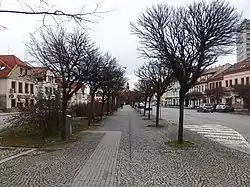 Mírové Square | |
 Flag  Coat of arms | |
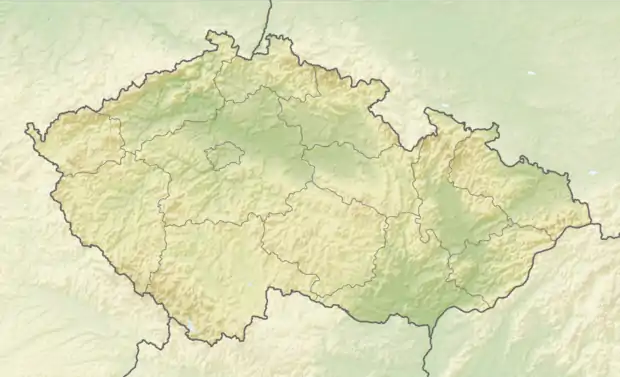  Dobříš Location in the Czech Republic | |
| Coordinates: 49°46′52″N 14°10′2″E | |
| Country |  Czech Republic Czech Republic |
| Region | Central Bohemian |
| District | Příbram |
| First mentioned | 1252 |
| Government | |
| • Mayor | Pavel Svoboda |
| Area | |
| • Total | 53.42 km2 (20.63 sq mi) |
| Elevation | 371 m (1,217 ft) |
| Population (2021-01-01)[1] | |
| • Total | 8,828 |
| • Density | 170/km2 (430/sq mi) |
| Time zone | UTC+1 (CET) |
| • Summer (DST) | UTC+2 (CEST) |
| Postal code | 263 01 |
| Website | www |
Administrative parts
Village of Trnová is an administrative part of Dobříš.
History
The settlement on the Golden Path trade route was first mentioned when in 1252 King Wenceslaus I of Bohemia signed a treaty with the Cistercian abbey of Plasy. Temporarily held by the noble House of Rosenberg, King John of Bohemia had a hunting lodge erected at Dobříš. It was devastated during the Hussite Wars in 1421.[2]
After the Kingdom of Bohemia had passed to the Habsburg Monarchy, Dobříš was given market town rights by King Ferdinand I in 1543, confirmed by his son and successor Emperor Maximilian II in 1569. The keep in Dobříš was acquired by the German House of Mansfeld in 1630, who had it rebuilt in a Rococo style chateau from 1745 onwards. It was inherited by the Austrian Colloredo-Mansfeld dynasty in 1780.[2]
Economy
In the 19th century, the town became associated with the manufacturing of gloves, which began in 1865. This industry was first developed by Salamon Abeles. After World War II, a glove factory (Rukavičkářské závody) was still operating here.[2] The factory employed 3,300 people at its peak, but the production ended in 1992. Since 1993, the tradition is held by a small company NAPA.[3]
In the town centre and near the main road to Prague there are Bobcat factories.
Sights
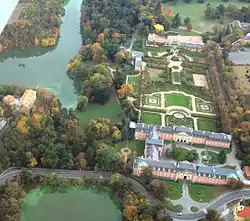
Dobříš Chateau is the most significant monument in the town. Its parts are French formal garden (one of the most popular and valuable in the country) and English landscape garden.[4]
Notable people
- Josef Balabán (1894–1941), soldier and resistance fighter
- Jorge Amado (1912–2001), Brazilian writer; lived here
- Jan Drda (1915–1970), writer, journalist and politician; buried here
- Zélia Gattai (1916–2008), Brazilian writer; lived here
- Filip Dort (born 1980), footballer; lives here

References
- "Population of Municipalities – 1 January 2021". Czech Statistical Office. 2021-04-30.
- "Historie Dobříše" (in Czech). Město Dobříš. Retrieved 2021-05-16.
- "Rukavičkářské závody v Dobříši mívaly 3.300 zaměstnanců. Dnes je rukavičkářské řemeslo na vymření" (in Czech). Czech Radio. 2018-07-12. Retrieved 2021-05-16.
- "Zámek Dobříš – Dobříš Chateau" (in Czech). Město Dobříš. Retrieved 2021-05-16.
- "Hrabě z Dobříše dovezl ondatry přes oceán, hlodavec obsadil celou Evropu" (in Czech). iDnes. 2020-04-21. Retrieved 2021-05-16.
- "Partnerská města" (in Czech). Město Dobříš. Retrieved 2020-08-08.
External links
 |
Wikimedia Commons has media related to Dobříš. |
Authority control  | |
|---|---|
| General | |
| National libraries | |
| Other | |