Drombeg stone circle
Drombeg stone circle (also known as The Druid's Altar), is a small axial stone circle located 2.4 km (1.5 mi) east of Glandore, County Cork, Ireland.[3][4]
Ciorcal an Droma Bhig | |
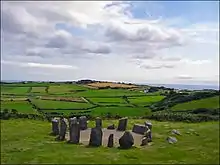 Drombeg site, looking south | |
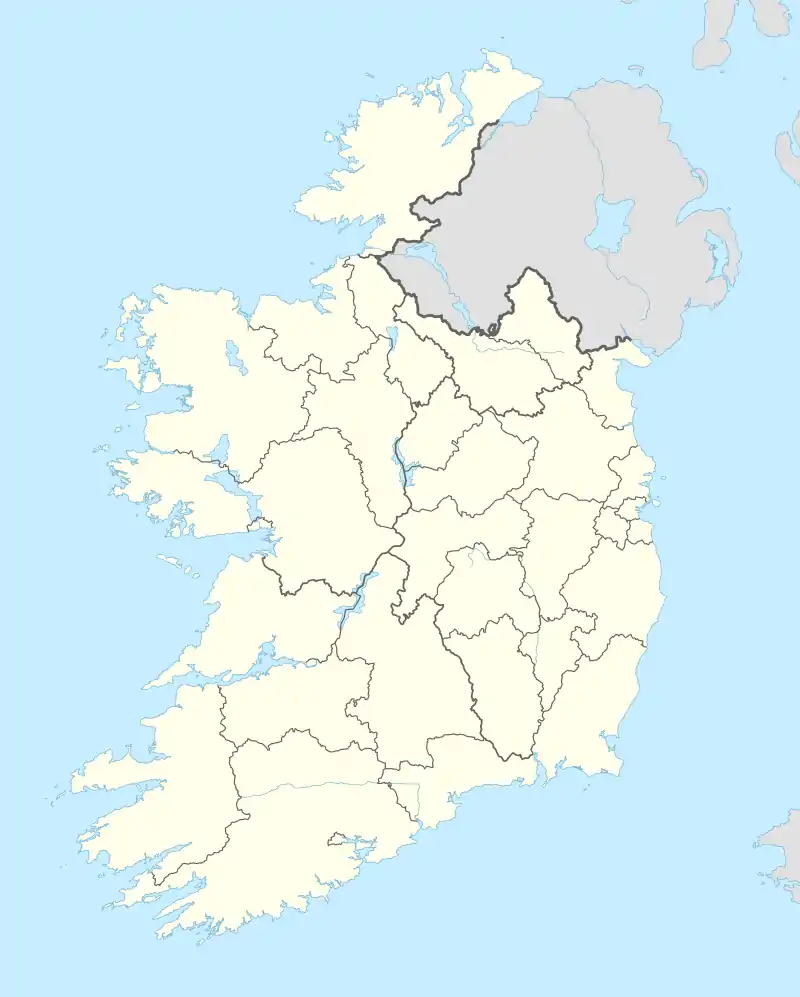 .svg.png.webp) Location of site in Ireland | |
| Alternative name | Druid's Altar |
|---|---|
| Location | County Cork, Ireland Irish Grid: W245352) |
| Coordinates | 51.56456°N 9.08702°W |
| Type | Axial stone circle |
| Area | 9.3 metres (31 ft) (diameter) |
| Height | 1.8 metres (5 ft 11 in) (highest stone) |
| History | |
| Periods | Bronze Age[1] to early Iron Age[2] |
| Site notes | |
| Archaeologists | Edward M. Fahy (1957) |
| Management | National Monument Service |
| Public access | Yes |
| Reference no. | 381 |
Although not an especially significant example, Drombeg is one of the most visited megalithic sites in Ireland, and is protected under the National Monuments Act.[5] It was excavated in 1958, when the cremated remains of an adolescent was found in a pot in the circle's center.[5]
Features
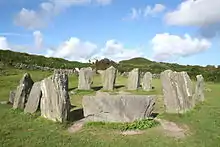
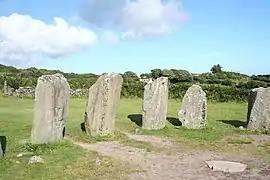
The stone circle originally consisted of seventeen closely spaced stones of which 13 survive. The stones are made from local sandstone.[6] The circle spans 9.3 metres (31 ft) in diameter. As an axial or "Cork–Kerry" stone circle, it contains two taller entrance stones placed opposite a recumbent axial stone. Its axis is orientated south west towards the setting sun.
The most westerly stone (1.9m long) is the long recumbent and has two egg shaped cup-marks, one with a ring around it.[3] An axial stone circle, also known as a "Cork–Kerry type" stone circle, it is flanked by a pair of 1.8m high axial portal stones, which mark the entrance to the stone circle, and face the recumbent altar stone.[6] This arrangement creates a south-west axis, and orients the monument in the direction of the setting sun during the midwinter solstice.[7][2][5]
Near the stone circle, approximately 40m to the west, are two round stone-walled prehistoric huts and a fulacht fiadh.[5] Evidence suggests the fulacht fiadh was in use until approximately the 5th century AD. Of the two huts, the largest had a timber roof supported by timber posts. The smaller hut contains the remains of a cooking sport on its eastern side. A causeway leads from the huts to the fulacht fiadh, which has a hearth, well and a water trough.[3]
Excavations
Following a number of surveys in the early 1900s,[8] the site was excavated and restored in 1957.[2] Radiocarbon dating of samples taken from the site suggest that it was active c. 1100 - 800 BC. An inverted pot, found in the centre of the circle, contained the cremated remains of a young adolescent wrapped with thick cloth. The pot was found close to the centre of the circle and was found alongside smashed sherds and a collection of sweepings from a pyre.[7]
Gallery
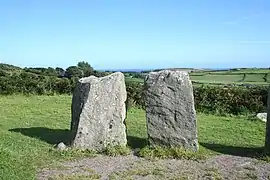 Portal stones
 Eastern part
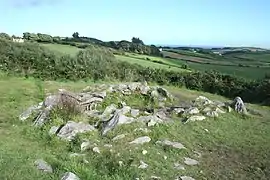 Cooking place
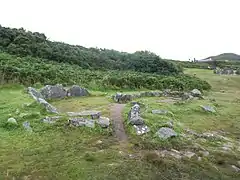 Dwelling remains
References
Notes
- Roseingrave 2014.
- Fahy 1959.
- Weir 1980.
- Weir 2008.
- Noonan 2001, p. 85.
- Newland 2003, p. 140.
- "Drombeg stone circle, Co Cork". Stonepages.com. Retrieved 6 January 2017.
- Keogh 2017.
Sources
- Fahy, E.M. (1959). "A Recumbent-stone Circle at Drombeg, Co. Cork". Journal of the Cork Historical and Archaeological Society. 2. LXIV: 1–27.
- Keogh, Jackie (4 January 2017). "New discoveries about Drombeg Stone Circle". Southern Star. Retrieved 6 January 2017.
- Newland, Sonya (2003). The Magic & Mystery of Ireland. Bath: Parragon. p. 140. ISBN 1-40540-798-0.
- Noonan, Damien (2001). Castles & Ancient Monuments of Ireland. Arum Press. ISBN 1-85410-752-6.
- Roseingrave, Louise (11 December 2014). "Was Drombeg's stone circle designed using skills learned in Babylon?". Irish Times. Retrieved 7 April 2015.
- Weir, Anthony (1980). Early Ireland. A Field Guide. Belfast: Blackstaff Press. pp. 114–115.
- Weir, Anthony (2008). "Drombeg". The Megalithic Portal. Retrieved 11 June 2008.

