Dutch garden
Dutch garden refers firstly to gardens in the Netherlands, but also, mainly in the English-speaking countries, to various types of gardens traditionally considered to be in a Dutch style. Historically gardens in the Netherlands have generally followed trends from neighbouring countries, but from the Early Modern period, Dutch gardens were distinctive for the wider range of plants available over the rest of Europe north of the Alps, and an emphasis on individual specimen plants, often sparsely planted in a bed. In the 17th century and into the 18th, the Dutch dominated the publishing of botanical books, and established the very strong position in the breeding and growing of garden plants, which they still retain. They were perhaps also distinguished by their efficient use of space, and in large examples, the use of topiary (sculptured bushes and trees) and small "canals", long thin, rectangular artificial stretches of water.[1]

Because the Netherlands is one of the most densely populated countries, gardens are generally small and because houses are placed right next to each other, there is not very much light available. From the 19th century onwards, Dutch gardens adapted to wider trends, mostly from England and France. Dutch gardens are relatively small, and tend to be "self-contained and introspective", with less linkage to the wider landscape around.[2]
.jpg.webp)
The history of "Dutch-style" gardens abroad perhaps begins in the 17th century. On the one hand these have a concentration on the display of specimen plants, initially often imported from the Netherlands. In larger gardens, canals and topiary are often found.
Later, from the 19th century onwards, rectangular flower gardens, often slightly sunk in tiers, and now heavily planted, were seen as "Dutch". Any garden with large numbers of tulips is also easily labelled as a Dutch garden.
Het Loo
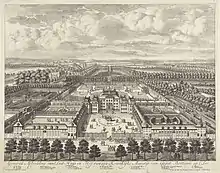
The gardens of Het Loo Palace, laid out by a pupil of Le Notre under William III, were the largest Dutch version of the French formal garden, in the style of the Gardens of Versailles; in recent decades they have partly been returned to this style, with elaborately-patterned parterres. But these could not be said to be typical of the Dutch style.[3]
Dutch influence on England
In England, Dutch influence became strong for a period after the Dutch King William III of England reached the throne through his wife; both were interested in gardening.[4] Westbury Court Garden, now carefully restored to its design around 1700 is perhaps the best example in England of a more native Dutch style for a large house. The Dutch garden was the description given to a particular type of rectangular flower garden space, often enclosed within hedges or walls, even if part of a larger garden or parkland. The Dutch version of the French formal garden, this space would be laid out in a highly cultivated and geometrical, often symmetrical, fashion, shaped by plantings of highly coloured flowers, originally very well-spaced by modern standards, and edged with box or other dense and clipped shrubs, or low walls (sometimes in geometrical patterns), and sometimes, also, with areas of artificial water, with fountains and water butts, which were also laid out in symmetrical arrangements.
The restoration at Westbury Court prompted some discussion among English garden historians as to what, if anything, constituted a historical "Dutch garden", and how Dutch the typical features ascribed to them actually were.[5] To some extent calling formal gardens in England "Dutch" avoided the accusation that they were actually in a style that was essentially French, at a time of wars between England and France.
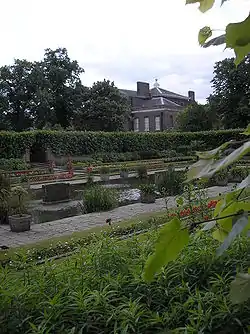
Later, in England the term was used for flower gardens that are heavily planted within a geometric frame. The flower beds and areas of water would be intersected by geometrical path patterns, to make it possible to walk around the garden without damaging any of its features. An example, not now planted in an authentic style, is to be found adjacent to Kensington Palace, due south of the orangery. The Privy Garden at Hampton Court Palace has been restored in recent decades in a more authentic version of the style around 1700, when it was planted under William III. Unlike Louis XIV's much larger Gardens of Versailles, this was only accessible to a small group of courtiers.[6] Another example, less ambitious, is at Clandon Park in Surrey. The Dutch garden, with its geometry and formality, was in opposition to the cottage garden, which in its modern form is characterised by grass, winding and asymmetrical paths (if any) and a blurring of the lines between flowers and grass by allowing shrubs to grow over flower bed boundaries.
Flora
Common flowers in the Dutch garden are:
Noteworthy gardens in the Netherlands

Some noteworthy public Dutch gardens are:
- The Keukenhof
- Gardens of Arcen Castle
- Gardens of Oud Valkenburg Castle
- Westbury Court Garden
Notes
 |
Wikimedia Commons has media related to Dutch Garden, Kensington Gardens. |
- Quest-Ritson, 81-82
- Quest-Ritson, 81
- Quest-Ritson, 81-82
- Quest-Ritson, 80-81
- Christopher Hussey associated the Dutch style not so much with topiary as with canals, giving Westbury Court as the prime example, observes David Jacques, "Who Knows What a Dutch Garden Is?" Garden History 30.2, Dutch Influences (Winter 2002:114–130) p. 123. Similarly Miles Hadfield considered that "an essential of Dutch versions of the grand manner was that the ground be tolerably level, with an abundance of water" (Hadfield, Gardening in Britain 1960:154). Later, Hadfield found "not the slightest hint" of a Dutch connection at Westbury Court (Hadfield, "William, Mary, and Westbury", Garden History 2 (1974:27–33).
- Quest-Ritson, 81
References
- Quest-Ritson, Charles, The English Garden: A Social History, 2003, Penguin, ISBN 978014029502X
| Gardening | |
|---|---|
| Types of gardens |
|
| Horticulture | |
| Organic | |
| Plant protection | |
| Related articles | |
| |


Authority control: National libraries  |
|---|