EMR camouflage
The EMR camouflage (Russian: Единая маскировочная расцветка (ЕМР)[1], romanized: Edinaya maskirovochnaya rascvetka (EMR), sometimes called as RusPat, is a military camouflage pattern in use in the Russian Armed Forces. Designed and introduced in 2008, the EMR camouflage replaced the Flora camouflage pattern.
| EMR | |
|---|---|
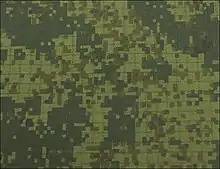 EMR camouflage pattern | |
| Type | Military camouflage pattern |
| Place of origin | Russia |
| Service history | |
| Used by | Armed Forces of Belarus Russian Armed Forces |
| Wars | War in Donbas Syrian civil war |
| Production history | |
| Designer | 15 Central Research Institute, Russian Ministry of Defence |
| Designed | 2008 |
| Produced | 2008 - present |
| Variants | Leto (summer), Sever (northern region), Zima (winter), Gorod (urban) |
History
This camouflage appeared in 2008 (accepted for supply a year later),[1] after a fundamental decision was made to change Flora. Initially, it was assumed that since "Flora" roughly corresponds to the American Woodland, which in the US Armed Forces was changed to digital camouflages, then the Russian Armed Forces should keep up with this process. The creation of the EMR was heavily influenced by the German Flektarn camouflage, the developers of which managed to "combine the incompatible": small spots that perform an imitation function are combined in this color scheme so that they form groups of large spots that perform a deforming function.
The developers of EMR followed the same path, taking into account the results of studies that showed the effectiveness of extremely small ("pixel") spots as constituent elements of the texture pattern.[2]
.jpg.webp)
EMR is a single camouflage pattern, developed at 15 Central Research Institute of the Ministry of Defence of the Russian Federation as a universal pattern, depending on the color, it can be adapted to a variety of terrain conditions, has good camouflage properties and is the main pattern of the Ratnik combat system.[3]
Currently, EMR is the main camouflage used by the Russian Armed Forces. The Armed Forces of Belarus uses it as their standard camouflage. However, it's believed that the Belarusian version of the EMR has a slightly different color scheme.[4]
Design
The name ЕМR (Edinaya Maskirovochnaya Rascvetka) stands for "Unified Camouflage Coloration" (in this sense the word "unified" refers to the fact that it is common to all the armed forces of Russia). However, it is known that the first manufacturer of products with this color gave it the name "ZDU" - "protection until it stops". In the West, this camouflage is known as the "RusPat" (Russian Pattern). The pattern is often referred to as Tsifra, Tetris, DigiFlora[5] or "digital flora."
Several variations of this pattern have been produced, the most common of which is the leto (summer) variant incorporating tiny pixels of black, reddish-brown and foliage green on a pale green background. Other versions include sever (northern regions), zima (winter), and gorod (urban). Full-scale adoption began in 2011.[6]
Users
 Belarus - Armed Forces of Belarus, with slightly different color scheme.[7]
 Russia - Russian Armed Forces[8]
Gallery
 Russian Army field uniform in current EMR camouflage pattern
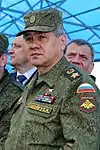 Russian Minister of Defence, General Sergey Shoigu in field uniform
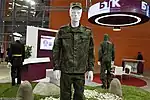 Display of the EMR combat uniform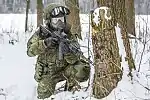
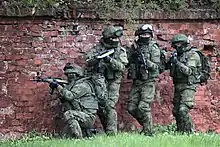 Russian Airborne Forces conducting land operations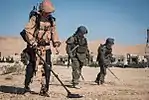
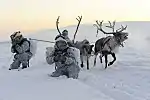 Another variation of the EMR pattern for use in snowy conditions of the Arctic, seen here with the 80th Independent Brigade
Reference
 |
Wikimedia Commons has media related to EMR camouflage. |
- "Виды камуфляжа - ОБЗОР | ГОРЯЧАЯ ТОЧКА". 27 April 2017.
- "Современные камуфляжи: разновидности и перспективы". forma-odezhda.ru. Retrieved 2021-03-15.
- "Набор трафаретов EMP (Digital Flora)". novokraska.ru. Retrieved 2021-03-15.
- "Современные камуфляжи: разновидности и перспективы". forma-odezhda.ru. Retrieved 2021-03-15.
- "Is the Army's Multicam Camouflage Good or a Just Trend?". 17 September 2019.
- "Russia - Camopedia". www.camopedia.org. Retrieved 2021-03-15.
- "Современные камуфляжи: разновидности и перспективы". forma-odezhda.ru. Retrieved 2021-03-15.
- "Сообщение Управления пресс-службы и информации Министерства обороны Российской Федерации : Министерство обороны Российской Федерации".
.jpg.webp)