EMU100 series
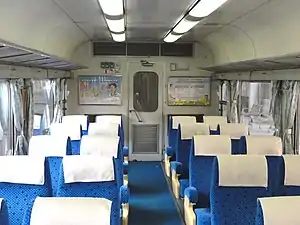
The Taiwan Railway EMU100 series was a set of rail cars fabricated by British Rail Engineering Limited and the General Electric Company in 1976 that has operated in Taiwan.[1] The alternating current electric multiple unit (EMU) fleet entered full squadron service in 1979, and was withdrawn from service in 2009. This class of railcars were the first to operate on the electric Tzu-Chiang Express. Due to the unit's British origin, rail buffs have variously nicknamed them "British Girl", "British Lady", or "British Grandma".[2]
| EMU100 series | |
|---|---|
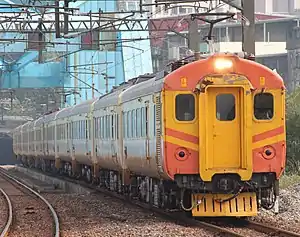 EMU100 Tzu-Chiang Express at Badu station | |
 | |
| In service | 1978–2009 |
| Manufacturer | British Rail Engineering Limited |
| Family name | British Rail Mark 2 |
| Constructed | 1977 |
| Number built | 13 sets |
| Formation | 5 cars per set |
| Capacity | 236 seats |
| Operator(s) | Taiwan Railways Administration |
| Specifications | |
| Car length | 20.09 m (65 ft 11 in) |
| Width | 2.802 m (9 ft 2+3⁄8 in) |
| Height | 3.8 m (12 ft 5+5⁄8 in) |
| Maximum speed | 120 km/h (75 mph) |
| Power output | 1,275 kW (1,710 hp) |
| Electric system(s) | 25 kV 60 Hz Overhead |
| Track gauge | 1,067 mm (3 ft 6 in) |
Background
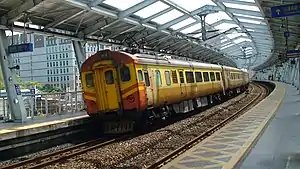
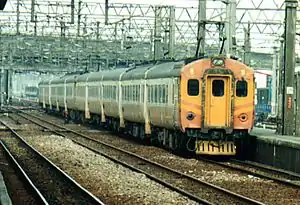
In the early 1970s, the West Coast Mainline Electrification Scheme was already planned. Taiwan Railways had ordered 13 five-car electric multiple unit sets from England's British Rail Engineering Limited (BREL) and General Electric Company. Identified as the Taiwan Railways EMU100 series, the set included driving power coach 50EP100, motor coach 55EM100, two trailers 40ET100, and driving trailer 40ED100. Based on the British Rail Mark 2 design, they were built at British Rail Engineering Limited's York Carriage Works in 1977/78.[3] Throughout 1978 the sets were delivered to Taiwan for testing and acceptance.[4][5][6]
Although full service was inaugurated on 15 August 1978, within a month the EMU100 units had been temporarily sidelined due to air conditioning trouble and various component issues. The 50-ton motor power coach (50EP100), which contained the 25 kV AC main transformer, was too heavy and caused bogie suspension stress issues, and was a safety concern when operating at high speeds. After four month of intensive troubleshooting involving TRA Mechanical section and the original equipment manufacturers, the vehicles were re-launched on 2 January 1979 in revenue passenger service. It was not until 1 July 1979, when the West Coast Mainline Electrification Project had reached substantial completion throughout its entire project length, that Tzu-Chiang was able to reach its full potential of operating at 120 km/h. Taking 4 hours and 10 minutes between Taipei and Kaohsiung, the EMU100 broke prior service speed records set by the White Steel Train DR2700 diesel multiple unit operating as the Kuang-Hwa Express, and became TRA's newest-generation premier express. [7][8][9]
After 30 years of service, the EMU100 series was withdrawn from regular commercial service in 2009. It has been used on special occasions since.[10]
References
- Huang, Powen (黃柏文). The Patriarchal EMU100 ("元老級的自強號"). In Train Collection. Retrieved from http://emu300ct.myweb.hinet.net/index/tramus/EMU100.htm on October 27, 2010.
- "流浪攝影記: 車種介紹-EMU100自強號" (in Chinese). Retrieved 2012-03-22.
- BREL boosts export sales with £8m share of emu order International Railway Journal January 1978 page 24
- Taiwan emu delivery by BRE begins The Railway Magazine issue 921 January 1978 page 41
- Trains for Taiwan Modern Railways issue 355 April 1978 pages 173-176
- Taiwan emu delivery concluded The Railway Magazine issue 931 November 1978 page 561
- 自強號 (in Chinese). 悠遊台灣鐵道. Retrieved 2012-03-22.
- "EMU100型自強號簡介" (in Chinese). Retrieved 2012-03-22.
- "新阿霖車站:電聯車EMU100型" (in Chinese). 1999-07-21. Retrieved 2012-03-22.
- Shan, Shelley (2011-03-07). "Around-the-nation train tour resumes in Hualien". Taipei Times. Retrieved 2013-11-17.
External links
 Media related to TRA EMU100 at Wikimedia Commons
| Diesel locomotives |
| ||||||
|---|---|---|---|---|---|---|---|
| Electric locomotives |
| ||||||
| Electric multiple units | |||||||
| Steam locomotives |
| ||||||
| Railcars |
| ||||||