Efforts to impeach Andrew Johnson
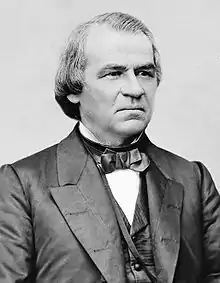
During his presidency, Andrew Johnson, the 17th president of the United States, saw multiple efforts to impeach him.
| ||
|---|---|---|
|
16th Vice President of the United States
17th President of the United States
Vice presidential and Presidential campaigns
Post-presidency
 |
||
.jpg.webp)

The Radical branch of the Republican Party was eager to impeach Johnson long before the moderates in the party were willing to. After a number of efforts to impeach Johnson failed, the House Committee on the Judiciary launched a formal impeachment inquiry in January of 1867, which lasted until November. This inquiry led the committee to vote in June against presenting articles of impeachment, and in November to recommend impeachment. The House then voted against impeachment on December 7, 1867.
After Johnson violated the Tenure of Office Act, which was passed over his veto, the United States House of Representatives voted to impeach him on February 24, 1868. He was acquitted in the subsequent impeachment trial.
Background
Andrew Johnson became president on April 15, 1865, ascending to the office following the assassination of his presidential predecessor Abraham Lincoln. While Lincoln had been a Republican, Johnson, his vice president, was a Democrat, the two of them having run on a unity ticket in the 1864 United States presidential election.
Even while he was vice-president, there was at least some serious consideration given to the prospect of using impeachment to remove Johnson from that office. After Johnson's drunken behavior at the second inauguration of Abraham Lincoln (where Johnson was first sworn-in as vice president), Senator Charles Sumner considered seeking to persuade members of House of the Representatives to pursue an impeachment, and went as far as researching precedent on federal impeachment.[1]
Early efforts to impeach
As early as 1866, some of the "Radical Republicans" entertained the thought of removing Johnson through impeachment.[2] However, the Republican party was divided on the prospect of impeachment, with moderates in the party, who held a plurality, widely opposing it at this point.[2] The radicals were more in favor of impeachment, as their plans for strong reform in reconstruction were greatly imperiled by Johnson.[2]
One of the first Radical Republicans to explore impeachment was House Territories Committee chairman James Mitchell Ashley. Ashley was convinced of a baseless conspiracy theory that faulted Johnson for involvement in conspiring in the assassination of Lincoln. Thus, Ashley had strong personal motivation for wanting to remove Johnson from office.[2] Ashley quietly began researching impeachment.[2]
House Military Affairs Committee chairman Robert C. Schenck began exploring the idea of impeaching Johnson after Johnson delivered demagogic attacks which questioned the legitimacy of the United States Congress. Schenk believed that Johnson's questioning of the legitimacy of Congress risked sparking another civil war.[2] Around this same time, in 1866, Benjamin Butler, a popular major general who was a candidate for the House at the time, regularly denounced Johnson in his stump speeches and called for his removal from office.[2] Johnson, during a late summer 1866 speaking tour dubbed the "Swing Around the Circle", remarked that some members of Congress would "clamor and talk about impeachment" because he chose to wield his veto power.[3]
Another Radical Republican congressman who pushing for impeachment was George S. Boutwell.[2][4] Boutwell announced at an October meeting in Boston that he would push in Congress for the opening of an impeachment inquiry.[4]
In November, the National Intelligencer alleged that the push to impeach Johnson originated from the tariff lobby. This claim was challenged by the Chicago Tribune, which wrote, "the movement to impeach Andrew Johnson comes from the people, and not from any lobby, or any set of politicians".[5]
By the end of November, congressman-elect Benjamin Butler was promoting the idea of impeaching Johnson on eight articles.[6] The articles he proposed charged Johnson with:
- "Degrading and debasing...the station and dignity of the office of Vice-President and that of vice president" by being publicly drunk at "official and public occasions"[6]
- "Officially and publicly making declarations and inflammatory harangues, indecent and unbecoming in derogation of his high office, dangerous to the permanency of our republican for of government, and in design to excite the ridicule, fear, hatred, and contempt of the people against the legislative and judicial departments therof"[6]
- "Wickedly, tyrannically, and unconstitutionally...usurping the lawful rights and powers of the Congress"[6]
- "Wickedly and corruptly using and abusing" the constitutional power of the President by making recess appointments with the "design to undermine, overthrow and evade the power" of the Congress to advice and consent on such appointments[6]
- "Improperly, wickedly, and corruptly abusing the constitutional power of pardons" with his pardons for ex-Confederates; "knowingly and wilfully violating the constitutionally enacted laws of the United States by appointing disloyal men to office and illegally and without right giving to them emoluments of such office from the Treasury, well knowing the appointees to be ineligible to office"[6]
- "Knowingly and willfully neglecting and refusing to carry out the constitutional laws of Congress" in the former Confederate states "in order to encourage men lately into rebellion and in arms against the United States to the oppression and injury of the loyal true citizens of such States"[6]
- "Unlawfully, corruptly, and wickedly confederating and conspiring with one John T. Monroe...and other evil disposed persons, traitors, and Rebels" in the New Orleans massacre of 1866.[6]
In December 1866, House Republicans met to plan for the end of the 39th United States Congress, which would expire in March 1867.[2] George S. Boutwell brought up the idea of impeachment during the caucus meeting, but moderates quickly killed discussion.[2] Later that month, James Mitchell Ashley attempted to open a house impeachment inquiry but this effort was voted down.[2] In an effort to block any further efforts to impeach Johnson, the moderate Republicans leading the party's caucus passed a rule for the Republican caucus which required that both a majority of House Republicans and a majority of the House Committee on the Judiciary would be required to approve any measure regarding impeachment in party caucus prior to it being considered in the House.[2][7]
Radical Republicans continued to seek Johnson's impeachment.[2] They disobeyed the rule put in place for the Republican caucus.[7] Radicals proposed a number of impeachment resolutions, which the moderate Republicans often stifled by referring to committees.[7] On January 7, 1867, Benjamin F. Loan and John R. Kelso introduced two separate impeachment resolutions against Johnson, but the House refused to hold debate or vote on either resolution.[2]
1867 impeachment inquiry
Also on January 7, 1867, ignoring the rule requiring approval of the Republican caucus, James Mitchell Ashley introduced his own impeachment-related resolution.[2] Unlike the other two bills, Ashley's bill offered a specific outline of how such an impeachment process would proceed. Rather than going to a direct vote on impeaching the president, his resolution would instruct the Judiciary Committee to "inquire into the official conduct of Andrew Johnson", investigating what it called Johnson's "corruptly used" powers, including his political appointments, pardons for ex-Confederates, and his legislative vetoes.[2][8] While giving the general charge of "high crimes and misdemeanors", the bill did not specify what the high crimes and misdemeanors Johnson had committed were.[9] The bill passed in the house 107–89.[2] It was seen as offering Republicans a chance to register their displeasure with Johnson, without actually formally impeaching him.[2]
Based upon Ashley's impeachment resolution, the Judiciary Committee began to gather evidence from witnesses in closed sessions.[2] While the committee did run out of time, with the 39th Congress expiring, they ruled that they had received “sufficient testimony” to continue their investigation in the new 40th Congress.[2] On March 7, 1867, the 40th Congress ordered the Judiciary Committee to continue its inquiry.[10]
In March, amid the inquiry, Radical Republicans, dissatisfied with the slow pace of the inquiry, attempted to bypass that process and secure Republican caucus approval for impeachment.[7] John A. Bingham and James F. Wilson (the chairman of the House Committee on the Judiciary) killed this effort by the Radical Republicans.[7]
President Johnson kept secret tabs on the House impeachment inquiry through the Pinkerton Detective Agency.[2]
In the 40th United States Congress, the House Committee on the Judiciary resumed the inquiry.[2] They held month of closed-door hearings.[2] On June 3, 1867, in a 5–4 vote, the committee voted against sending articles of impeachment to the full house, with three moderate Republican members joining two Democratic members of the committee in voting against doing so.[2][8]
During an 1867 summer meeting, held in response to provocative actions taken by Johnson, more conservative Democrats were able to kill an effort by Radical Republicans to call for an October session of congress dealing with impeachment.[7]
The House Committee on the Judiciary did not deliver its report to the full congress before the 1867 recess, meaning they had not yet formally closed their inquiry. By the time congress' recess ended in late November 1867, attitudes of Republicans had shifted more in favor of impeachment. John C. Churchill, a moderate Republican on the committee, had changed his mind in favor of impeachment. On November 25, 1867, the House Committee on the Judiciary voted in a 5–4 vote to recommend impeachment proceedings, and submitted its report to the House.[8][11] The committee, in actually, submitted three reports. Along with the majority report in favor of impeachment, two dissenting reports were submitted, one written by the two Democratic members and another written the two moderate Republicans that had voted against recommending impeachment. The majority report was written by Radical Republican member of the committee Thomas Williams, and listed seventeen instances in which it argued Johnson had reached the threshold of impeachment.[11]
The inquiry had lasted eleven months, seen 89 witnesses interviewed, and seen 1,200 pages of testimony published.[12] Among those that appeared before the committee were John Covode (who urged impeachment)[13] and Joseph Scott Fullerton.[14]
House rejection of impeachment recommendation
On December 5, 1867, the House brought the Committee on the Judiciary's impeachment recommendation to the floor for consideration. The committee's Radical Republicans selected, from their ranks, to have George Boutwell argue the case for impeachment to the house. He made a four hour presentation, stretched over two legislative days, which historian Michael Les Benedict later described as, "the clearest, most eloquent, and most convincing argument for the liberal view of the impeachment power".[15] After his presentation, James F. Wilson, chairman of the House Committee on the Judiciary took to the floor to argue against impeachment.[15]
On December 7, House voted against impeachment by a margin of 108–57, with 66 Republicans and 42 Democrats voting against impeachment.[15]
One motivating factor for Republicans' decision to vote against impeachment may have been the successes Democrats had in the 1867 elections, including winning control of the Ohio General Assembly, as well as other 1867 election outcomes, such as voters in Ohio, Connecticut, and Minnesota turning down propositions to grant African Americans suffrage.[16][17]
Impeachment
.jpg.webp)
On January 22, 1868, the House approved by a vote of 103–37 a resolution launching an inquiry run by Committee on Reconstruction. On February 21, 1868, Johnson, in violation of the Tenure of Office Act that had been passed by Congress in March 1867 over Johnson's veto, attempted to remove Edwin Stanton, the secretary of war who the act was largely designed to protect, from office.[18] On February 22, the committee released a report which recommended Johnson be impeached for high crimes and misdemeanors.[19]
Also on January 22, 1868, a one sentence resolution to impeach Johnson, written by John Covode, was also referred to the Committee on Reconstruction. The resolution read, "Resolved, that Andrew Johnson, President of the United States, be impeached of high crimes and misdemeanors."[20][21][22] On February 24, the United States House of Representatives voted 126–47 to impeach Johnson for "high crimes and misdemeanors", which were detailed in 11 articles of impeachment (the 11 articles were collectively approved in a separate vote a week after impeachment was approved).[23][24][25] The primary charge against Johnson was that he had violated the Tenure of Office Act by removing Stanton from office.[23]
Johnson was narrowly acquitted in his Senate trial, with 35 to 19 votes in favor of conviction, one vote short of the necessary two-thirds majority.[26]
References
- Poore, Ben Perley (5 March 1887). "REMINISCENCES OF PUBLIC MEN". Newspapers.com. Grand Island Herald. Retrieved 1 June 2021.
- "Building the Case for Impeachment, December 1866 to June 1867 | US House of Representatives: History, Art & Archives". history.house.gov. United States House of Representatives. Retrieved 2 March 2021.
- Shafer, Ronald G. (11 January 2020). "'A national disgrace': As impeachment hung over a president's head, he went on a wild rally tour". Washington Post. Retrieved 2 March 2021.
- "What Next?". Newspapers.com. Vernon County Censor. 31 October 1866. Retrieved 5 March 2021.
- "Chicago Tribune". Newspapers.com. Chicago Tribune. 8 Nov 1866. Retrieved 24 June 2021.
- "The Proposed Impeachment". Newspapers.com. The Evening Telegraph (Philadelphia). 1 Dec 1866. Retrieved 5 March 2021.
- Benedict, Michael Les (1998). "From Our Archives: A New Look at the Impeachment of Andrew Johnson" (PDF). Political Science Quarterly. 113 (3): 493–511. doi:10.2307/2658078. ISSN 0032-3195. JSTOR 2658078. Retrieved 2 March 2021.
- "Impeachment Efforts Against President Andrew Johnson | US House of Representatives: History, Art & Archives". history.house.gov. United States House of Representatives. Retrieved 2 March 2021.
- Ross, Edmond G. (1868). "History of the Impeachment Of Andrew Johnson President Of The United States". www.gutenberg.org. Retrieved 2 March 2021.
- "Johnson's Impeachment | House Divided". hd.housedivided.dickinson.edu. House Divided: The Civil War Research Engine at Dickinson College. Retrieved 13 March 2021.
- "Impeachment Rejected, November to December 1867 | US House of Representatives: History, Art & Archives". history.house.gov. United States House of Representatives. Retrieved 2 March 2021.
- Osborne, John. "The Fortieth Congress strongly rejects its Judiciary Committee's recommendation to President Johnson. | House Divided". hd.housedivided.dickinson.edu. House Divided: The Civil War Research Engine at Dickinson College. Retrieved 13 March 2021.
- Dodds, A. John. "HONEST JOHN COVODE". Retrieved 12 March 2021.
- "IMPEACHMENT INVESTIGRATION". Newspapers.com. Chicago Tribune. 30 Mar 1867. Retrieved 2 June 2021.
- "The Case for Impeachment, December 1867 | US House of Representatives: History, Art & Archives". history.house.gov. United States House of Representatives. Retrieved 2 March 2021.
- Stewart, David O. (2009). Impeached: the Trial of President Andrew Johnson and the Fight for Lincoln's Legacy. New York: Simon and Schuster. pp. 95–97. ISBN 978-1-4165-4749-5.
- Castel, Albert E. (1979). The Presidency of Andrew Johnson. American Presidency. Lawrence, Kan.: The Regents Press of Kansas. p. 146. ISBN 978-0-7006-0190-5.
- Trefousse, Hans L. (1989). Andrew Johnson: A Biography. New York City: W. W. Norton & Company. p. 306. ISBN 978-0-393-31742-8.
- Hinds, Asher C. (4 March 1907). "HINDS' PRECEDENTS OF THE HOUSE OF REPRESENTATIVES OF THE UNITED STATES INCLUDING REFERENCES TO PROVISIONS OF THE CONSTITUTION, THE LAWS, AND DECISIONS OF THE UNITED STATES SENATE" (PDF). United States Congress. pp. 845–846. Retrieved 2 March 2021.
- "Avalon Project : History of the Impeachment of Andrew Johnson - Chapter VI. Impeachment Agreed To By The House". avalon.law.yale.edu. The Avalon Project (Yale Law School Lilian Goldman Law Library). Retrieved 13 March 2021.
- "The House Impeaches Andrew Johnson | US House of Representatives: History, Art & Archives". history.house.gov. United States House of Representatives. Retrieved 13 March 2021.
- "Impeachment of Andrew Johnson | US House of Representatives: History, Art & Archives". history.house.gov. United States House of Representatives. Retrieved 13 March 2021.
- "Johnson Impeached, February to March 1868 | US House of Representatives: History, Art & Archives". history.house.gov. United States House of Representatives. Retrieved 2 March 2021.
-
 This article incorporates public domain material from the Congressional Research Service document: Stephen W. Stathis and David C. Huckabee. "Congressional Resolutions on Presidential Impeachment: A Historical Overview" (PDF). Retrieved December 31, 2019.
 - This article incorporates public domain material from the Congressional Research Service document: Stephen W. Stathis and David C. Huckabee. "Congressional Resolutions on Presidential Impeachment: A Historical Overview" (PDF). Retrieved December 31, 2019.
- "Impeached but Not Removed, March to May 1868 | US House of Representatives: History, Art & Archives". history.house.gov. United States House of Representatives. Retrieved 2 March 2021.