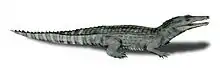
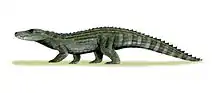
Eothoracosaurus
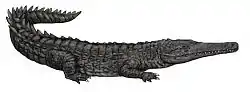
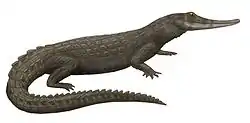
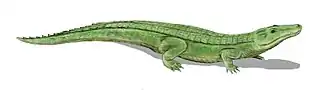
Eothoracosaurus is an extinct genus of eusuchian crocodylomorphs which existed during the Late Cretaceous period. Thoracosaurs in general were traditionally thought to be related to the modern false gharial, largely because the nasal bones contact the premaxillae, but phylogenetic work starting in the 1990s instead supported affinities within gavialoid exclusive of such forms. One recent phylogenetic study published by Lee & Yates (2018) suggests that thoracosaurs might instead be non-crocodilian eusuchian.[2] If the animal was a gavialoid, it was one of the earliest and most basal gavialoids known.
| Eothoracosaurus Temporal range: Late Cretaceous, | |
|---|---|
 | |
Scientific classification  | |
| Kingdom: | Animalia |
| Phylum: | Chordata |
| Class: | Reptilia |
| Superorder: | Crocodylomorpha |
| Clade: | Neosuchia |
| Clade: | Eusuchia |
| Genus: | †Eothoracosaurus Brochu 2004 |
| Type species | |
| Eothoracosuchus mississippiensis | |
Fossils are present from the Ripley Formation in Mississippi and date back to the early Maastrichtian stage of the Late Cretaceous. Some fragmentary material from the Coon Creek Formation of western Tennessee dating back to the late Campanian (slightly older than the specimens from Mississippi) has been referred to Eothoracosaurus as well. The Coon Creek Formation seems to have been deposited in a marine setting, with oceanic fauna such as the sharks Otodus and Squalicorax, the sea turtle Toxochelys, and mosasaurs including Plioplatecarpus and Globidens present from these strata.[3] This suggests that Eothoracosaurus may also have led a marine lifestyle. Certain aspects of the cranial morphology of known specimens, such as a long anterior frontal process and widely spaced supratemporal fenestrae, distinguish it from the closely related Thoracosaurus neocesariensis from the late Maastrichtian and early Paleocene of New Jersey.[4]
References
- Rio, Jonathan P.; Mannion, Philip D. (6 September 2021). "Phylogenetic analysis of a new morphological dataset elucidates the evolutionary history of Crocodylia and resolves the long-standing gharial problem". PeerJ. 9: e12094. doi:10.7717/peerj.12094. PMC 8428266. PMID 34567843.
- Michael S. Y. Lee; Adam M. Yates (2018). "Tip-dating and homoplasy: reconciling the shallow molecular divergences of modern gharials with their long fossil record". Proceedings of the Royal Society B: Biological Sciences. 285 (1881): 20181071. doi:10.1098/rspb.2018.1071. PMC 6030529. PMID 30051855.
- Gibson, M. A (2008). "Review of vertebrate diversity in the Coon Creek Formation lagerstätte (Late Cretaceous) of western Tennessee". Geological Society of America Abstracts with Programs. 40 (3): 8.
- Brochu, C. A. (2004). "A new Late Cretaceous gavialoid crocodylian from eastern North America and the phylogenetic relationships of thoracosaurs". Journal of Vertebrate Paleontology. 24 (3): 610–633. doi:10.1671/0272-4634(2004)024[0610:ANLCGC]2.0.CO;2.
 Paleontology portal
| |||||||||||||||||||||||||||||||||||||||||||||||
| |||||||||||||||||||||||||||||||||||||||||||||||
| |||||||||||||||||||||||||||||||||||||||||||||||
| |||||||||||||||||||||||||||||||||||||||||||||||