Eternal return
Eternal return (German: Ewige Wiederkunft; also known as eternal recurrence) is a concept that the universe and all existence and energy has been recurring, and will continue to recur, in a self-similar form an infinite number of times across infinite time or space.
Premise
The basic premise proceeds from the assumption that the probability of a world coming into existence exactly like our own is nonzero. Then, if time is infinite, our existence must recur an infinite number of times. This is similar, but not identical, to the claim of Tegmark[1] that
A person living on a planet called Earth, with misty mountains, fertile fields and sprawling cities, in a solar system with eight other planets. The life of this person has been identical to yours in every respect – until now... it looks like we will just have to live with it, since the simplest and most popular cosmological model today predicts that this person actually exists in a Galaxy about 10^10^29 meters away
In 1871, Louis Auguste Blanqui, assuming a Newtonian cosmology where time and space are infinite, claimed to have demonstrated eternal recurrence as a mathematical certainty.[2]
Classical antiquity
In ancient Greece, the concept of eternal return was most prominently associated with Stoicism, the school of philosophy founded by Zeno of Citium.
However, there are hints that the theory may not have originated with the Stoics. According to Porphyry, it was one of the teachings of Pythagoras that "after certain specified periods, the same events occur again" and that "nothing was entirely new".[3] Eudemus of Rhodes also references this Pythagorean doctrine in his commentary on Aristotle's Physics. In a fragment preserved by Simplicius, Eudemus writes:[4]
One might raise the problem whether the same time recurs, as some say, or not. "The same" has many senses: the same in form seems to occur as do spring and winter and the other seasons and periods; similarly the same changes occur in form, for the sun performs its solstices and equinoxes and its other journeys. But if someone were to believe the Pythagoreans that numerically the same things recur, then I also will romance, holding my staff, while you sit there, and everything else will be the same, and it is plausible to say that the time will be the same.
The Stoics, possibly inspired by the Pythagoreans,[5] incorporated the theory of eternal recurrence into their natural philosophy. According to Stoic physics, the universe is periodically destroyed in an immense conflagration (ekpyrosis), and then experiences a rebirth (palingenesis). These cycles continue for eternity, and the same events are exactly repeated in every cycle.[6] The Stoics may have found support for this doctrine in the concept of the Great Year,[7] the oldest known expression of which is found in Plato's Timaeus. Plato hypothesised that one complete cycle of time would be fulfilled when the sun, moon and planets all completed their various circuits and returned to their original positions.[8]
Sources differ as to whether the Stoics believed that the contents of each new universe would be one and the same with those of the previous universe, or only so similar as to be indistinguishable.[9] The former point of view was attributed to the Stoic Chrysippus by Alexander of Aphrodisias, who wrote:[10]
They hold that after the conflagration all the same things come to be again in the world numerically, so that even the same peculiarly qualified individual as before exists and comes to be again in that world, as Chrysippus says in his books On the World.
On the other hand, Origen characterises the Stoics as claiming that the contents of each cycle will not be identical, but only indistinguishable:[11]
To avoid supposing that Socrates will live again, they say that it will be some one indistinguishable from Socrates, who will marry some one indistinguishable from Xanthippe, and will be accused by men indistinguishable from Anytus and Meletus.
Origen also records a heterodox version of the doctrine, noting that some Stoics suggest that "there is a slight and very minute difference between one period and the events in the period before it".[12] This was probably not a widely-held belief, as it represents a denial of the deterministic viewpoint which stands at the heart of Stoic philosophy.[13]
Christian authors attacked the doctrine of eternal recurrence on various grounds. Origen argued that the theory was incompatible with free will (although he did allow the possibility of diverse and non-identical cycles).[14] Augustine of Hippo objected to the fact that salvation was not possible in the Stoic scheme, arguing that even if a temporary happiness was attained, a soul could not be truly blessed if it was doomed to return again to misery.[15]
Augustine also mentions "certain philosophers" who cite Ecclesiastes 1:9–10 as evidence of eternal return: "What is that which hath been? It is that which shall be. And what is that which is done? It is that which shall be done: and there is no new thing under the sun. Who can speak and say, See, this is new? It hath been already of old time, which was before us." Augustine denies that this has reference to the recurrence of specific people, objects, and events, instead interpreting the passage in a more general sense. In support of his argument, he appeals to scriptural passages such as Romans 6:9, which affirms that Christ "being raised from the dead dieth no more".[15]
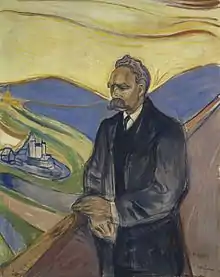
Friedrich Nietzsche
The concept of eternal recurrence is central to some important writings of Friedrich Nietzsche.[16] It appears in a few of his works, in particular §285 and §341 of The Gay Science and in Thus Spoke Zarathustra. In Ecce Homo (1888), he wrote that the thought of the eternal return was the "fundamental conception" of Thus Spoke Zarathustra.[17] The origin of the idea is dated by Nietzsche himself to August 1881, while he was walking in Sils-Maria.

Interpretations of the eternal recurrence as it appears in Nietzsche's works have mostly revolved around cosmological and attitudinal and normative principles.[18]
As a cosmological principle, it has been supposed to mean that time is circular, that all things recur eternally.[18] A weak attempt at proof has been noted in Nietzsche's notebooks, and it is not clear to what extent, if at all, Nietzsche believed in the truth of it.[18] Critics have mostly dealt with the cosmological principle as a puzzle of why Nietzsche might have touted the idea.
As an attitudinal principle it has often been dealt with as a thought experiment, to see how one would react, or as a sort of ultimate expression of life-affirmation, as if one should desire eternal recurrence.[18]
As a normative principle, it has been thought of as a measure or standard, akin to a "moral rule".[18]
One of the most discussed appearances of eternal recurrence in Nietzsche's work is section 341 in The Gay Science, "The Greatest Weight":
What if some day or night a demon were to steal after you into your loneliest loneliness, and say to you, "This life as you now live it and have lived it, you will have to live once more and innumerable times more; and there will be nothing new in it, but every pain and every joy and every thought and sigh and everything unutterably small or great in your life will have to return to you, all in the same succession and sequence [...]
Would you not throw yourself down and gnash your teeth and curse the demon who spoke thus? Or have you once experienced a tremendous moment when you would have answered him: "You are a god and never have I heard anything more divine" [...][19]
As Heidegger points out in his lectures on Nietzsche, Nietzsche's first mention of eternal recurrence, in aphorism 341 ("The Greatest Weight") of The Gay Science, presents this concept as a hypothetical question rather than postulating it as a fact. According to Heidegger, it is the burden imposed by the question of eternal recurrence—whether or not such a thing could possibly be true—that is so significant in modern thought: "The way Nietzsche here patterns the first communication of the thought of the 'greatest burden' [of eternal recurrence] makes it clear that this 'thought of thoughts' is at the same time 'the most burdensome thought.' "[20] Robert Wicks suggests that the concept of eternal recurrence, as portrayed in "The Greatest Weight," "serves to draw attention away from all worlds other than the one in which we presently live, since eternal recurrence precludes the possibility of any final escape from the present world.[21] Wick's analysis implies that eternal recurrence does not refer to the endless repetition of specific events, but rather the inescapable general circumstances that constitute existence in the physical world.
Several authors have pointed out other occurrences of this hypothesis in contemporary thought. Rudolf Steiner, who revised the first catalogue of Nietzsche's personal library in January 1896, pointed out that Nietzsche would have read something similar in Eugen Dühring's Courses on philosophy (1875), which Nietzsche readily criticized. Lou Andreas-Salomé pointed out that Nietzsche referred to ancient cyclical conceptions of time, in particular by the Pythagoreans, in the Untimely Meditations. Henri Lichtenberger and Charles Andler have pinpointed three works contemporary to Nietzsche which carried on the same hypothesis: J.G. Vogt, Die Kraft. Eine real-monistische Weltanschauung (1878), Auguste Blanqui, L'éternité par les astres[22] (1872) and Gustave Le Bon, L'homme et les sociétés (1881). Walter Benjamin juxtaposes Blanqui and Nietzsche's discussion of eternal recurrence in his unfinished, monumental work The Arcades Project.[23] However, Gustave Le Bon is not quoted anywhere in Nietzsche's manuscripts; and Auguste Blanqui was named only in 1883. On the other hand, Nietzsche read Vogt's work during the summer of 1881 in Sils-Maria.[24] Albert Lange mentions Blanqui in his Geschichte des Materialismus (History of Materialism), a book Nietzsche read closely.[25]
Walter Kaufmann suggests that Nietzsche may have encountered this idea in the works of Heinrich Heine, who once wrote:
[T]ime is infinite, but the things in time, the concrete bodies, are finite. They may indeed disperse into the smallest particles; but these particles, the atoms, have their determinate numbers, and the numbers of the configurations which, all of themselves, are formed out of them is also determinate. Now, however long a time may pass, according to the eternal laws governing the combinations of this eternal play of repetition, all configurations which have previously existed on this earth must yet meet, attract, repulse, kiss, and corrupt each other again...[26]
To comprehend eternal recurrence in his thought, and to not merely come to peace with it but to embrace it, requires what he calls amor fati, "love of fate".[27] In Ecce Homo—"Why I Am So Clever", section 10, he confesses:[28]
"My formula for greatness in a human being is amor fati: that one wants nothing to be different, not forward, not backward, not in all eternity. Not merely bear what is necessary, still less conceal it—all idealism is mendacity in the face of what is necessary—but love it."
In Carl Jung's seminar on Thus Spoke Zarathustra, Jung claims that the dwarf states the idea of the eternal return before Zarathustra finishes his argument of the eternal return. "'Everything straight lies,' murmured the dwarf disdainfully. 'All truth is crooked, time itself is a circle.'" However, Zarathustra rebuffs the dwarf in the following paragraph, warning him against the spirit of gravity.
Gilles Deleuze suggested that Nietzsche's eternal return was not only a directive for ethical behavior, but also a radical understanding of the nature of time. As he put it, "The present must coexist with itself as past and yet to come. The synthetic relation of the moment to itself as present, past, and future grounds its relation to other moments. The eternal return is thus an answer to the problem of passage [between past and present, or present and future]."[29] Deleuze contrasted this understanding to an understanding that Nietzsche was referring to a literal, mechanistic return of the same moment. Deleuze rather claimed that Nietzsche was attempting to synthesize being and becoming: "It is not being that returns but rather returning itself that it constitutes being insofar as it is affirmed of becoming."[29] Deleuze's own articulation of this conception was further expanded in Difference and Repetition (1968).
Albert Camus
The philosopher and writer Albert Camus explores the notion of "eternal return" in his essay on "The Myth of Sisyphus", in which the repetitive nature of existence comes to represent life's absurdity, something the hero seeks to withstand through manifesting what Paul Tillich called "The Courage to Be". Though the task of rolling the stone repeatedly up the hill without end is inherently meaningless, the challenge faced by Sisyphus is to refrain from despair. Camus concludes, "one must imagine Sisyphus happy."[30]
Opposing arguments and criticism
Nietzsche scholar Walter Kaufmann has described an argument originally put forward by Georg Simmel, which rebuts the claim that a finite number of states must repeat within an infinite amount of time:
Even if there were exceedingly few things in a finite space in an infinite time, they would not have to repeat in the same configurations. Suppose there were three wheels of equal size, rotating on the same axis, one point marked on the circumference of each wheel, and these three points lined up in one straight line. If the second wheel rotated twice as fast as the first, and if the speed of the third wheel was 1/π of the speed of the first, the initial line-up would never recur.[31]
See also
- Big Bounce – Hypothetical cosmological model for the origin of the known universe
- Cyclic model
- Fractals
- Endless knot
- Ergodic theory
- Eternal return (Eliade)
- Eternalism (philosophy of time)
- Eureka: A Prose Poem – Lengthy non-fiction work by American author Edgar Allan Poe
- Hauntology
- Historic recurrence – Repetition of similar events in history
- Infinite loop – Programming idiom
- Mandala – Spiritual and ritual symbol in Hinduism, Jainism and Buddhism
- Möbius strip – Two-dimensional surface with only one side and one edge
- Nietzsche and Asian Thought
- Ouroboros – Symbolic serpent with its tail in its mouth
- Poincaré recurrence theorem – Theorem
- Present
- Slaughterhouse-Five – 1969 novel by Kurt Vonnegut
- Social cycle theory – Type of social theories
- UTM theorem – Affirms the existence of a computable universal function
- Wheel of time – Religious and philosophical concept of cyclical, repeating epochs or ages
References
- Tegmark M., "Parallel universes". Sci. Am. 2003 May; 288(5):40–51.
- Jean-Pierre Luminet (2008-03-28). The Wraparound Universe. AK Peters, Ltd. ISBN 978-1-56881-309-7.
- "Porphyry, Life of Pythagoras (§19)". Translated by Kenneth Sylvan Guthrie. 1920. Hosted at the Tertullian Project.
- Simplicius: On Aristotle's Physics 4.1-5, 10-14. Translated by J. O. Urmson. Cornell University Press. 1992. p. 142. ISBN 0-8014-2817-3.
- Zeller, Eduard (1880). The Stoics, Epicureans and Sceptics. Translated by Oswald J. Reichel. London: Longmans, Green and Co. pp. 166–7.
- Sellers, John (2006). Stoicism. Acumen. p. 99. ISBN 978-1-84465-053-8.
- White, Michael J. (2003). "Stoic Natural Philosophy (Physics and Cosmology)". In Inwood, Brad (ed.). The Cambridge Companion to the Stoics. Cambridge University Press. pp. 141–2. ISBN 0-521-77985-5.
- Plato, Timaeus 39d.
- "Stoicism: Physical Theory". Stanford Encyclopedia of Philosophy. Retrieved 11 December 2021.
- Salles, Ricardo (2005). "On the Individuation of Times and Events in Orthodox Stoicism". In Salles, Ricardo (ed.). Metaphysics, Soul, and Ethics in Ancient Thought. Clarendon Press. p. 107. ISBN 0-19-926130-X.
- Origen: Contra Celsum. Translated by Henry Chadwick. Cambridge University Press. 1965. p. 238 (book IV, section 68).
- Chadwick 1965, pp. 279–80 (book V, section 20).
- White 2003, p. 143
- Origen: On First Principles. Translated by G. W. Butterworth. Harper & Row. 1966. pp. 87–8 (book II, chapter 3, section 4).
- Augustine: The City of God Against the Pagans. Translated by R. W. Dyson. Cambridge University Press. 1998. pp. 516–7 (book XII, chapter 14).
- Anderson, R. Lanier (2017), "Friedrich Nietzsche", in Zalta, Edward N. (ed.), The Stanford Encyclopedia of Philosophy (Summer 2017 ed.), Metaphysics Research Lab, Stanford University, retrieved 2020-07-23
- Nietzsche, Ecce Homo, "Why I Write Such Good Books", "Thus Spoke Zarathustra", §1
- Sinhababu, N., & Teng, K.U. (2019). Loving the Eternal Recurrence. The Journal of Nietzsche Studies 50(1), 106-124. https://www.muse.jhu.edu/article/721006.
- Schacht, Richard (2001). Nietzsche's Postmoralism: Essays on Nietzsche's Prelude to Philosophy's Future. Cambridge University Press. p. 237. ISBN 978-0-521-64085-5.
- See Heidegger Nietzsche. Volume II: The Eternal Recurrence of the Same trans. David Farrell Krell. New York: Harper and Row, 1984. 25.
- Wicks, Robert (2018), "Nietzsche's Life and Works", in Zalta, Edward N. (ed.), The Stanford Encyclopedia of Philosophy (Fall 2018 ed.), Metaphysics Research Lab, Stanford University, retrieved 2020-07-23
- Tremblay, Jean-Marie (2 February 2005). "Louis-Auguste Blanqui, (1805-1881), L'éternité par les astres. (1872)". texte.
- Walter Benjamin. The Arcades Project. Trans. Howard Eiland and Kevin McLaughlin. Cambridge: Belknap-Harvard, 2002. See chapter D, "Boredom Eternal Return," pp. 101-119.
- "La bibliothèque de Nietzsche". Archived from the original on November 16, 2006. and "revision of previous catalogues". Archived from the original on 2006-11-16. Retrieved 2007-01-05. on the École Normale Supérieure's website
- Alfred Fouillée, "Note sur Nietzsche et Lange: le "retour éternel", in Revue philosophique de la France et de l'étranger. An. 34. Paris 1909. T. 67, S. 519-525 (in French)
- Kaufmann, Walter. Nietzsche; Philosopher, Psychologist, Antichrist. 1959, page 376.
- Dudley, Will. Hegel, Nietzsche, and Philosophy: Thinking Freedom. Cambridge University Press, Cambridge 2002, page 201.
- Basic Writings of Nietzsche. trans. and ed. by Walter Kaufmann (1967), p. 714.
- Deleuze, Gilles, 1925-1995. (1983). Nietzsche and philosophy. New York: Columbia University Press. p. 48. ISBN 0-231-05668-0. OCLC 8763853.CS1 maint: multiple names: authors list (link)
- Camus, Albert (1991). The Myth of Sisyphus: And Other Essays. New York: The Myth of Sisyphus: And Other Essays. ISBN 978-0679733737.
- Kaufmann, Walter. Nietzsche: Philosopher, Psychologist, Antichrist. (Fourth Edition) Princeton University Press, 1974. p327
Citations
- Louis-Auguste Blanqui, Eternity by the Stars, tr. with an intro by Frank Chouraqui (New York: Contra Mundum Press, 2013).
- Paolo D'Iorio, "The Eternal Return: Genesis and Interpretation", in The Agonist, vol. III, issue I, spring 2011.
- Hatab, Lawrence J. (2005). Nietzsche's Life Sentence: Coming to Terms with Eternal Recurrence. New York: Routledge. ISBN 0-415-96758-9.
- Lorenzen, Michael (2006). "The Ideal Academic Library as Envisioned through Nietzsche's Vision of the Eternal Return". MLA Forum 5, no. 1. Archived from the original on 2006-11-14. Retrieved 2006-11-21.
- Lukacher, Ned (1998). Time-Fetishes: The Secret History of Eternal Recurrence. Durham, N.C.: Duke University Press. ISBN 0-8223-2253-6.
- Magnus, Bernd (1978). Nietzsche's Existential Imperative. Bloomington: Indiana University Press. ISBN 0-253-34062-4.
- Jung, Carl (1988). Nietzsche's Zarathustra: Notes of the Seminar Given in 1934 - 1939 (2 Volume Set). Princeton University Press. ISBN 978-0-691-09953-8.
- Mircea Eliade (1954). Myth of the Eternal Return. Bollingen Foundation Princeton University Press. ISBN 978-0691-01777-8.
External links
- Nietzsche’s notebook of 1881: The Eternal Return of the Same. July 2021. Translation by Daniel Fidel Ferrer. Free online.
 Quotations related to Eternal return at Wikiquote
| Key concepts |  | ||||||||
|---|---|---|---|---|---|---|---|---|---|
| Measurement and standards |
| ||||||||
| Philosophy of time | |||||||||
| |||||||||
| Human experience and use of time | |||||||||
| Time in science |
| ||||||||
| Related topics | |||||||||
| |||||||||

