Fader Bergström
Fader Bergström, stäm up och klinga (Father Bergström, start playing and sounding) is one of the Swedish poet and performer Carl Michael Bellman's best-known and best-loved songs, from his 1790 collection, Fredman's Epistles, where it is No. 63. The melody is based on a minuet by Carl Envallsson. Bergström was a musician, and the song celebrates dancing and drinking late into the evening.
| "Fader Bergström" | |
|---|---|
| Art song | |
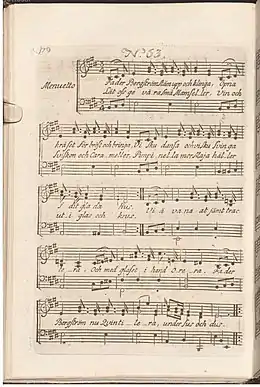 First page of sheet music for the 1810 edition | |
| English | Fader Bergström |
| Written | 1773 |
| Text | poem by Carl Michael Bellman |
| Language | Swedish |
| Melody | Carl Envallsson's Bobis bröllop |
| Composed | 1788 |
| Published | 1790 in Fredman's Epistles |
| Scoring | voice and cittern |
Context
Carl Michael Bellman is a central figure in the Swedish song tradition and a powerful influence in Swedish music, known for his 1790 Fredman's Epistles[1] and his 1791 Fredman's Songs. A solo entertainer, he played the cittern, accompanying himself as he performed his songs at the royal court.[2]
Jean Fredman (1712 or 1713 – 1767) was a real watchmaker of Bellman's Stockholm. The fictional Fredman, alive after 1767, but without employment, is the supposed narrator in Bellman's epistles and songs.[3] The epistles, written and performed in different styles, paint a complex picture of the life of the city during the eighteenth century. A frequent theme is the demimonde, with Fredman's cheerfully drunk Order of Bacchus,[4] a loose company of ragged men who favour strong drink and prostitutes. At the same time as depicting this reality, Bellman creates a rococo picture of life, full of classical allusion, following the French post-baroque poets; the women, including the beautiful Ulla Winblad, are "nymphs", and Neptune's festive troop of followers and sea-creatures sport in Stockholm's waters.[5] The juxtaposition of elegant and low life is humorous, sometimes burlesque, but always graceful and sympathetic.[2] The songs are "most ingeniously" set to their music, which is nearly always borrowed and skilfully adapted.[6]
Song
Music and verse form
The song is marked "Diktad midt i veckan" (Dictated midweek); it was written in September 1773.[7] The melody is in the key of D major, marked Menuetto (a dance), and in 3
4 time. The rhyming pattern is the shifting ABBBC-DDDC-EEEC-ABAB-CDCD-EEED.[8] The melody was derived from a minuet with the "timbre" label "Minuet af herr Böritz d. ä." in Carl Envallsson's 1788 Bobis bröllop.[7][9][10]
Lyrics
The lyrics have been translated into English by Eva Toller. Bergström was a musician, playing a wind instrument for people's name days in the Katarina Church area of Stockholm,[11] and the song celebrates dancing and drinking late into the evening. The last few lines of Toller's version run:[12]
| Carl Michael Bellman, 1790[1][13] | Prose translation |
|---|---|
| Väljom nattens sköte under aftonstjärnans klara brand till vårt glada möte, med pokaln i hand; och i mörkrets dvala res Cupidos altar, där du spör, Bacchi källarsvala druvans ångor strör. Lät den dumma i oket tråka och den sluga sin hjärna bråka! Vin och flickor och Fredmans stråka natten ljuvlig gör. | Choose the bosom of the night, below the bright flame of the evening star for our happy gathering, with the goblet in our hands; and in the drowsy darkness, erect the altar of Cupid, where you see (that) the cellar-cool vapours of Bacchus's grapes are spread. Let the dull one be bored in the yoke, and the cunning one exercise his brain! Wine and girls and Fredman's violin-bow make the night delightful. |
Reception
Students of Swedish literature are expected to study Fredman's Songs and Epistles.[14]
Epistle 63 has been recorded by Fred Åkerström on his album Glimmande nymf,[15][16] by Fredrik Berg on his 2014 album Angående Fredrik Bergs tolkning av C M Bellman, where it is the first track,[17] and by Rolf Leanderson on his 2012 album Carl Michael Bellman: Songs & Epistles in Swedish.[18]
References
- Bellman 1790.
- "Carl Michael Bellmans liv och verk. En minibiografi (The Life and Works of Carl Michael Bellman. A Short Biography)" (in Swedish). The Bellman Society. Retrieved 25 April 2015.
- Britten Austin 1967, pp. 60–61.
- Britten Austin 1967, p. 39.
- Britten Austin 1967, pp. 81–83, 108.
- Britten Austin 1967, p. 63.
- Massengale 1979, pp. 196–198
- Hassler & Dahl 1989, p. 149.
- "N:o 63". Bellman.net. Retrieved 3 June 2019.
- Envallson, Carl (1788). Bobis bröllop, lyrisk comedie uti tre acter [Bobi's Wedding, a lyric comedy in three acts] (in Swedish). Stockholm.
- Hassler & Dahl 1989, p. 15.
- Toller, Eva (2009). "FADER BERGSTRÖM, STÄM UPP OCH KLINGA – EPISTEL NR 63 FATHER BERGSTRÖM, START PLAYING – EPISTLE NB 63" (PDF). Eva Toller. Retrieved 3 June 2019.
- Hassler & Dahl 1989, pp. 147–150.
- "LITTERATURLISTA V15 LV1150 Moment 2: Klassiker ur Sveriges litteratur". Gothenburg University. Archived from the original on 7 March 2016. Retrieved 5 March 2016.
- Hassler, paged 281–282.
- "Fred Åkerström - Fader Bergström (Fredmans epistel nr:63)". YouTube. Retrieved 3 June 2019.
- Berg, Fredrik (9 January 2014). Angående Fredrik Bergs tolkning av C M Bellman. Mr Music.
- Berg, Rolf (1 April 2012). Carl Michael Bellman: Songs & Epistles in Swedish. Bluebell.
Sources
- Bellman, Carl Michael (1790). Fredmans epistlar. Stockholm: By Royal Privilege.
- Britten Austin, Paul (1967). The Life and Songs of Carl Michael Bellman: Genius of the Swedish Rococo. New York: Allhem, Malmö American-Scandinavian Foundation. ISBN 978-3-932759-00-0.
- Hassler, Göran; Dahl, Peter (illus.) (1989). Bellman – en antologi [Bellman – an anthology]. En bok för alla. ISBN 91-7448-742-6. (contains the most popular Epistles and Songs, in Swedish, with sheet music)
- Kleveland, Åse; Svenolov Ehrén (illus.) (1984). Fredmans epistlar & sånger [The songs and epistles of Fredman]. Stockholm: Informationsförlaget. ISBN 91-7736-059-1. (with facsimiles of sheet music from first editions in 1790, 1791)
- Massengale, James Rhea (1979). The Musical-Poetic Method of Carl Michael Bellman. Stockholm: Almqvist & Wiksell International. ISBN 91-554-0849-4.
External links
| Works |  | |
|---|---|---|
| Characters | ||
| Interpreters, Albums | ||
| Scholars, Translators | ||
| Institutions | ||