Fast flux
Fast flux is a DNS evasion technique used by cyber criminals to hide phishing and malware delivery sites behind an ever-changing network of compromised hosts acting as reverse proxies to the backend botnet master—a bulletproof AS.[1] It can also refer to the combination of peer-to-peer networking, distributed command and control, web-based load balancing and proxy redirection used to make malware networks more resistant to discovery and counter-measures. The Storm Worm (2007) is one of the first malware variants to make use of this technique.
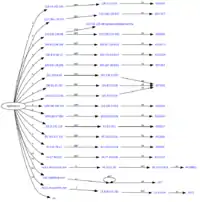
The basic idea behind Fast flux is to have numerous IP addresses associated with a single fully qualified domain name, where the IP addresses are swapped in and out with extremely high frequency, through changing DNS resource records, thus the authoritative name servers of the said fast-fluxing domain name is—in most cases—hosted by the criminal actor.[2]
Fast-flux service network
A fast-flux service network (FFSN) is a network infrastructure resultant of the fast-fluxed network of compromised hosts; the technique is also used by content distribution networks (CDNs) where the dynamic IP address is converted to match the domain name of the internet host, usually for the purpose of load balancing using round-robin domain name system (RR-DNS).[3] The purpose of using FFSN infrastructure for the botnets is to relay network requests and act as a proxy to the backend bulletproof content server which function as an "origin server".[4] The frontend bots, which act as an ephemeral host affixed to a control master, are called flux-agents whose network availability is indeterminate due to the dynamic nature of fast-fluxing.[1]
Types
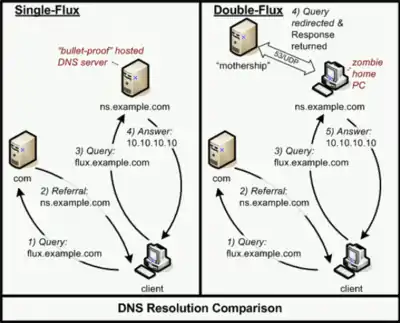
Fast-fluxing is generally classified into two types: single fluxing and double fluxing, a build-on implementation over single fluxing. The phraseologies involved in fast-fluxing includes "flux-herder mothership nodes" and "fast-flux agent nodes", referred to the backend bulletproof botnet controller and the compromised host nodes involved in reverse proxying the traffic back-and-forth between the origin and clients respectively.[5][1] The compromised hosts used by the fast-flux herders typically includes residential broadband access circuits, such as DSL and cable modems.[6]
Single-flux network
In single-flux network, the authoritative DNS server of a fast-fluxing domain name repeatedly permutes the DNS resource records of the said domain with low time to live (TTL) values, conventionally between 180 and 600 seconds. The permuted record within the zone file includes A, AAAA and CNAME record, the disposition is usually done by means of round robin from the registry of exploited host's IP addresses and DDNS names.[7][8][9] Although the commonly proxied application protocol by the frontend flux-agent redirector nodes remains HTTP and DNS, other services such as SMTP, IMAP and POP can also be delivered through the flux-agent since the transfer between the backend flux-herder mothership node and flux-agent utilize transport layer (L4) TCP and UDP level port binding techniques.[10]
Double-flux network
A Double-flux network is an implementation complexity over single-flux, in which both the DNS A, AAAA, or CNAME and the IP addresses of the authoritative name server of the fast-fluxing domain name is reverse proxied through a fluxing-agent to the backend mothership node.[10] In this infrastructure, the authoritative name Server record of the fast-fluxing domain points to a frontend redirector, which forwards the DNS datagram to the backend mothership node. The DNS resource records, including the NS record, are set with a lower TTL value, which gets permuted at the fast-flux mothership node's DNS zone file. This architecture results in an additional indirection.[11][12] The NS records in double-fluxing network usually point to a referrer host, that listens on port 53, rather than the flux-agents. The referrer hosts forward the DNS queries to a backend DNS server that hosts the zone file for the domain name, and the response message is directly sent from the backend DNS server to the querying resolver, instead of relaying the response message back through the referring name server.[13]
Domain-flux network
Domain-flux network involves keeping a fast-fluxing network operational through continuously rotating the domain name of the flux-herder mothership nodes. The domain names are dynamically generated using a selected pseudorandom domain generation algorithm (DGA), and the flux operator mass-registers the domain names. An infected host repeatedly tries to initiate a flux-agent handshake by spontaneous generating, resolving and connecting to an IP address until an acknowledgment, to register itself to the flux-herder mothership node.[11] A notable example includes Conficker, a botnet which was operational by generating 50,000 different domains in 110 top-level domains (TLDs).[14]
Security countermeasures
The detection and mitigation of fast-fluxing domain names remain an intricate problem in network security. Although fingerprinting the backend fast-flux mothership node remains increasingly difficult, service providers could detect the upstream mothership nodes through probing the frontend flux-agents in a special way by sending a crafted HTTP request that would trigger an out-of-band network request from the backend fast-flux mothership node to the client in an independent channel, such that the client could deduce the mothership node's IP address by analyzing the logs of its network traffic.[15] Various security researchers suggests that the effective measure against fast-fluxing is to take down the domain name from its use. However, the domain name registrars are reluctant in doing so, since there aren't jurisdiction independent terms of service agreements that must be observed; in most cases, fast-flux operators and cybersquatters are the main source of income to those registrars.[16] Other countermeasures against fast-fluxing domains include deep packet inspection (DPI), host-based firewall, and IP-based access control lists (ACLs), although there are serious limitations in these approaches due to the dynamic nature of fast-fluxing.[17]
See also
References
- Li & Wang 2017, p. 3.
- Almomani 2016, p. 483.
- Almomani 2016, p. 483-484.
- Almomani 2016, p. 484.
- Salusky & Daford 2007, p. 1.
- Konte, Feamster & Jung 2008, p. 8.
- Salusky & Daford 2007, p. 1-2.
- Li & Wang 2017, p. 3-4.
- "FAQ: Fast-fluxing". Andorra: The Spamhaus Project. Archived from the original on 29 April 2021. Retrieved 12 December 2021.
- Salusky & Daford 2007, p. 2.
- Li & Wang 2017, p. 4.
- Salusky & Daford 2007, p. 2-3.
- Konte, Feamster & Jung 2008, p. 4-6.
- Li & Wang 2017, p. 4-5.
- Salusky & Daford 2007, p. 7.
- Konte, Feamster & Jung 2008, p. 8-11.
- Florian Tegeler; Xiaoming Fu; Giovanni Vigna; Christoper Kruegel (10 December 2012). "BotFinder: finding bots in network traffic without deep packet inspection". Association for Computing Machinery: 349–360. doi:10.1145/2413176.2413217. ISBN 9781450317757. Cite journal requires
|journal=(help)
Bibliography
- Almomani, Ammar (24 August 2016). "Fast-flux hunter: a system for filtering online fast-flux botnet". Neural Comput & Applic. Springer Publishing (29). doi:10.1007/s00521-016-2531-1.
- Li, Xingguo; Wang, Junfeng (25 September 2017). "Botnet Detection Technology Based on DNS". Future Internet. Sichuan University. 9 (4). doi:10.3390/fi9040055.
- Salusky, William; Daford, Robert (13 July 2007). "Know Your Enemy: Fast-Flux Service Networks". The Honeynet Project. Archived from the original on 30 September 2012 – via Wayback Machine. Cite journal requires
|journal=(help) - Konte, M.; Feamster, N.; Jung, J. (January 2008). "SAC 025: SSAC Advisory on Fast Flux Hosting and DNS" (PDF). Security and Stability Advisory Committee (SSAC). Internet Corporation for Assigned Names and Numbers (1). Archived (PDF) from the original on 22 November 2021. Retrieved 12 December 2021.
- Spamhaus explanation of Fast Flux hosting
- Phishing by proxy SANS Internet Storm Center diary from 2006-11-28 describes use of compromised hosts within botnets making use of fast flux techniques to deliver malware.
- MySpace Phish and Drive-by attack vector propagating Fast Flux network growth SANS Internet Storm Center diary from 2007-06-26 with technical details on FluxBot and fast flux techniques (note: contains links to malicious code).
- Know Your Enemy: Fast-Flux Service Networks; An Ever Changing Enemy honeynet.org technical article from July 2007 and additional information on fast flux, including "single-flux" and "double-flux" techniques.
- Measuring and Detecting Fast-Flux Service Networks article by Holz et al. from February 2008 with empirical measurement results on fast flux.
- Fast flux foils bot-net takedown SecurityFocus article from 2007-07-09 describing impact of fast flux on botnet counter-measures.
- Attackers Hide in Fast Flux darkreading article from 2007-07-17 on the use of fast flux by criminal organizations behind malware.
- CRYPTO-GRAM October 15, 2007 issue Bruce Schneier mentions fast flux as a DNS technique utilized by the Storm Worm.
- ATLAS Summary Report - Real-time global report of fast flux activity.
- SAC 025 SSAC Advisory on Fast Flux Hosting and DNS
- GNSO Issues Report on Fast Flux Hosting
- FluXOR project from Computer and Network Security Lab (LaSeR) @ Università degli Studi di Milano (down as 07/27/2012)