Felipe Rose
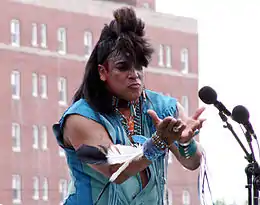
Felipe Rose (Born 12 January 1954) is an American musician who was an original member of the disco group the Village People. While in the group, he performed as an "Indian" character - usually wearing a costume consisting of an imitation war bonnet, loincloth and theatrical face paint. Rose was a member of the group from 1977 until 2017, when the name of the group was turned over to original lead singer Victor Willis. Rose subsequently launched a solo career and released the single "Going Back to My Roots" in 2018.
Felipe Rose | |
|---|---|
 | |
| Background information | |
| Birth name | Felipe Ortiz Rose |
| Born | 12 January 1954 Manhattan[1] |
| Genres | Disco |
| Occupation(s) | Singer |
| Years active | 1970–present |
Early years
Felipe Ortiz Rose[note 1] was born in Manhattan[1] to a Puerto Rican mother.[2] He currently claims Lakota/Taino descent,[2] but at other times has said he is Apache.[3] He was raised in Brooklyn, where he displayed an interest in the arts during his childhood. His mother was his main inspiration as she herself had been a dancer for the Copacabana during the 1940s and 1950s. In 1970, when Rose was 16 years old, he won a scholarship to study dance with the Ballet de Puerto Rico under the guidance of Pascual Guzman. He participated in a dance-drama recital of Julia de Burgos at the Lincoln Center for the Performing Arts with the Ballet Company. The New York Post called his performance "poignant and compelling".[1][4]
Village People
Rose began as a nightclub dancer. He describes being encouraged by an aunt to begin dancing "in his father's tribal regalia", which he says led to his costume in the Village People. Rose was working as a dancer and a bartender in the gay New York discotheque The Anvil, dressed "as an [American] Indian" when he was discovered by French producer Jacques Morali and executive producer Henri Belolo and so became the first recruit for Village People.[1][4]
In 1977, Village People had their first hit with "San Francisco", although this song became a hit only in the United Kingdom. Then in 1978 they had their first hits in the U.S. with "Macho Man" followed by "YMCA"[1][4]
In the 1980s, Rose sang and danced for the Latin music maestro Tito Puente and he also starred in a regional theatre production of West Side Story. In 1996, Rose started the Tomahawk Group, an entertainment and recording company which handles the Village People's releases and songs. The company is also in charge of the group's many engagements. Rose has also been the producer of various artists.[4]
Solo career
In 2000, Rose began to work on his solo career. His single "Trails of Tears" was nominated for 3 NAMMY Awards (Native American Music Awards) for Best Historical Recording, Song of the Year, and Best Producer. In 2002, Rose was the opening act of the fifth Annual Native American Music Awards celebrated at the Marcus Amphitheatre in Milwaukee, Wisconsin. That year he won a NAMMY Award for the Best Historical Recording.[1][4]
Rose has appeared in the following movies: Can't Stop the Music (1980), The Best of Village People (1993), and Feathers and Leathers: The Story of the Village People (1999). He also participated in the 2000 documentary, Village People: The E! True Hollywood Story.[1][4]
Charity work
Rose and Village People have raised millions of dollars for many charities. Among them are the Native American College Fund and various AIDS charities. Rose is a member of the board of directors of Sixuvus Ltd, the Advisory Board of the Native American Music Association, the LARAS-Latin Grammys, and the Winter Music Conference.[1][4]
Personal life
For a time Rose lived in Richmond, Virginia, and briefly in Jersey City, New Jersey, though he found it to be too crowded. In a 2008 interview, he stated that approximately four or five years prior, he moved to Asbury Park, New Jersey on the advice of several friends who lived there, saying, "So I came down and I just fell in love with the shore...I love the diversity of Asbury because it brings everyone together. There is a very large gay and lesbian community here, but the diversity of artists is amazing; it’s become very bohemian. Families [are] everywhere and there’s so much to do. Every weekend there's something – an art show, life guard races, film festivals.[1]
Notes
See also
References
- Anderson, Teja (October 25, 2008). "Felipe Rose: Village People's Macho Man". Livinginmedia.com. Archived from the original on December 31, 2008.
- Stuever, Hank (January 13, 2005). "Celebrity Artifact". The Washington Post. Archived from the original on September 2, 2008. Retrieved September 30, 2017.
- "Banda Village People llega al Perú". El Peruano. Retrieved May 25, 2019.
Felipe Rose, el nativo apache americano
- "Felipe Rose". Sobelpromotions.com. Archived from the original on September 28, 2013.
External links
- Official website
- Felipe Rose at IMDb
- "A Pop Culture icon, Felipe remained one of the original members in the band for over 40 years and one of the most recognizable ones". Pop Expresso. January 12, 2021.
Authority control  | |
|---|---|
| General | |
| National libraries | |
| Other | |