Fleetwood Park Racetrack
Fleetwood Park was a 19th century horse racing track in what is now the Morrisania section of the Bronx. The track operated under various managements between 1870 and 1898, most notably the New York Driving Club. The races were a popular form of entertainment, drawing crowds as large at 10,000 spectators.
 | |
| Location | Morrisania, Bronx, New York |
|---|---|
| Coordinates | 40.83°N 73.92°W |
| Operated by | Driving Club of New York |
| Date opened | June 8, 1871 |
| Date closed | January 1, 1898 |
| Race type | Trotting |
Description
Fleetwood Park was located in the town of Morrisania, Westchester County (now the Morrisania section of the Bronx), adjacent to Railroad (now Park) Avenue between 2nd and 5th Streets. This corresponds to between Webster and Sheridan Avenues and 165th and 167th Street on the modern Bronx street grid.[1] For most of the track's lifetime, Trotting races were run on the 1 mile (1.6 km)[2] oval by the New York Driving Club.[3]: 704–705
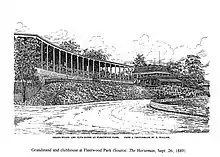
Robert Bonner had his stables and Fleetwood Park Club nearby and at one point served as president of the New York Driving club.[3]: 705, 753 [4][5]: 165 Members of the club included William K. Vanderbilt, William Rockefeller, William C. Whitney, Leonard Jerome,[6] and Nathan Strauss, with a total membership of over 500 by 1886.[7] Former US president Ulysses S. Grant often attended races at the track.[1]
Timeline
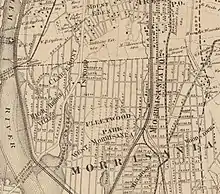
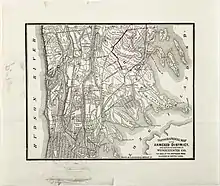
Horses had been raced near this location as far back as 1750, on a race course built by Staats Long Morris, who took advantage of the relatively level land. It is unknown how long this track lasted, and there is no record of racing in the area until 1870 when William Morris leased part of his estate to two brothers, Henry and Philip Dater[6][1] for a 20 year term.[8]: 289 The Daters opened a track on June 8, 1871, but the venture failed and the property reverted to Morris in 1880.[6]
The property was leased in 1881 to the New York Driving Club (Gentlemen's Driving Association in some sources)[9][10] who ran the track as Fleetwood Park.[3]: 705
The New York Times observed in 1895 that the track had reached 25 years of continuous operation that year, outlasting many of the other trotting tracks of its day. The paper noted that $200,000 (equivalent to $5,400,000 in 2020) had been invested in grading the terrain of the Morris estate to make it suitable for racing. A depression at the southeastern end had been filled and rocks at the northern end had to be removed by blasting and cutting.[4]
In 1896, The Driving Club of New York renewed the lease with a $2,500 (equivalent to $78,000 in 2020) reduction in rent.[11] Pressure from real estate developers led to the track being permanently closed on January 1, 1898.[6]: 4 The next year, the Empire City Trotting Club began operations at Yonkers Raceway.[12][13] By 1904, the property was being divided up into building lots by real-estate developers.[14]
Miscellaneous
Attendance at races was as large as 10,000 spectators. People travelled to the track by carriage from New York City, by steamboat from Fulton Market slip in Brooklyn and Peck slip in Manhattan to the Morrisania dock from which they made connections via horse-drawn coaches, or by train from Grand Central.[2] A streetcar line known as the North Third Avenue and Fleetwood Park Railroad (later merged into the Union Railway) ran from 138th street to the Fleetwood Park entrance.[15][16]: 169
In 1889, Fleetwood Park and nearby Claremont Park were considered as possible sites for a 1892 World's Fair.[17][18] The fair was to be the International Columbian Exposition, celebrating the 400th anniversary of Christopher Columbus finding the new world. The alternative locations in New York were Inwood, Oak Point-Barretto Point, Port Morris, Cedar Park, and Morningside Park-Riverside Park-Bloomingdale Asylum. In 1890, however, the US Congress designated Chicago as the host city for the exposition.
The grounds were also used for youth baseball games.[19]
In December 1890, Charles H. Swords, a local resident, was found dead in a ditch on the Fleetwood Park grounds. It was suspected that he was taking a short-cut through the park on his way home from either the Morrisania train station or a local road house when he suffered some sort of medical incapacitation, fell down an embankment, and eventually died from exposure.[20][21]
In 1896, the New York Driving Club was sued by Charles Schreiber, who leased some land adjacent to the race course for gardening. Schreiber claimed that runoff water from the track was damaging his garden. Schreiber won the case, for unknown damages.[22]
References
- Ultan, Lloyd (September 26, 2013). "The Other Racetrack". Riverdale Review. p. 5. Retrieved 7 December 2021.
- "Fleetwood Park: Ten Thousand Persons Witness the Grand Trotting Contest". The New York Herald. 1872-07-10. p. 5. ISSN 2474-3224. Retrieved 2021-12-05 – via Library of Congress: Chronicling America.
- Wells, James Lee (1927). The Bronx and its people; a history, 1609-1927. New York, The Lewis historical Pub. Co., Inc. LCCN 27024588 – via Internet Archive.CS1 maint: date and year (link)
- "Twenty-Five Years Old; Fleetwood Park Has Reached Its Silver Anniversary. Opened for Harness Racing in 1870 Prominent Patrons of Trotting That Have Held Office in the Driving Club -- Programme for the Opening To-day". The New York Times. 1895-05-11. p. 6. ISSN 0362-4331. Retrieved 2021-12-05.
- Comfort, Randall. History of Bronx borough, city of New York. LCCN 06029984 – via Hathi Trust.
- Dolkart, Andrew S. (1994). Clay Avenue Historic District (PDF). New York: New York City Landmarks Preservation Commission. LP-1898.
- Ryder, Jill (2017-05-01). The Carriage Journal: Vol 55 No 3 May 2017. Carriage Assoc. of America. p. 135.
- Jenkins, Stephen (1912). The story of the Bronx from the purchase made by the Dutch from the Indians in 1639 to the present day. G.P. Putnam's Sons / The Knickerbocker Press. OL 16491842W – via Internet Archive.
- "Gentlemen's Driving Association". The New York Times. 1882-04-04. ISSN 0362-4331. Retrieved 2021-12-09.
- Ryder, Jill (2017-05-01). The Carriage Journal: Vol 55 No 3 May 2017. Carriage Assoc. of America. p. 135.
- "Active Trotting Men". The Journal. New York. February 3, 1896. p. 10. Retrieved December 6, 2021 – via Library of Congress: Journaling America.
- "Yonkers Raceway". www.yonkers-raceway.info. Retrieved 2021-12-05.
- "Horse Racing". The New York Times. Retrieved December 4, 2021.
- "In the Real Estate Field; Operator Buyer of Blocks Sold by Elevated Railroad – Big Building project in the Bronx – Deals on Lower Fifth Avenue and Upper Broadway". The New York Times. 1904-03-10. ISSN 0362-4331. Retrieved 2021-12-09.
- "The Huckleberry Road; Consolidation Agreement is Filed in Albany. The Union Railway Company Created – Capital, $2,000,000 – The Trolley to Supplant Horse Power – Eight Miles of New Road". The New York Times. 1892-07-06. ISSN 0362-4331. Retrieved 2021-12-09.
- Hoardly, Lauterbach & Johnson, council (1900). Union Railway Company of New York City. ark:/13960/t26b1vk7c – via Internet Archive.CS1 maint: multiple names: authors list (link)
- "Another Good Fair Site; Advantages of Claremont and Fleetwood Parks. Lands Adapted by Nature and Approved by Engineers for Such a Purpose – Means of Access". The New York Times. 1889-07-21. p. 16. ISSN 0362-4331. Retrieved 2021-12-03.
- "Looking at Various Sites; Trying to Find a Place for the Great Fair. The Advantages of Inwood and Claremont Pointed Out Yesterday – Another Tour Today". The New York Times. 1889-09-18. p. 8. ISSN 0362-4331. Retrieved 2021-12-03.
- "Sports and Sportsmen". The Jersey City News. July 19, 1900. p. 4 (column 1). Retrieved December 8, 2021 – via Library of Congress.
- "Swords's Death a Mystery". The Evening World. December 8, 1890. p. 1 (column 4). Retrieved December 10, 2021 – via Library of Congress: Chronicling America.
- "What a Death This Was". The Sun. December 9, 1890. p. 3 (column 2). Retrieved December 10, 2021 – via Library of Congress: Chronicling America.
- "Schreiber v. Driving Club of New York". The New York Supplement. 37. St. Paul: West Publishing Co. 1896. pp. 348–352. Archived from the original on 2021-12-06.