Fort Ridgely
Fort Ridgely was a frontier United States Army outpost from 1851 to 1867, built 1853–1854 in Minnesota Territory. It was located overlooking the Minnesota river southwest of Fairfax, Minnesota. Half of the fort's land was part of the Dakota reservation in the Minnesota river valley. Fort Ridgely had no defensive wall, palisade, or guard towers. The Army referred to the fort as the "New Post on the Upper Minnesota" until it was named for three Maryland Army Officers named Ridgely (Thomas, Randolph and Lott Henderson), who died during the Mexican–American War; Randolph and Lott Henderson were killed in action and Thomas died in Baltimore, Maryland in Dec 1847.[2]
Fort Ridgely | |
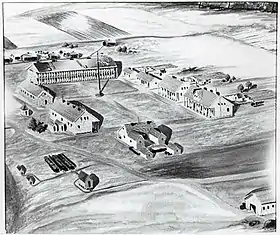 Fort Ridgely in 1862 | |
   | |
| Location | Nicollet County, south of Fairfax, Minnesota |
|---|---|
| Coordinates | 44°27′3″N 94°43′54″W |
| Built | 1853 |
| Architectural style | unpallisaded frontier fort |
| NRHP reference No. | 70000304[1] |
| Added to NRHP | December 02, 1970 |
History
Construction
The War Department hired Mr. Jessie H. Pomeroy of St. Paul to build both Fort Ridgely and Fort Ripley. At Ridgely there were two Companies of troops that assisted in quarrying the granite two miles away, transporting it to the site, and the erection of a 400-man stone barracks. It formed one side of the 90 square yard parade ground of the wall-less fort.
In 1854–55, Congress approved $10,000 for the clearing of timber on a military road from St Anthony Falls to Fort Ridgely. On July 22, 1856, Congress approved another $50,000 to build a wagon road from Fort Ridgely to South Pass, Nebraska Territory.[3] William H. Nobles was appointed superintendent of the road's construction. He encountered problems receiving disbursements to cover the basic labor costs incurred.
Sioux Uprising
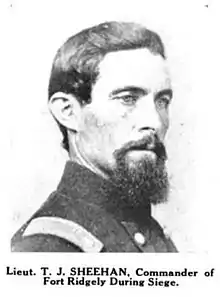
The fort played an important role in the Dakota War of 1862.[4] On August 18th Captain Marsh took most of the garrison to the Lower Sioux Agency upon receiving reports that the Agency had been attacked. Second Lt. Gere and a few men were on duty there. Marsh and his men came under attack when they stopped for water. That action became known as the Battle of Redwood Ferry. Prior, Capt. Marsh had sent 1st Lt. Sheehan and his Fort Ripley C Company detachment to the Upper Sioux agency. After some disagreement, Lt. Sheehan was able to get the Indian agent to distribute food. Thinking their task was completed, the troop departed to return to their own post.
At roughly the same time Capt. Marsh was being informed of the problems at the Lower Sioux Agency. He sent a runner to catch up with Lt Sheehan's detachment for their support before leaving for Redwood ferry.[5] Lt. Sheehan and his men had gone 40 miles before they were caught up with.[5] Sheehan marched his men all night and made it back to Ridgely by noon the next day. When 2nd Lt. Gere learned of Capt. March's death he sent a Private William Sturgis to inform Fort Snelling. Sturgis rode through the night covering the 125 miles in eighteen hours.[5] The Sioux attacked Ridgely's combined military/civilian force twice, on August 20 and August 22. B and C Companies of the 5th Minnesota together with settlers of the Minnesota River valley (totaling 230) versus 800 Sioux lead by Little Crow.[5] Some of the civilians were native Métis members of the Renville Rangers militia. They had been just departing for Fort Snelling and the Civil War when Private Sturgis gave them word they were needed.[5] Fort artillery is credited with repulsing the overwhelming force. Ordinance Sargent John Jones was the sole regular Army at the fort. He is credited with Fort Ridgely's successful defense by training the 5th Minnesota infantrymen to be artillery men of the three cannon [5] that had not been sent east. C Company remained at the fort until after Col. Sibley arrived with the 6th Minnesota, Companies A, B, F, G 7th Minnesota,Company A 9th Minnesota and Companies G & I 10th Minnesota. With dead laying all over the frontier, Sibley dispatched 170 men as burial parties. Two of those burial parties met and bivouacked 16 miles from Fort Ridgely. On Sept 2nd they were ambushed in the Battle of Birch Coulee. Lt. Sheehan and his men were part of the relief force. Afterwards Sibley ordered them back to Fort Ripley to get their garrison back to strength with the frontier in turmoil.
On 4 September the 3rd Minnesota arrived back at Fort Snelling and joined Sibley at Fort Ridgely on the 12th.
As the war against the Sioux expanded, three Companies of the 30th Wisconsin Infantry Regiment later transitioned Fort Ridgely and New Ulm enroute to Fort Wadsworth (Sisseton).[6] For a period a battery of the 3rd Minnesota light Artillery was posted to the fort. Sargent Jones resigned from the U.S. Army for a Captain's commission in the 3rd Minn. Artillery. Postwar Capt. Jones served one term as the Chief of police in St. Paul.
Notable Officers posted to Fort Ridgely
Notable officers posted to Fort Ridgely included:
- Major Samuel Woods (6th U.S. Infantry), first post commander 1852–53, would become a Lt. Colonel and paymaster of the Department of Dakota.
- Major George W. Patten, post commander twice, 1856 and 1861. Lost a hand at the Battle of Cerro Gordo, Mexico and became a Lt. Colonel.
- Lt. Alfred Sulley[7] 1855 made Major General by end of Indian Wars.
- Lt. John C. Kelton[7] (6th U.S. Infantry) 1852 would become the Adjunct General United States Army
- Lt. Winfield Scott Hancock[7] 1853 would become a Major General and commander of the Department of Dakota
- Lt. Henry E. Maynadier (10th U.S. Infantry) 1856–57, became a brevet Major General[8]
- Lt. Frederick Steele[7] 1854, became a Major General
- Capt. John J. Abercrombie[7] 1854, also served at Fort Ripley and established Fort Abercrombie. Became a Brigadier General.
- Colonel Edmund Brooke Alexander, post commander, 10th U.S. Infantry 1857[9] would become a brevet Brigadier General
- Major Thomas W. Sherman (3rd U.S. Artillery) at post when the post was made the Artillery School for Practice Fort Ridgely. He was there 1858–1861 except while commander of an expedition to Kettle Lake in Dakota Territory in 1859. He would become a brevet Major General
- Major William W. Morris (4th U.S. Artillery) at post 1861 became a brevet Major General
- Capt. John S. Marsh replaced Major Morris and was killed in action at Redwood ferry 1862, (B Co. 5th Minnesota Infantry)
- 2nd Lt. Thomas P. Gere (B Co. 5th Minnesota) assumed command when Capt. Marsh was killed. He received the Medal of Honor at the Battle of Nashville
- 1st Lt. Timothy J. Sheehan assumed post command from 2nd Lt. Gere 1862 (C Co. 5th Minnesota Infantry) wounded twice defending the post, made Lt. Colonel by end of Civil War, wounded 2 twice more
- Major John Parker post commander, 1st Minnesota Mounted Rangers
- Capt. Bernard Bee became Brigadier General CSA and is credited with giving Stonewall Jackson his nickname at the First Battle of Bullrun, where he was killed in action.
- Major J.C. Pemberton post commander 1859–61[7] became a CSA Lt. General and would surrender to Ulysses Grant at Vicksburg.
- Lt. Lewis A. Armistead[7] post commander (6th Infantry), became a CSA Lt. General
- Corporal Daniel W. Burke(Companies B & E 2nd U.S. Infantry) 1858–59 would become Brigadier General. He received the Medal of Honor during the Civil War at the Battle of Shepherdstown.
- Capt. James L. Fisk (3rd Minnesota Infantry special assignment Quartermaster Corps) 1863,64.
Units assigned to the outpost
In its time, numerous units were assigned to the outpost. From the U.S. Army: Companies of the 2nd, 6th, and 10th Infantry Regiments as well as batteries of the 2nd, 3rd, 4th Artillery Regiments, as well as I Co. 1st U.S. Volunteer Regiment.[7]
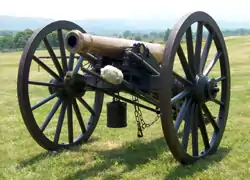
Until 1859 the garrison was typically three companies of infantry of 30-40 men each. That year the Army designated the fort as an Artillery School for Practice and supplied six pieces of various calibers: two M1841 6-pounder field guns, 12 pounder, M1841 mountain howitzer, 12 pound Napoleon, and M1841 24-pounder howitzer.[7]
From 1857 to 1861, Companies G, I, L 2nd Artillery were variously posted to northern forts: Snelling, Ridgely, and Ripley.[10] In 1859, Companies F and K of the 4th Artillery were posted to the Fort. May of 1861 saw E Company 3rd Artillery withdrawn to the east because of the rebellion.
| Specifications of the ordnance at the Artillery School: [11][12] | Description | Caliber | Barrel length | Barrel weight | Carriage weight | Shot weight | Charge weight | Range 5° elev. |
|---|---|---|---|---|---|---|---|---|
| M1841 6-pounder cannon | 3.67 in (9.3 cm) | 60 in (152.4 cm) | 884 lb (401 kg) | 900 lb (408 kg) | 6.1 lb (2.8 kg) | 1.25 lb (0.6 kg) | 1,523 yd (1,393 m) | |
| M1841 12-pounder cannon | 4.62 in (11.7 cm) | 78 in (198.1 cm) | 1,757 lb (797 kg) | 1,175 lb (533 kg) | 12.3 lb (5.6 kg) | 2.5 lb (1.1 kg) | 1,663 yd (1,521 m) | |
| M1841 12-pounder howitzer | 4.62 in (11.7 cm) | 53 in (134.6 cm) | 788 lb (357 kg) | 900 lb (408 kg) | 8.9 lb (4.0 kg) | 1.0 lb (0.5 kg) | 1,072 yd (980 m) | |
| M1841 24-pounder howitzer | 5.82 in (14.8 cm) | 65 in (165.1 cm) | 1,318 lb (598 kg) | 1,128 lb (512 kg) | 18.4 lb (8.3 kg) | 2.0 lb (0.9 kg) | 1,322 yd (1,209 m) | |
| M1857 12-pounder Napoleon | 4.62 in (11.7 cm) | 66 in (167.6 cm) | 1,227 lb (557 kg) | 1,128 lb (512 kg) | 12.3 lb (5.6 kg) | 2.5 lb (1.1 kg) | 1,619 yd (1,480 m) | |
During the civil war Companies from Minnesota Volunteer Regiments served in place of the regular army. These included the 1st, 2nd, 4th, 5th, 6th, 8th, 9th, and 10th regiments, 2nd Cavalry, 1st Mounted Rangers, Brackett's Cavalry and a battery from the 3rd light artillery.[7]
1864 wagon train
On July 15, 1864 Capt. James L. Fisk of the Quartermaster Corps lead 97 wagons of pioneers out of Fort Ridgely to meet Gen. Sulley at Fort Rice for escort to the gold fields in Montana Territory.[13] Gen.Sulley departed early, so Fort Rice provided a 40 man escort. On September 2nd, one hundred eighty miles west, the train ran into Sitting bull's warriors. The wagon train made a 300' diameter defense of sod that was named Fort Dilts. The cavalry rescued them on the 20th, but a wagon of poisoned food was left by Minnesotans that had lost family in the 1862 uprising.[14] Upon reaching Fort Rice the wagon expedition disbanded.[13]
Abandonment of the post
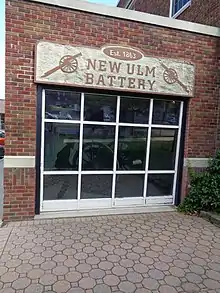
The Army abandoned Fort Ridgely in 1867 and posted the garrison to Fort Wadsworth (Sisseton). Civilians occupied the vacant buildings and later dismantled them for the building materials. In 1863 one of the 6 pounders from the fort was given to the New Ulm Battery by General Sibley.[15]
Site of the fort today
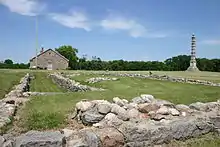
Today the building foundations have been exposed by State archeologists. The Nicollet County Historical Society maintains the publicly-owned portion of the site for the Minnesota Historical Society within Fort Ridgely State Park. The old commissary building (partially reconstructed by the Civilian Conservation Corps in the 1930s) now houses the Park's museum. Fort Ridgely was added to the National Register of Historic Places in 1970, with much of the park added in 1989.
References
- "National Register Information System". National Register of Historic Places. National Park Service. March 13, 2009.
- Upham, Warren (1920). Minnesota Geographic Names: Their Origin and Historic Significance. Minnesota Historical Society. p. 373.
- Fort Ridgely South Pas Road Act of March 1861, Report of the Secretary of Interior 1862, 37th Congress, 2nd session, House of Representatives Doc. No. 35, Library of Congress
- "Park Info: Fort Ridgely State Park". Minnesota Department of Natural Resources. Archived from the original on 28 November 2015. Retrieved 6 February 2012.
- Massacre!, American Heritage Volume 13 Issue 3, American Heritage Publishing Co., Ralph K. Andrist, April 1962, p.3
- 30th Wisconsin Infantry, Wisconsin in the Civil War, Wisconsin Historical Society Historical essay, Charles E. Estabrook (1914), pp. 789–792
- On Duty at Fort Ridgely, Minnesota 1853-67, Paul Hedren, South Dakota Historical Society Press, 1977, pp. 168–92, appendix
- Major General Maynadier, Cullum's Registry, Vol. 2, Bill Thayer, University of Chicago web site, April 2019, p. 452 penelope.uchicago.edu
- Reminiscences of Little Crow, Minnesota Historical Society Collections, Dr. Asa Daniels, 1862,
- Second Regiment of Artillery, The Army of the US Historical Sketches of the Line and Staff with Portraits of the Generals in Chief, Lt. W.A. Simpson, New York Maynard, Merrill and Company, 1896, p. 312, U.S Army Center of Military History website
- Coggins 1983, p. 66.
- Coggins 1983, p. 77.
- Fort Dilts, Fort Dilts State Historic Site, State Historical Society of North Dakota, 612 East Boulevard Ave., Bismarck, North Dakota 58505
- Fort Dilts: Guns, arrows and poison?, Virginia Grantier, The Dickenson Press, 30 August, 2014
- New Ulm boasts the state’s only “Department of Defense,” which is celebrating its 150th anniversary, New Ulm Journal, Josh Moniz, April 16, 2013, MinnPost | P.O. Box 18438 | Minneapolis, MN
See also
Further reading
- Barnes, Jeff. Forts of the Northern Plains: Guide to Historic Military Posts of the Plains Indian Wars. Mechanicsburg, PA: Stackpole Books, 2008.
External links
 Media related to Fort Ridgely at Wikimedia Commons
- Fort Ridgely State Park from the Minnesota Department of Natural Resources
- Minnesota Historical Society: Fort Ridgely
- Nicollet County Historical Society
- Fort Ridgely watercolor by Lt. Sulley 1855, at the Gilcrease Museum, Tulsa, Oklahoma