Funeral Parade of Roses
Funeral Parade of Roses (薔薇の葬列, Bara no Sōretsu) is a 1969 Japanese drama art film directed and written by Toshio Matsumoto, loosely adapted from Oedipus Rex and set in the underground gay culture of 1960s Tokyo. It stars Peter as the protagonist, a young transgender woman, and features Osamu Ogasawara, Yoshio Tsuchiya and Emiko Azuma. A product of the Japanese New Wave, the film combines elements of arthouse, documentary and experimental cinema, and is thought to have influenced Stanley Kubrick's film adaptation of Anthony Burgess' novel A Clockwork Orange (1971).[1]
| Funeral Parade of Roses | |
|---|---|
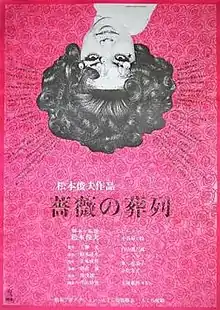 Japanese film poster | |
| Directed by | Toshio Matsumoto |
| Written by | Toshio Matsumoto |
| Produced by |
|
| Starring |
|
| Cinematography | Tatsuo Suzuki |
| Edited by | Toshie Iwasa |
| Music by | Joji Yuasa |
| Distributed by | Art Theatre Guild |
Release date |
|
Running time | 105 minutes |
| Country | Japan |
| Language | Japanese |
The title is a pun, as "rose" (bara) in Japanese can have a similar meaning to "pansy" in English slang.[2]
The film was released by A.T.G. (Art Theatre Guild) on September 13, 1969 in Japan; however, it did not receive a United States release until October 29, 1970. Matsumoto's previous film For My Crushed Right Eye contains some of the same footage and could be interpreted as a trailer for Funeral Parade. In June 2017, it received a 4K restoration and a limited theatrical rerelease.[3] In 2020, it received a limited edition Blu-ray release from the British Film Institute in the UK.[4]
Plot
The film follows the trials and tribulations of Eddie and other transgender women in Tokyo.[5] The main plot continuously jumps around the timeline of events. The film also contains scenes shot in a documentary style, in which the film's cast members are interviewed about their sexuality and gender identity.
As a child, Eddie was abused by his father. When his father abandons Eddie and his mother, Eddie suggests to his mother that, though her husband has left them, she still has him to rely on, and his mother laughs at him. Some time later, Eddie finds his mother with another man, and Eddie stabs them both using a knife.
Now an adult, Eddie works at the Genet, a gay bar in Tokyo that employs several transvestites to service customers. The Genet is managed by drug dealer Gonda, with whom Leda, the madame or "lead girl" of the bar, lives and is in a relationship. Leda correctly begins to suspect that Eddie and Gonda have a secret sexual relationship, and Gonda promises to make Eddie the new madame of the bar.
One day, Eddie witnesses a street protest and enters an art exhibit, where a voice on a tape recorder speaks about individuals masking their personalities, "wearing" one or more "masks" in order to avoid loneliness.[6] Eddie also goes shopping with friends, visiting clothing stores and a hair salon, eating ice cream and entering a men's bathroom, where they stand in front of urinals in their skirts. Eddie also associates with Guevara, a member of a filmmaking collective who makes avant-garde films. After viewing one of Guevara's works, Eddie and others smoke marijuana and dance.
While out with two friends, Eddie and two friends are confronted by a trio of women, and a fight ensues. Gonda visits Leda and is angered when she feigns concern for Eddie's well-being. Leda is later found lying in her bed, having died by suicide, wearing a veil and surrounded by roses. On the floor are two dolls, one with a nail in its upper chest, and the other with a nail in each eye.
After Leda's funeral, Eddie is promoted to madame of the Genet. While Eddie takes a shower, Gonda finds a book containing a photograph of Eddie as a young boy, with his parents. Though a hole has been burnt through the face of Eddie's father in the picture, Gonda recognizes Eddie's mother as his former lover. Realizing that Eddie is his child, Gonda kills himself with a knife. Upon seeing this, Eddie takes the knife and stabs herself in each eye, before stumbling outside in front of a crowd of people.
Cast
- Peter as Eddie
- Osamu Ogasawara as Leda
- Yoshio Tsuchiya as Gonda
- Emiko Azuma as Eddie's mother
- Toyosaburo Uchiyama as Guevara
- Don Madrid as Tony
- Koichi Nakamura as Juju
- Chieko Kobayashi as Okei
- Shōtarō Akiyama as himself
- Kiyoshi Awazu as himself
Production
The film was set and shot in Tokyo.
References
- ‘Funeral Parade of Roses’: Edgy 1969 Japanese drama that inspired Kubrick’s ‘A Clockwork Orange’ Dangerous Minds, 15 June 2016. Retrieved 13 August 2020.
- "Exclusive - Fantagraphics to publish 'Massive' anthology of gay manga". 31 December 2013. Retrieved 13 April 2017.
- "'Funeral Parade of Roses' Review: New 4K Restoration is Still Erotically Charged". Cinemacy. 14 June 2017. Retrieved 23 June 2021.
- Funeral Parade of Roses (2-Disc Blu-ray)
- Cleary, Tamsin (16 June 2020). "Why Funeral Parade of Roses is a landmark of Japanese queer cinema". British Film Institute. Retrieved 6 May 2021.
- Vicari, Justin (2016). Japanese Film and the Floating Mind: Cinematic Contemplations of Being. McFarland & Company. p. 75. ISBN 978-1476664989.
- Sources
- (in Japanese) 薔薇の葬列 (Bara no Sōretsu) at the Japanese Movie Database
- "Eros Effect" review by Lucid Screening
- Sharp, Jasper (26 September 2006). "Funeral Parade of Roses (Review)". Midnight Eye. Retrieved 18 October 2007.
- Thompson, Nathaniel (2006). DVD Delirium: The International Guide to Weird and Wonderful Films on DVD; Volume 3. Godalming, England: FAB Press. pp. 250–251. ISBN 1-903254-40-X.
- "Timeline for a Timeless Story" essay by Jim O'Rourke
External links
- Funeral Parade of Roses at IMDb
- Funeral Parade of Roses is available for free download at the Internet Archive