Gas-generator cycle
The gas-generator cycle is a power cycle of a pumped liquid bipropellant rocket engine. Part of the unburned propellant is burned in a gas generator (or preburner) and the resulting hot gas is used to power the propellant pumps before being exhausted overboard, and lost. Because of this loss, this type of engine is termed open cycle.
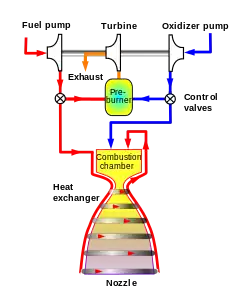
Description
There are several advantages to the gas-generator cycle over its counterpart, the staged combustion cycle. The gas generator turbine does not need to deal with the counter pressure of injecting the exhaust into the combustion chamber. This simplifies plumbing and turbine design, and results in a less expensive and lighter engine.
The main disadvantage is lost efficiency due to discarded propellant. Gas-generator cycles tend to have lower specific impulse (efficiency) than staged combustion cycles. However, there are forms of the gas-generator cycle that redirect the exhaust into the engine nozzle. This is seen in the F-1 and Merlin 1D Vacuum rocket engines, as used on the Saturn V booster stage and the Falcon 9 second stage, respectively. However, in this case, the gas-generator pressure must be higher, because pressure always goes from high to low in a rocket engine, from the turbopumps to the combustion chamber. This creates more harsh conditions for the gas-generator, meaning that the generator must be made from a stronger material, meaning that there is going to be more dry mass. In other designs such as the LR91, the gas generator exhaust is vented through a steerable nozzle to provide roll axis control.
As in most cryogenic rocket engines, some of the fuel in a gas-generator cycle may be used to cool the nozzle and combustion chamber (regenerative cooling).[1] The ultimate performance of a rocket engine is primarily limited by the ability of the construction materials to withstand the extreme temperatures of rocket combustion processes, as a higher temperature directly increases the local speed of sound that limits exhaust velocity.[2]
Some engines, including the RD-107 used on the Soyuz, use a third fuel, typically hydrogen peroxide, which decomposes as it passes over a catalyst producing gasses which are used to drive the turbines. Engines using this system are mechanically simple, but have poor specific impulse.
Usage
Gas-generator combustion engines include the following:
- Vulcain,[3] HM7B
- Merlin[4]
- RS-68[5]
- RS-27A[6]
- J-2X[7]
- F-1[8]
- RD-107[9]
- CE-20[10]
- Archimedes (rocket engine)[11]
Rocket launch systems that use gas-generator combustion engines:
See also
References
- "ch2-6". nasa.gov.
- "Mass Flow Choking". nasa.gov.
- "Vulcain-2 Cryogenic Engine Passes First Test with New Nozzle Extension" (PDF). ESA.
- "SpaceX Merlin Engine". SpaceX. Archived from the original on 2011-01-03.
- "Delta 4 Data Sheet".
- Joe Stangeland. "Turbopumps for Liquid Rocket Engines". Archived from the original on 2012-10-18.
- "J-2X Engine".
- "F-1 Engine Fact Sheet" (PDF). Archived from the original (PDF) on 2016-04-13. Retrieved 2013-04-17.
- "RD-107". Encyclopedia Astronautica. Archived from the original on 2014-02-09.
- Asraff, A and Muthukumar, R and Ramnathan, T and Balan, C (2008). Structural Analysis of Propulsion System Components of an Indigenous Cryogenic Rocket Engine. 44TH AIAA/ASME/SAE/ASEE JOINT PROPULSION CONFERENCE & EXHIBIT. doi:10.2514/6.2008-5120.CS1 maint: multiple names: authors list (link)
- "Neutron|Rocket Lab"
- "Falcon 9 Overview". Archived from the original on 2013-05-01.
- "Falcon Heavy Overview".
- "Advanced Rocket Engines" (PDF). Institute of Space Propulsion, German Aerospace Center (DLR). Archived from the original (PDF) on 2012-09-04.
- "Neutron|Rocket Lab"
External links
| Concepts | |||||||||
|---|---|---|---|---|---|---|---|---|---|
| Physical propulsion | |||||||||
| Chemical propulsion |
| ||||||||
| Electrical propulsion |
| ||||||||
| Nuclear propulsion |
| ||||||||
| External power | |||||||||
| Related concepts | |||||||||
 Spaceflight portal Spaceflight portal | |||||||||