Gelukkig zijn
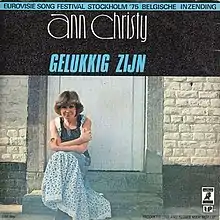
"Gelukkig zijn" (Dutch pronunciation: [ɣəˈlʏkəx sɛin]; translated: "Being happy"; English version: "Could It Be Happiness") was the Belgian entry at the Eurovision Song Contest 1975, performed in Dutch (first verse and chorus) and English by Ann Christy.
.svg.png.webp) "Gelukkig zijn" "Gelukkig zijn" | |
|---|---|
 | |
| Eurovision Song Contest 1975 entry | |
| Country | |
| Artist(s) | |
| Languages | |
| Composer(s) | Mary Boduin |
| Lyricist(s) | Mary Boduin |
| Conductor | |
| Finals performance | |
| Final result | 15th |
| Final points | 17 |
| Entry chronology | |
| ◄ "Fleur de liberté" (1974) | |
| "Judy et Cie" (1976) ► | |
The song was performed eleventh on the night, following Malta's Renato with "Singing This Song" and preceding Israel's Shlomo Artzi with "At Va'Ani". At the close of voting, it had received 17 points, placing 15th in a field of 19.
The song deals with the simple pleasures of life and muses "so that's called being excited". The singer then compares these feelings with "the feeling [she] get[s] from [him]" and considers that this, too, could be happiness.
In addition to the Dutch and English versions, Christy recorded the song in French (as "L'histoire du bonheur") and German ("Wenn keiner mehr zu dir steht").
This is the only one song in the Eurovision history when two version of the same song were sung in one version. This song was originally made for a jeans commercial.
It was succeeded as Belgian representative at the 1976 contest by Pierre Rapsat singing "Judy et Cie".