Ghana–Israel relations
Ghana–Israel relations refers to the current and historical relationship between Ghana and Israel. Ghana–Israel relations dates back to the mid-1950s after Israel offered support to develop the Ghanaian armed forces. However, following the 1973 Yom Kippur War Ghana severed relationships with Israel in protest against the seizure and belligerent occupation of more Palestinian lands by the Israeli army. Until 2011 when Ghana and Israel resumed formal relation and opened embassies in the Tel Aviv District city of Ramat Gan[1] and Accra respectively,[2][3] the Israeli embassy in Nigeria was the only known conduit of engagement between the two countries.
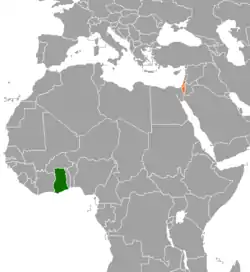 | |
 Ghana |
 Israel |
|---|---|
History
An Israeli consulate was established in Ghana in 1956, prior to independence.[4][5] Ghana was the first country from Sub-Saharan Africa to establish diplomatic relations with Israel.[4]
In April 1959, Israel, with help from India, supervised the establishment of the Ghana Air Force. A small Israeli team also trained aircraft maintenance personnel and radio technicians at the Accra-based Air Force Trade Training School. Although the British persuaded Ghanaian President Kwame Nkrumah to withdraw Israeli advisers in 1960, Ghanaian pilots continued to receive some training at aviation schools in Israel. After Nkrumah's overthrow, Israeli military activities in Ghana ended, but Israel continued to aid Ghana in shipping, construction, security, research, manpower training, and agriculture.[6][4]
From shortly after the Yom Kippur War through September 2011, Israel and Ghana maintained basic diplomatic ties through Nigeria.[3] In September 2011, Ghana and Israel renewed direct diplomatic relations.[3][7]
Relationship as influenced by Palestine-Israel conflict
Fluctuations in Ghana-Israel relationships have been influenced by the Palestine-Israel conflict. Ghana is widely considered a leader in the colonial resistance struggles of sub-Saharan Africa and its government has held the responsibility to show solidarity to jurisdictions that had a similar history. Ghana was an early proponent of a two-state solution to the Palestine-Israel conflict whereby the State of Palestine would be established alongside the state of Israel according to demarcations set by the United Nations and observed by nearly 200 other countries. When Israeli armed forces ignored the United Nations Security Council Resolution 242 to withdraw from seized Arab lands pre-1967 borders the Ghanaian government cut direct diplomatic ties with Israel, only allowing for minimal engagement though the Israeli embassy in Nigeria.
After 38 years of strained relationships, the Ghanaian President John Evans Atta Mills accepted the renewal of diplomatic ties with Israel in 2011 whereby the two countries would collaborate in the development of the economy of shipping, construction, security, research, manpower training, and agriculture.
In December 2017, when then-US President Donald Trump gave Israel the green light to move its capital from Tel Aviv to Jerusalem, the Ghanaian government boycotted an invitation to attend the opening of a US embassy in Jerusalem the following year.
In 2018, the Ghanaian legislature reiterated that “Ghana is undoubtedly committed towards the cause of the Palestinian people" and that Israel as described by one of the parliamentarians was a "rogue state" and "a modern-day settler-colonial power". This recent sour of relationships between the two countries was due to a Ghanaian MP who upon invitation was scheduled to give a lecture in Palestine was denied entry into the occupied territories by Israeli border police. When a journalist back in Ghana called to interview the Israeli ambassador in Ghana, he threatened to drop the call if the interviewer continued to use the phrase "occupied Palestinian territories" because according to him, "Palestine does not exist". Then Ghanaian president Nana Akufo-Addo was later advised by the legislature to once again recall the Ghanaian ambassador to Israel.
Trade
In October 2004, a four-day Israeli trade fair titled "Applicable Technologies Fair 2004" occurred in Accra, Ghana. Ghanaian Minister of Trade and Industry Alan John Kyerematen urged investors to undertake mutual investments including in irrigation and agriculture.[8]
References
- Tourism : Embassies and Consulates in Israel Science.co.il
- "Israel Reopens Embassy in Ghana". Israel National News. September 15, 2011. Retrieved February 20, 2021.
- Medzini, Ronen (September 15, 2011). "Ghana renews diplomatic ties with Israel". Ynetnews. Retrieved February 20, 2021.
- Historical Dictionary of Ghana - David Owusu-Ansah - Google Books
- Ghana's Foreign Policy, 1957-1966: Diplomacy Ideology, and the New State - Willard Scott Thompson - Google Books
- Foreign relations of Ghana-Israel Library of Congress
- Historical Dictionary of Ghana - David Owusu-Ansah - Google Books
- Israeli trade exhibition opens Ghana News Agency, 26 October 2004
External links
- Ghana Israel Chamber of Commerce
- United Friends of Israel inaugurated Ghana Web, 10 June 2000
- Israel Pledges To Assist Ghana Daily Graphic, 8 September 2009
| Africa |  | ||
|---|---|---|---|
| Americas | |||
| Asia | |||
| Europe |
| ||
| Related topics | |||
| Africa |  | |
|---|---|---|
| Americas | ||
| Asia |
| |
| Europe | ||
| Oceania | ||
| Former | ||
| Multilateral relations | ||
| Diplomacy | ||