Gigi Ibrahim
Gigi Ibrahim (also Gihan Ibrahim) is an Egyptian citizen journalist, revolutionary socialist, and activist. During the Egyptian revolution of 2011, she used Twitter to report on events at protests. She became a face of the events in Egypt for much of the Western media, which rarely mentioned her political views. She continued to protest and to use Twitter as a platform through the 2013 Egyptian coup d'état, later founding a shoe manufacturing company in Cairo.
Gigi Ibrahim | |
|---|---|
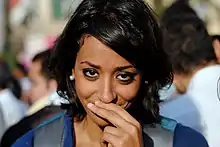 Gigi Ibrahim in May 2011 | |
| Born | 1986/1987 (age 34–35)[1] |
| Nationality | Egyptian |
| Alma mater | The American University in Cairo |
| Occupation | Citizen journalist, activist |
Born to Egyptian parents in Long Beach, California, Ibrahim lived in Egypt until she was 14. Her family returned to California after her mother died when she was 14, and she began attending high school at a local Catholic school. Two weeks into the school year, the September 11 attacks occurred, and FBI agents searched the Ibrahims' home; Ibrahim was additionally asked to give a presentation about Islam at her school. The experience led Ibrahim to realize that her life was going to be affected by her Muslim and Egyptian identities, and her interest in politics increased over the following years. Ibrahim graduated high school in 2005, attending Orange Coast College before transferring to The American University in Cairo in 2008, where she became involved with the Revolutionary Socialists. She graduated in 2010 with a degree in political science.
Despite her family's discomfort with her involvement in protests, Ibrahim became an organizer of the Egyptian revolution of 2011, using social media including Twitter. Ibrahim and other Egyptian youth on Twitter played a leading role in organizing the events of January 25, 2011; her tweets additionally helped human rights groups to document arrests and state violence during the revolution. By winter of 2012, at which point she was involved in protests against the Supreme Council of the Armed Forces, Ibrahim had more than 30,000 followers on Twitter. Western news media treated her as a face of the Egyptian revolution, and she made regular appearances on CNN, was described as "a symbol of the uprising" on PBS NewsHour, and appeared on the cover of Time magazine. Her political views were rarely mentioned by Western media.
After the 2013 Egyptian coup d'état, many militants from the revolution chose to leave Egypt, and Ibrahim's husband left in order to continue working as a journalist. Ibrahim stayed, and continued her involvement in activism and protests well into 2013. She went on to found a shoe manufacturing company in Cairo. As of 2021, she was the co-owner of shoe manufacturing company Bulga, which designs shoes through collaboration with indigenous groups in various regions of Egypt and manufactures them using only Egyptian materials and labor.
Early life and education
Ibrahim was born in Long Beach, California to Egyptian parents. When she was a year old, the family moved back to Egypt. After her mother died, she went back to California[2] with her father and sister in 2001;[3] she was 14 at the time.[2] She enrolled in a local Catholic school as a freshman.[3]
While Ibrahim was in her second week of classes at the school, the September 11 attacks occurred. The next day, Federal Bureau of Investigation agents searched the Ibrahims' home, explaining that a neighbor had called a tipline to report the family. The neighbor's concerns were the fact that Ibrahim's uncle sometimes walked outside at night while speaking Arabic on phone calls, and a U-Haul truck had recently been parked outside their house. As the only Muslim in her class, Ibrahim was also asked to give a presentation about Islam at her school despite the fact that her family was not very religious. The experience led Ibrahim to realize that her life was going to be different because she was Muslim and Egyptian.[3]
Over the years that followed, Ibrahim gained an increasing level of interest in politics.[3] She became involved in a group that advocated for the rights of illegal immigrants to the United States in response to what she saw as discriminatory enforcement of immigration law by local police officers, and was also involved in pro-Palestinian activism. However, she was largely unaware of political events in Egypt at the time, and visited Egypt only rarely.[4]
Ibrahim graduated Cornelia Connelly High School in 2005,[5] and then attended Orange Coast College.[2] She transferred to The American University in Cairo[6][7] in 2008[2] at the age of 22, where she became involved in the local politics of Egypt and participated in protests throughout 2009 and 2010. During this time, she became involved with the Revolutionary Socialists,[4] of which she is a member.[8] She graduated in 2010 with a degree in political science.[2]
Involvement in Egyptian politics
We coordinated the timing, place and the content of the demands ... We started with 100 people, then we became thousands and thousands of people chanting against the regime
– Ibrahim in the UNESCO Courier, 2011[9]
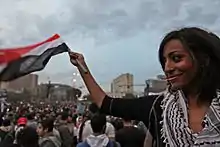
Ibrahim told Al Jazeera that her political activism began when she started talking to people who were involved in the labour movement, and that her family was uncomfortable with her going to protests.[10] She became involved in the Egyptian revolution of 2011[1][11] as an organizer,[7][12] additionally engaging in citizen journalism by using social media including Twitter while attending protests[13][8] "to spread accurate information and paint a picture at the ground".[14] Ibrahim and other Egyptian youth on Twitter played a leading role in organizing the events of January 25, 2011.[9] Her tweets also helped to document arrests and state violence[15] for human rights groups.[16]
In October 2011, Ibrahim reported that she had been briefly arrested while filming a strike action by public transport workers in Cairo, and was released after agreeing to delete her footage.[17]
By winter of 2012, Ibrahim had more than 30,000 followers on Twitter, and was active in protests against the Supreme Council of the Armed Forces.[18]
Reception by Western media
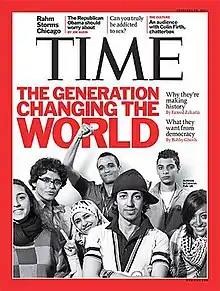
Ibrahim became a face of the events in Egypt for much of the media.[19] She regularly appeared on CNN,[3] sometimes live from the 2011 protests, and additionally reported live from the protests on Al Jazeera.[20] Her political views were rarely mentioned in Western media.[19]
Judy Woodruff described Ibrahim as "a symbol of the uprising" on PBS NewsHour.[21] On The Daily Show, Ibrahim told Jon Stewart that she initially joined the protests because of a class she took at the American University in Cairo called "Social Mobilization under Authoritarian Regimes."[22] The New York Times conducted an interview with her using Skype,[23] and a February 2011 Frontline episode titled "Gigi's Revolution" examined her relationship with her elite Egyptian family and "her attempts to convince her family of the righteousness of her cause."[24] On February 14, 2011, she appeared on an Al Jazeera English talk show alongside Alaa Abd El-Fattah and Mohamad Waked to discuss the events in Egypt after the fall of Hosni Mubarak.[25] She was also featured on the cover of the February 28, 2011 issue of Time magazine,[26] later criticizing the related article in that issue by saying that the West "needs to believe that we could not have [made revolution possible] without their digital toys."[27]
After the 2013 coup in Egypt
In July 2013, many militants from the revolution chose to leave after the 2013 Egyptian coup d'état, but Ibrahim stayed.[28] As of July 2013, Ibrahim was living in Nasr City and continued to participate in activism and protests.[29] In August 2013, she was part of a group called the Third Square that met in Sphinx Square in Giza to protest both the military government and the Muslim Brotherhood.[30]
After the 2013 coup, Ibrahim's husband went into exile because he wanted to remain a journalist, while she founded a shoe manufacturing company in Cairo.[28] In January 2021, she told Jeune Afrique that it was dangerous to protest and to be a journalist who didn't work on behalf of the regime, explaining that "We now live under a dictator worse than Mubarak [...] Any protest is punishable by sanctions. The protest is now being done underground."[28]
Shoe manufacturing career
After the 2013 coup in Egypt, Ibrahim founded a shoe manufacturing company in Cairo.[28]
A September 2021 article in The National identified Ibrahim as the co-owner of Cairo shoe manufacturing company Bulga, founded in 2016, along with artisan Mona Sorour. Ibrahim manages advertising, public relations and sales for the company, which is named after the traditional balgha. The shoes are designed through collaboration with indigenous groups in various regions of Egypt and manufactured in multiple workshops across the country, using exclusively Egyptian materials and labor; Ibrahim cited the decline of traditional craftsmanship resulting from the increase in mass-produced items as a major factor in the creation of Bulga.[31]
Ibrahim has a United States passport and could leave Egypt. In October 2021, she explained her decision to remain in the country to The New Yorker, saying that "Maybe here I’m a second-class citizen as an Egyptian woman, but [in the U.S.] I’m a second-class terrorist."[3]
References
- Ourdan 2011.
- Sandy et al. 2013.
- Stack 2021.
- Abu Hijleh 2011, p. 11.
- "Gigi Ibrahim '05". Cornelia Connelly High School. Archived from the original on June 22, 2020. Retrieved May 22, 2021.
- Mackey, Robert (January 27, 2011). "Interview With an Egyptian Blogger". The New York Times. Retrieved May 22, 2021.
- "Egyptian activist to speak at this year's CWA". University of Colorado Boulder. March 16, 2011. Retrieved May 22, 2021.
- Fleishman, Jeffrey (February 14, 2012). "After revolution in Egypt, women's taste of equality fades". Los Angeles Times. Retrieved May 22, 2021.
- Mellor 2014, p. 91.
- Naib, Fatma (February 19, 2011). "Women of the revolution". Al Jazeera. Retrieved May 22, 2021.
- "Egypt unrest: Alert as mass protests loom". BBC News. January 28, 2011. Retrieved May 22, 2021.
- Smet, Brecht De (2015). A Dialectical Pedagogy of Revolt: Gramsci, Vygotsky, and the Egyptian Revolution. Boston: Brill Academic Publishers. p. 309. ISBN 978-90-04-26266-9. OCLC 900277006.CS1 maint: date and year (link)
- Allen, Bennett (April 4, 2011). "Citizen Journalism: Life on the Ground at the Egyptian Revolution". Vanity Fair. Retrieved May 22, 2021.
- Rogers, Tony (January 28, 2011). "Citizen Journalist Gigi Ibrahim Uses Tools of the Web to Spread News of Cairo Protests". About.com. Archived from the original on August 26, 2012. Retrieved May 21, 2021.CS1 maint: unfit URL (link)
- Hidalgo, Alonso. "Redes sociales, política y activismo" [Social media, politics and activism] (PDF). Quehacer (in Spanish). Centro de Estudios y Promocion del Desarrollo: 99.
- England, Phil (May 2011). "A digital revolution in Egypt and beyond". New Internationalist. ISSN 0305-9529.
- Tarek, Sherif (October 2, 2011). "Activist Gigi Ibrahim to keep filming drivers' protests despite military arrest". Ahram Online. Retrieved May 22, 2021.
- Woods, Elliott D. (2012). "The Faces of Tahrir Square: Last spring's protests were only the beginning of a much longer struggle". The Virginia Quarterly Review. 88 (1): 98. ISSN 0042-675X. JSTOR 26446367 – via JSTOR.
- Tufekci, Zeynep (July 2013). ""Not This One": Social Movements, the Attention Economy, and Microcelebrity Networked Activism". American Behavioral Scientist. 57 (7): 858–859. doi:10.1177/0002764213479369. ISSN 0002-7642. S2CID 145744470 – via SAGE Publishing.
- Bebawi 2014, p. 18.
- Hermida, Alfred (2016). Tell Everyone: Why We Share and Why It Matters. Toronto: Doubleday Canada. pp. 106–109. ISBN 978-0-385-67958-9. OCLC 957224135.
- Anderson, Lisa (2012). "Too Much Information? Political Science, the University, and the Public Sphere". Perspectives on Politics. American Political Science Association. 10 (2): 389. doi:10.1017/S1537592712000722. ISSN 1537-5927. JSTOR 41479557. S2CID 145613815 – via JSTOR.
- Bebawi 2014, p. 131–132.
- "Gigi's Revolution" (video). PBS Frontline. February 22, 2011. Retrieved May 22, 2021.
- Bebawi 2014, p. 64.
- Helmy, Dina (February 27, 2011). "Some find Time Magazine cover controversial". American University in Cairo. Retrieved May 22, 2021.
- Srinivasan, Ramesh (2017). "5. Taking Back Our Media". Whose Global Village?. New York University Press. p. 221. doi:10.18574/9781479873906-007 (inactive October 31, 2021). ISBN 9781479873906.CS1 maint: DOI inactive as of October 2021 (link)
- Jachmann, Luis (January 25, 2021). "Égypte – Gigi Ibrahim: " La contestation se fait désormais dans la clandestinité "" [Egypt – Gigi Ibrahim: "The protest is now done underground"]. Jeune Afrique (in French). Retrieved May 22, 2021.
- "Gigi Ibrahim Discusses What Happens Next in Egypt with Tim Pool". Vice News. July 5, 2013. Retrieved May 22, 2021.
- Parvaz, D. (August 23, 2013). "Between Tahrir and Rabaa: The Third Square". Al Jazeera. Retrieved May 22, 2021.
- Tabikha, Kamal (September 2, 2021). "How fashion label Bulga is reviving traditional Egyptian shoes with an artisanal touch". The National. Retrieved October 2, 2021.
Bibliography
- Abu Hijleh, Khaled (2011). "Mobile Revolution". UNESCO Courier. Interview of Gigi Ibrahim. ISSN 2220-2269. Retrieved October 14, 2021.
- Bebawi, Saba (2014), Bebawi, Saba; Bossio, Diana (eds.), "A Shift in Media Power: The Mediated Public Sphere during the 'Arab Spring'", Social Media and the Politics of Reportage, London: Palgrave Macmillan UK, pp. 123–138, doi:10.1057/9781137361400_7, ISBN 978-1-349-47230-7, retrieved October 14, 2021
- Mellor, Noha (January 2, 2014). "Who Represents the Revolutionaries? Examples from the Egyptian Revolution 2011". Mediterranean Politics. 19 (1): 82–98. doi:10.1080/13629395.2013.826446. ISSN 1362-9395. S2CID 144766171.
- Ourdan, Rémy (February 21, 2011). "Egypte : le "journalisme citoyen" de Mona et Gigi sur Twitter" [Egypt: Mona and Gigi's "citizen journalism" on Twitter]. Le Monde (in French). Retrieved May 22, 2021.
- Sandy, Bennett; Laso, Maria; St. John, Kelly; Bentley, Amy (March 1, 2013). "20 Women to Watch". OC Metro. Archived from the original on May 31, 2015.
- Stack, Megan K. (October 7, 2021). "The Inconsistency of American Feminism in the Muslim World". The New Yorker. Retrieved October 14, 2021.
External links
 Media related to Gigi Ibrahim at Wikimedia Commons
- Media related to Photographs by Gigi Ibrahim at Wikimedia Commons